
Every product sold in a store or online needs a unique identification number, and for metal souvenirs the identifier is only half the task. A barcode printed on a paper hang tag behaves differently from a code marked into a polished zinc alloy surface, and the GS1 rules treat those two cases separately. Buyers who decide the code type before the artwork is locked avoid the expensive rework of discovering at production stage that a label will not stick or a laser mark will not read on a curved flank.

Who allocates the number, and what a GTIN actually is
The GS1 barcode pages open with a single sentence: “Every product sold online or in stores needs a unique identification number.” GS1 is, in its own words, the only authorised provider of Global Trade Item Numbers for trading on Amazon and leading global retailers, operating through local organisations in more than 120 countries.
A Global Trade Item Number identifies any pre-defined trade item, meaning a product or service that may be priced, ordered or invoiced at any point in any supply chain. Two points follow. A trade item is defined by how it is traded, not by what it is physically, and allocation sits with the brand owner, responsible for allocating a different GTIN to every different product.
That second point is where metal souvenir programmes go wrong, because a gift range multiplies faster than the buyer expects. One souvenir shape often ships in gold and silver, at two sizes, with a screen-printed logo in one variant and an enamel-filled logo in another, in gift box and bulk-packed versions. Each is a different trade item, because a separate GTIN is required whenever the trade item declarations differ.
One further point is frequently misunderstood. The barcode generally does not carry the description or the price: as the GS1 FAQ states, it identifies the item uniquely, and all product information is held in a database. A buyer building a retailer catalogue therefore needs a product data workflow as much as a printing workflow. And the identifier is not the symbol: a GTIN is a numeric string ending in a check digit, while the symbol is the carrier that encodes it.
GTIN lengths and how the check digit is calculated
The GS1 General Specifications, current version 26.0 published in January 2026, state that a GTIN may be an eight, twelve, thirteen or fourteen digit string. The four lengths are not interchangeable labels for the same product. The fourteen digit form is used for containers and carriers, the thirteen digit form is the retail form carried by EAN-13, and the eight digit form is the compressed option reserved for small packaging. Shorter forms encoded in a carrier that must hold a fixed length fourteen digit string are prefixed with leading zeroes acting as filler digits, and those zeroes do not change the GTIN concerned.
The check digit algorithm is the same for all fixed length numeric GS1 data structures that require one, which makes it straightforward to verify a number printed by a supplier. Each position is multiplied alternately by three and by one, starting with three, the weighted results are accumulated, and the check digit is that sum subtracted from the nearest equal or higher multiple of ten. The specification works an eighteen digit example through to a final digit of nine.
Two further rules matter for metal goods. Barcodes representing different GTINs must never be visible on one item, and a trade item must not carry two or more barcodes encoding different GTINs. This bites when a hang tag carries a retail barcode while the metal face carries a limited edition serial number: that combination is legitimate, since the two carry different data types, but it must be planned.
The specifications also require that point of sale barcodes carry the GTIN in human readable form adjacent to the barcode, that for EAN and UPC barcodes this shows the GTIN-8, GTIN-12 or GTIN-13 below the barcode, and that where a 2D barcode is the only barcode it displays the fourteen digit form. On a polished metal surface this layer often decides the outcome, because a reader struggling with a low contrast laser mark falls back on reading the digits rather than decoding the symbol.
Which identifier applies to a metal souvenir
Beyond the GTIN itself, the specifications define other identification keys, and the choice depends on what the number needs to identify.
| Identifier | Length and structure | What it identifies | When a metal souvenir programme needs it |
|---|---|---|---|
| GTIN-8 | 8 digits | A single trade item in compressed form | Authorised where the printable packaging area is under 80 cm2, the largest label area is under 40 cm2, or the product is cylindrical with a diameter under 30 mm |
| GTIN-12 | 12 digits | A single trade item | Used with UPC-A in North American retail; also carried by the GS1 DataBar retail POS family |
| GTIN-13 | 13 digits | A single trade item | The standard retail form in most of the world, carried by EAN-13 |
| GTIN-14 | 14 digits | A single trade item in fixed length form | Used when a carrier must encode a fixed length 14 digit string, shorter GTINs zero padded |
| SSCC | 18 digits: extension digit, company prefix, serial reference, check digit | An individual logistics unit | The code on the shipping unit, linking goods received to the purchase order and consignment |
| GLN | 13 digits: company prefix, location reference, check digit | A physical location, fixed or mobile | Identifies the store or distribution centre receiving the stock |
| Serialised item key | GTIN plus serial number | A single unit of a made to stock product | For limited edition or numbered souvenir runs where each piece is tracked, carried as element strings 01 and 21 |
| Batch or lot number | Up to 20 characters, element string 10 | A production batch | Ties a shipment to a specific plating or production run |
| Customer part number | Up to 30 characters, element string 241 | The buyer’s own reference for the item | Where the retailer already has an internal code for the souvenir |
| Consumer product variant | Up to 20 characters, element string 22 | A variant of the same product | A finish or colour difference within one counted trade item |
The GTIN-8 row affects metal souvenirs most, because its authorisation conditions are about physical size and shape: a cylindrical item with a diameter below 30 millimetres qualifies on shape alone, but a larger coin does not and takes a GTIN-13 however small the hang tag.
The batch number row is where metal souvenirs gain something most consumer goods do not have. Because the plating, the alloy and the polish line are all manufacturing variables, a lot number at carton level lets a buyer scope a faulty batch to a run rather than to the whole consignment.
Where the code goes: labels versus direct part marking
The specifications draw a hard line on surfaces that distort a label. Some merchandise may not allow barcode labels due to rough or textured surfaces, because these distort the label and thus the barcode, and hang tags or loop tags may be necessary instead. Barcodes, including quiet zones, should never be placed on perforations, die cuts, seams, ridges, edges, tight curves, folds, flaps, overlaps and rough textures. A smooth, flat, plated face takes a printed label; a hammered, sandblasted or antique-finish surface distorts one. A highly curved face is a third case: the rules constrain the angle between the tangent to the centre of a curved barcode and the tangent to its extremity to less than 30 degrees.
That is why the direct part marking provisions exist. Direct part marking of a GS1 DataMatrix or GS1 QR Code should be reserved for surfaces no rougher than 250 micro inches and no smoother than 8 micro inches, with a minimum 20 percent difference in contrast between host and symbol. Minimum base material thickness is set by method: dot peen 1.016 millimetres, laser engraving 1.27 millimetres, laser etch 0.762 millimetres and electro-chemical etch 2.54 millimetres.
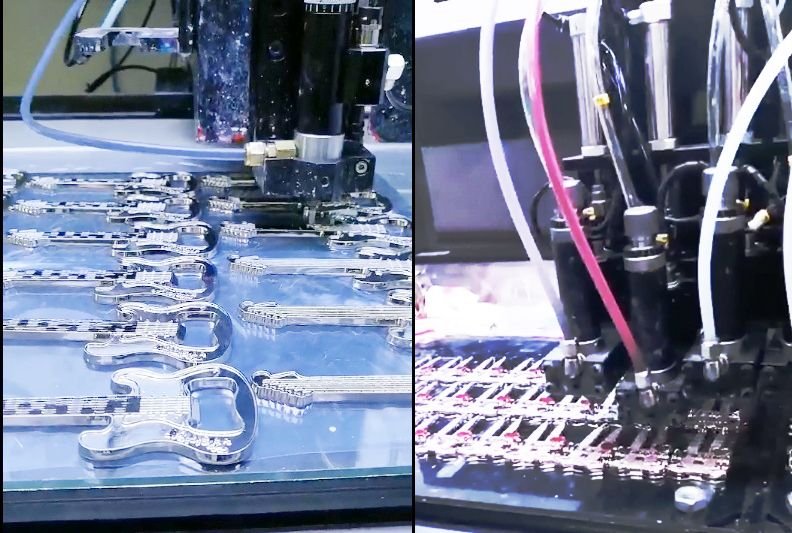
These numbers map onto the logo processes available for metal souvenirs. Laser engraving, alongside screen printing, embossing, debossing, moulded logo and enamel colour fill, suits direct part marking of a 2D code. Its 1.27 millimetre floor constrains a thin keychain, while the 0.762 millimetre floor for laser etch opens a smaller, flatter piece. Contrast is the half most often missed: a polished gold finish marked with a code does not meet 20 percent by default, because the marked area and the surrounding metal differ mainly in roughness rather than tone, so a recessed or mattened field must be agreed before sample approval.
Printing constraints that affect the artwork
Barcode placement rules constrain artwork layout in ways that surprise designers working from a brand guideline rather than a label specification. A barcode must not be closer than 8 millimetres or farther than 100 millimetres from the nearest edge of the package, so on a metal hang tag it can sit neither hard against the edge nor in the middle.
The minimum quiet zone width required by the main symbol is 7x, where x is the module width, tabulated for a nominal module of 0.330 millimetres as 11 modules or 3.63 millimetres on the left and 7 modules or 2.31 millimetres on the right for EAN-13, 7 on both sides for EAN-8, 9 on both sides for UPC-A and 9 left with 7 right for UPC-E. The GS1-128 symbol used for logistics labels carries a minimum quiet zone of 10x on each side, and its length including quiet zones cannot exceed 165.10 millimetres with no more than 48 encoded data characters.
Symbol height is fixed: at nominal size an EAN-13, UPC-A or UPC-E symbol is 22.85 millimetres high and an EAN-8 is 18.23 millimetres. Module width is a variable the application specification controls: for retail point of sale the minimum for EAN-13, EAN-8 and UPC-A is 0.264 millimetres, target 0.330, maximum 0.660; for general distribution EAN-13 moves to a minimum of 0.495, target 0.660, maximum 0.660, and GS1-128 runs from 0.495 to 1.016 millimetres; for logistics units GS1 DataMatrix with ECC 200 and GS1 QR Code both run from 0.743 to 1.50 millimetres, the DataMatrix with a 1x quiet zone and the QR Code 4x on all four sides, with a footnote allowing 0.250 millimetres on a small unit.
Adding a QR code that links to live product information
The migration from linear to 2D barcodes changes what one symbol on a metal souvenir can do. GS1 Digital Link is the standardised method for encoding identifiers such as GTINs, GLNs and SSCCs, along with batch numbers, serial numbers and expiry dates, so identifiers can be decoded by scanning software offline and connected to online information. For retail, GS1 describes it as the migration in which each product carries a single multipurpose 2D barcode usable at the point of sale and as a route to digital content such as certifications and traceability information. The practical advantage is that digital content can be updated without changing the code on the package: a gold plated commemorative coin can carry one permanently etched 2D symbol while the destination page changes with the season.
The URI syntax version in force is 1.7.0, ratified in August 2026, alongside a GS1-Conformant resolver version 1.2.0 from January 2026. The URI syntax distinguishes primary identification keys, key qualifiers for extensions such as batch or lot, and attributes for informative data such as expiry date. Since version 1.4.0 the GTIN in a URI is expected as 14 digits, zero padded, and the convenience alphabetic forms such as gtin and gln were removed as of version 1.3.0. The qualifier order is fixed, with the GTIN first, then an optional consumer product variant, an optional lot and an optional serial number, so a URI built in any other order will not resolve correctly.
Serialising a limited edition metal run
Numbered and limited edition metal souvenirs are the clearest case for serialisation, because each unit is a distinct object. The General Specifications describe the GTIN with a serial number as the GS1 identifier for a serialised made to stock product, carried as element strings 01 and 21 or in the GS1 Digital Link URI syntax, with the serial number element string taking up to 20 characters. This raises a manufacturing question rather than a data question: a number laser engraved into the face consumes flat area the design may need, and one on a hang tag is lost if the tag is replaced, so buyers who want the number to stay with the piece should choose the method early and check the thickness floor against the smallest item.
Traceability beyond the individual unit is handled by EPCIS, which GS1 describes as its flagship data sharing standard for enabling visibility across an entire supply chain, capturing the what, when, where, why and how of products and assets. EPCIS 2.0 defines six event types, one generic base class and five subclasses: object, aggregation, transaction, transformation and association events, and adds sensor data, certification details, JSON and JSON-LD syntax, a REST API for event capture and query, and the GS1 Digital Link URI syntax. Notably, it requires neither Electronic Product Codes nor RFID carriers, so a limited edition run can carry an engraved serial number, a QR code pointing at a live page and EPCIS events covering the plating run and container loading.

Identifier application checklist
Marking and finishing decisions belong on the same sample, since the logo process and the code placement share one face of the metal. Our guide to brand colour matching covers what constrains the finish, and our laboratory testing and certification guide covers the testing needed before a product can carry a certification claim in its digital page.
The sequence below follows the order the work has to happen in, because early decisions constrain later ones and cannot be revisited cheaply once tooling and artwork are committed. Two steps carry the most commercial weight: step one decides whether the programme is administratively manageable, since five finishes across three sizes and two logo processes can exceed fifteen trade items, and step eleven prevents the most expensive failure, because a label that does not adhere to an antiqued finish is discovered after the pieces are finished.
| Step | Action | Artefact produced | Why this step cannot be skipped or moved later |
|---|---|---|---|
| 1 | Build the trade item list, separating every size, finish, logo process and packaging configuration | A numbered list of trade items | A separate GTIN is required whenever the trade item declarations differ |
| 2 | Assign each trade item a GTIN, choosing GTIN-8 only where the size conditions are met | GTIN per trade item with its length | Allocation is the brand owner responsibility; GTIN-8 needs stated size and shape conditions |
| 3 | Compute and verify the check digit using the three, one alternating weight rule | Validated GTIN list | Catches transcription errors before they reach artwork |
| 4 | Decide the carrier: printed label, hang tag, loop tag, or a code marked into the metal | Carrier per item | Rough and textured surfaces distort labels; placement excludes seams, edges and tight curves |
| 5 | Where marked into the metal, choose the method and confirm thickness and the contrast field | Marking method and artwork | The four methods carry different thickness floors and a minimum contrast is required |
| 6 | Set symbol height, module width, quiet zone and distance from the nearest edge | Label artwork at the correct size | Symbol height and module width are fixed per symbol; quiet zone and edge distance are mandatory |
| 7 | Add the human readable number below the symbol, or the 14 digit form on a 2D symbol | Final artwork with human readable layer | Point of sale bars require the GTIN adjacent in human readable form |
| 8 | For limited editions, assign serial numbers and decide whether the number is on the piece or the tag | Serial list with the marking plan | A serial moved to the tag changes what stays traceable if packaging is replaced |
| 9 | For 2D symbols, build the URI in the permitted order | URI string per trade item | Qualifier order is fixed and the GTIN must be 14 digits, so a casual URI fails |
| 10 | Plan the logistics codes: SSCC for the unit and a lot number to scope issues to a run | Logistics labelling plan | The SSCC identifies the logistics unit; the lot number scopes a plating issue |
| 11 | Approve a physical sample of the finished labelling or marking | Approved reference sample | Marking quality, contrast and adhesion are judgeable only on the real finish |
| 12 | Agree the artwork lock date and write labelling and marking into the purchase order | Order annex with the artwork reference | Tooling, sample approval and production lead time run ahead of artwork |
Buyers who want to see how a finished item and its marking look together can request a sample through our sortiment af specialfremstillede metal-souvenirs or our custom medals and badges range, where flat surfaces, the easiest carriers for a printed label, are common. Sample lead time at Kingtop is 7 days and bulk production runs 15 to 20 days, with delivery by express, air or sea. The factory covers 9,600 square metres with more than 200 staff and daily capacity of 30,000 pieces, and marking method, label supply and barcode allocation are quoted on request at sales@kingtopgift.com.