
A brand colour on a metal souvenir is not a colour number. It is a number plus a substrate plus a process plus a measurement method, and every one of those four can move the result. Two buyers can both specify Pantone 186 C, and one receives a warm red on glossy enamel while the other receives a cool red on a matte recessed fill, because one ordered soft enamel and the other ordered hard. The way out of that ambiguity is not a better colour chart. It is a written colour specification that says which reference system is in use, which process carries it, how the difference will be measured, and what tolerance is acceptable in the units both sides agree on. ASTM D2244 makes that agreement mandatory in practice: for product specification, the purchaser and the seller should agree upon the permissible colour tolerance between test specimen and reference and the procedure for calculating it.
Why a Pantone Number Alone Is Not a Specification
Most brand buyers arrive at a metal gift factory with a Pantone code and an expectation. The expectation is that the piece will arrive in the brand colour. The code is necessary and it is not sufficient, and the gap between the two is where colour disputes are born.
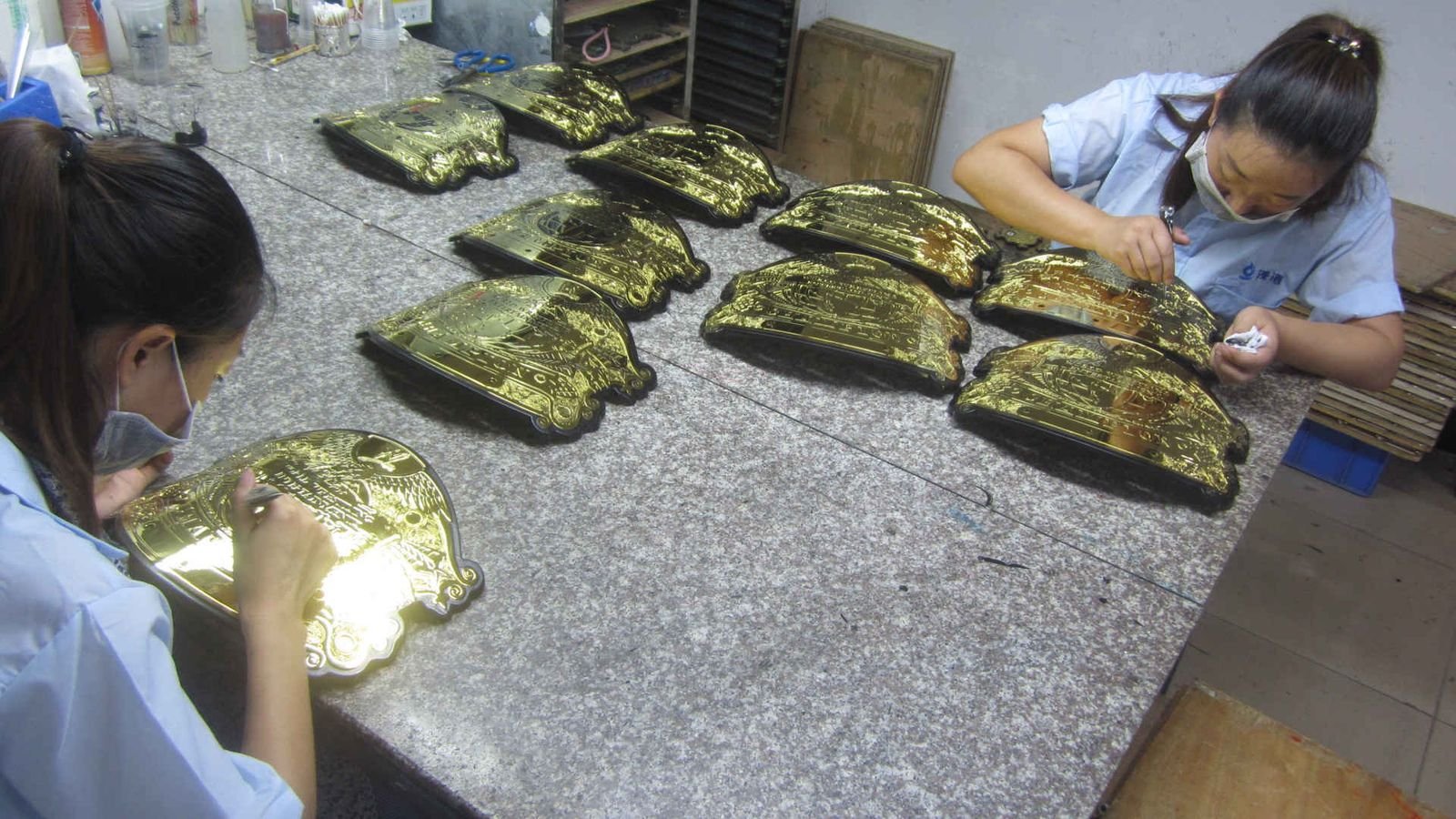
The first issue is that Pantone colours are defined for print and for solid colour applications, on paper and on plastic, under a particular viewing light. A metal souvenir is neither paper nor plastic. It is a reflective, often curved, sometimes specular surface with a metallic underneath, and light behaves differently on it. The same Pantone reference that looks correct on a printed swing tag will shift in hue on a curved metal surface because the angle of reflection changes across the form.
The second issue is the process. On a plated metal gift, colour can be delivered in three ways, and they behave differently. It can come from the plating itself, which is a metallic finish applied to the raw casting, in gold, silver, rose gold, antique brass, antique silver, antique copper, black nickel or dual tone. It can come from enamel colour fill, which is pigment carried in a glass or resin medium applied into the recessed areas of the design. It can also come from a dyed plating, where the plating bath is tinted to approach a specific colour. Each route has different tolerance behaviour, and two of them are incompatible with hard enamel for physical reasons that are explained below.
The third issue is measurement. “Looks close enough” is not a testable statement, and it is exactly the statement that appears in a dispute. If nobody defines the tolerance and the method before the order is placed, then the tolerance is decided afterwards by whoever is more annoyed, and that is not a process either side can budget for.
The Colour Standards That Actually Govern the Decision
ASTM D2244 and what it requires of buyer and seller
ASTM D2244 is the reference practice for calculating colour tolerances and colour differences from instrumentally measured colour coordinates. The official scope of ASTM D2244-16 states that the practice covers the calculation, from instrumentally measured colour coordinates based on daylight illumination, of colour tolerances and small colour differences between opaque specimens such as painted panels, plastic plaques, or textile swatches. The tolerances and differences are expressed in terms of approximately uniform visual colour perception in CIE 1976 CIELAB opponent-colour space, CMC tolerance units, CIE94 tolerance units, the DIN99 colour difference formula given in DIN 6176, or the CIEDE2000 colour difference units.
Two clauses in the standard matter most to a buyer writing a metal souvenir specification.
The first is section 1.2, which is the clause that turns colour matching from an argument into a contract term: for product specification, the purchaser and the seller shall agree upon the permissible colour tolerance between test specimen and reference and the procedure for calculating the colour tolerance. Each material and condition of use may require specific colour tolerances because other appearance factors, for example specimen proximity, gloss, and texture, may affect the correlation between the magnitude of a measured colour difference and its commercial acceptability.
That last sentence is the direct answer to the question a buyer actually has. A gloss enamel fill and a matte plating are not going to share one tolerance number, because gloss and texture change how a measured difference translates into whether a customer sees a defect. A specification that applies a single tolerance to every surface on the same order is a specification that will produce an argument on at least one of them.
The second clause is section 5.2, which addresses the choice of unit: colour differences calculated in ΔECMC or ΔE00 units are highly recommended for use with colour differences in the range of 0.0 to 5.0 ΔE*ab units. Both are appropriate for and widely used in industrial and commercial applications including, among others, coatings, cosmetics, inks, packaging, paints, plastics and printing. For colour work on coated metal, that range is where the work sits, which is why the recommendation matters. The standard also notes that the Hunter colour difference components are used by the coil coating and aluminium extrusion coating industries and are included in the appendix for historical purposes, which is a useful warning to buyers not to copy a tolerance convention from a coil coating specification into a die-cast souvenir order without checking it applies.
Two further points keep the standard honest. Section 5.4 requires that selection of colour tolerances based on instrumental values should be carefully correlated with a visual appraisal of the acceptability of differences in hue, lightness and saturation obtained using Practice D1729, and notes that the tolerance equations have been shown to agree with the visual evaluations to within the experimental uncertainty of the visual judgments. And sections 1.1 and 5.5 both address a failure mode that catches out buyers: where it is suspected that specimens may be metameric, meaning they possess different spectral curves though visually alike in colour, Practice D4086 should be used to verify instrumental results, and because the tolerance equations are derived or optimized for use under daylight illumination, use under other illuminants requires visual confirmation of the level of metamerism.
Metamerism deserves particular attention in a metal gift context, because the physical situation makes it more likely. A pigmented enamel and a dyed plating can look the same red under a showroom light and diverge under daylight, or match under daylight and diverge under warm shop lighting. If the brand colours are matched against a physical chip rather than a spectrophotometer reading, the buyer may be approving a metameric match without knowing it.
ISO/CIE 11664-6 and the formula behind the number
The CIEDE2000 formula referred to in the ASTM practice is specified in ISO/CIE 11664-6:2022, Colorimetry, Part 6: CIEDE2000 colour-difference formula. The standard was published in August 2022 as the second edition, seven pages, by the International Commission on Illumination technical committee. Its abstract states that the document specifies the method of calculating colour differences according to the CIEDE2000 formula, and that it is applicable to input values of CIELAB L*, a*, b* coordinates calculated according to ISO/CIE 11664-4. It can be used for the specification of the colour difference between two colour stimuli perceived as belonging to reflecting or transmitting objects.
The “reflecting or transmitting objects” wording is precisely the case for a metal souvenir. The standard also states that it does not apply to colour stimuli perceived as belonging to areas that appear to be emitting light as primary light sources or that appear to be specularly reflecting such light. A mirror-polished gold plating sits close to that excluded category in perception terms, which is one more reason the tolerance method and the surface finish have to be agreed together rather than separately.
For a buyer, the practical value of CIEDE2000 is that it is the current formula rather than a legacy one. Older specifications that quote a plain ΔE*ab figure without naming a formula are ambiguous, because different formulas produce different numbers from the same instrument readings. A specification that says “within ΔE 1.5” without stating the formula is not a usable specification. The specification should say CIEDE2000, or ΔE00, and should say so once, in the clause that governs the whole order.
Why the finish changes the number
The Pantone reference system is the starting point for colour matching on both enamel types. According to the technical comparison published by Metro Pins, hard enamel and soft enamel both use colour matching using PMS, Pantone, colours, but the process that carries the colour is different, and so is the result.
Hard enamel is heated to approximately 1,400 degrees Fahrenheit and then polished. It is roughly 1.5 mm thick by default at a 1.50 inch item size. All plating styles are available except PMS-dyed plating, because the polishing step removes the dyed layer. Polishing makes hard enamel pins around 5 per cent thinner and mutes the sharpness of some details. Soft enamel is heated to approximately 350 degrees Fahrenheit and then cured, is also roughly 1.5 mm thick by default at a 1.50 inch item size, allows all plating styles to be applied, and can carry an optional epoxy coating.
The comparison from Glory Awards sets out the commercial consequences in a table. Custom dyed plating is available in most PMS-C colours for soft enamel and not available for hard enamel, because polishing removes dyed plating. Glitter enamel is available for soft enamel and not available for hard enamel, because polishing disperses the glitter. Production time is 10 to 14 days after artwork approval for soft enamel, and 14 to 18 days for hard enamel because of the extra baking and polishing cycles.
Those two production windows matter for a colour brief, because the colour that gets approved is often not the colour that gets delivered. A buyer who approves a soft enamel sample and then receives hard enamel production has changed three variables at once, since the process, the surface and the timing all move. The same point applies in reverse for the coating on a plated piece. Choosing the finish first and the colour second is the only order that produces a stable answer.
One genuinely useful piece of good news sits in the same source. Hard enamel and soft enamel are produced from the same die-struck base, and an existing die from a soft enamel order can be used to produce hard enamel, and vice versa, without paying for a new mould, as long as the shape remains the same. A buyer who is undecided between the two finishes can approve a colour on one and produce the other, which shortens the approval cycle for a programme that has not yet settled on a finish.
Building the Colour Specification
A workable metal souvenir colour specification has five parts. Each one exists because without it a specific argument becomes possible later.
| Component | What to state | Dispute it prevents |
|---|---|---|
| Reference system | Pantone PMS code with the finish type, such as coated or uncoated, plus a physical chip retained by both sides | Two different chips read as the same number |
| Process and substrate | Plating colour, or enamel fill colour, on which substrate: zinc alloy, stainless steel, brass or bronze, or iron | Same colour requested on a different base and a different result |
| Surface finish | Gloss, matte or brushed plating; gloss or matte enamel; any epoxy or clear coat | Gloss and matte values compared against one tolerance |
| Measurement method | Instrument reading in CIELAB, CIEDE2000 units, under daylight illumination, with the metamerism check described where relevant | Two parties using different formulas and different light sources |
| Tolerance | A stated ΔE00 figure per surface type, agreed in advance, plus the rule for what happens when the reading is outside it | An undefined tolerance decided after the goods ship |
The fifth row is where most specifications stop short. Stating a tolerance without stating a consequence leaves the consequence to be negotiated under time pressure, when the buyer has already paid for the goods. The consequence should be written at the same time as the number: rework at the factory’s cost, or acceptance with a price adjustment, or rejection within a defined window. Whichever route is chosen, it belongs in the purchase order rather than in an email after the shipment is inspected.
The tolerance value itself should be set per surface rather than per order. ASTM D2244 gives the framework and the units, and it points to visual appraisal as the check on the instrumental result, but the numerical figure is a commercial decision between the two parties. The relevant facts for making it are the finish, the substrate, the size of the coloured area, and how visible the colour is on the finished piece. A large solid enamel field on a souvenir the customer holds in the hand is judged differently from a small enamel detail on a keychain loop.
There is one point worth making about the tolerance that many buyers miss. A tolerance applies to the comparison between the test specimen and the reference. It does not guarantee that a customer will perceive the pieces as identical to each other, because piece-to-piece variation within a batch is a separate question, and it applies equally to the metal underneath the colour. On a plated piece, the tolerance is effectively a tolerance on the plating bath. On an enamel piece, it is a tolerance on the pigment and the fill. Asking for the same ΔE00 figure on both is asking for the same number from two completely different processes.
Where the Process Choice Overrides the Colour Request
Some colour requests cannot be executed in some processes, and the buyer who finds this out after the sample is approved has already lost the schedule. The colour specification should therefore record the constraint, not just the request.
On the enamel side, a PMS-dyed plating cannot be delivered in hard enamel, because the polishing step removes the dyed layer. A glitter effect cannot be delivered in hard enamel, because polishing disperses the glitter. Neither limitation applies to soft enamel, which supports all plating styles and can carry an optional epoxy coating.
On the plating side, the available finish set is fixed: gold, silver, rose gold, antique brass, antique silver, antique copper, black nickel and dual tone. A brand colour that is not one of these needs to be delivered as enamel colour fill rather than as plating, which changes the specification, the appearance, the durability and the production window.
The durability difference follows from the process difference. The technical comparison records hard enamel as having exceptional durability and a superior finish, with a longer production cycle of multiple high-heat firings, and soft enamel as less durable and more quickly made, being the better choice for urgent orders, with enamel that can be marred by hard objects. For a souvenir that will be carried daily or used as a bottle opener, that difference is a specification decision rather than a cosmetic preference.
Because both enamels run on the same die-struck base and a die from one can produce the other without a new mould, the practical sequence for a brand buyer is to settle the finish and the plating requirement first, then approve colour. Doing it the other way round means re-approving a colour whenever the finish decision changes, and a colour approval cycle costs time in a way that a finish decision does not.
For a wider view of the plating options themselves, the metal keychain plating options guide covers the available finishes in more detail, and the hard enamel versus soft enamel guide compares the two finishes on a wider range of design decisions than colour alone.
Colour Deviation Acceptance Checklist
The checklist below is the sequence to run before you approve a colour and before you inspect a shipment. It is ordered so that the decisions that are expensive to reverse come first.
| Step | Check | Action if it fails |
|---|---|---|
| 1 | Is the finish decided before the colour is approved | Defer colour approval until the finish is fixed; a change later reopens the colour |
| 2 | Does the requested colour require a feature the chosen process cannot deliver, such as PMS-dyed plating in hard enamel | Move the colour to enamel fill, or change the finish, and re-specify |
| 3 | Is the reference a physical chip in the correct Pantone finish type, retained by both buyer and factory | Request the physical chip before approving any sample |
| 4 | Is the substrate stated for the colour area | State the substrate in the order; a colour moves between zinc alloy, brass and stainless steel |
| 5 | Is the surface finish stated, including gloss, matte, brushed or any clear coat | Add the finish to the specification and to the measurement record |
| 6 | Is the measurement method agreed, naming CIEDE2000 and the illumination condition | Adopt ASTM D2244 wording on the tolerance and the calculation procedure |
| 7 | Has a metamerism check been considered for the colour combination in question | Verify with D4086, or accept the match on visual grounds and record that decision |
| 8 | Is a tolerance figure set for each surface type, not one figure for the whole order | Set separate tolerances for gloss and matte surfaces |
| 9 | Is the consequence of an out-of-tolerance reading written into the order | Add rework, price adjustment or rejection as an agreed remedy |
| 10 | Is the inspection light and viewing distance fixed for the visual check that accompanies the instrumental one | Record the condition so the visual check can be repeated and defended |
| 11 | Is the batch sampling rule stated, so that out-of-tolerance pieces are found before shipment | Agree the sampling approach and the record that travels with the shipment |
| 12 | Is a physical reference piece retained for the term of the contract | Send one reference piece with the shipment and keep it until the contract closes |
Step 12 is worth doing even when everything else has been agreed. A retained reference piece costs nothing and settles the majority of colour arguments, because it converts a memory into a comparison. The same reasoning applies to the finish itself. Where the order includes a plating finish with a durability requirement, the salt spray test guide for metal finishes covers how the corrosion resistance requirement is specified, and the custom enamel lapel pin examples show how the colour and finish read on a finished piece.
One closing point on budget and timing. Because the choice of finish changes both the achievable colour and the production window, and because soft enamel runs 10 to 14 days after artwork approval against 14 to 18 days for hard enamel, the finish decision belongs at the point where the schedule is set rather than after it. At Kingtop, sampling takes 7 days and mass production runs 15 to 20 days, with a minimum of 100 pieces on existing moulds, 500 pieces for a standard design on existing moulds, and 1,000 pieces for a fully custom die casting. A colour approval cycle that has to be repeated because the finish moved will consume more of that window than the extra polishing stage ever will.
For a quotation on a specific colour, finish and quantity, send the artwork, the Pantone reference, the required finish and the delivery date to sales@kingtopgift.com. Whether a given colour is achievable on a given substrate and process, and what it costs, is confirmed per design and quoted individually.