
Most metal souvenir orders are held at a border for a reason that has nothing to do with the metal. The pallet arrives with no treatment mark, the dunnage was cut from untreated offcuts, and the whole consignment sits on the quay while a plant health inspector decides what to do with it. Since the International Plant Protection Convention’s standard on wood packaging entered into force across the trade on 1 January 2021, this is no longer a formality that a forwarder handles quietly on your behalf, and a buyer who has never seen an ISPM 15 mark will not know the paperwork is missing until it is too late to fix it. This guide sets out what the standard covers, what it exempts, what the mark on the pallet is supposed to prove, and how to design and test the pack so the goods survive both the customs hall and the road to the shelf.

There is a specific reason wood packaging ended up in the middle of metal sourcing conversations. Metal souvenirs are dense, sharp-edged and easy to damage, so they are packed into cartons, and those cartons are stacked on pallets, and those pallets are dunnage-blocked with loose timber. That timber is the only part of the consignment that most buyers never specify, and it is the only part of the consignment that a customs authority can legally refuse.
The rules are not obscure once you know where they sit. The International Plant Protection Convention, which administers plant health standards for international trade, published its standard on wood packaging material in international trade as ISPM 15, and the official page for that standard describes its purpose directly. It sets out phytosanitary measures that reduce the risk of introduction and spread of quarantine pests associated with the movement in international trade of wood packaging material made from raw wood. The standard covers dunnage. It excludes wood packaging made from wood processed in a way that leaves it free from pests, such as plywood, and it makes an important distinction about what it is not: the phytosanitary measures described are not intended to provide ongoing protection from contaminating pests or other organisms. In plain terms, the treatment protects the timber itself. It does nothing to protect your goods once the carton is open.
That last point matters more than it first appears, and it separates two problems that buyers tend to merge into one. Whether the pallet is legal is a border question. Whether the souvenirs arrive intact is a packaging engineering question, and it is answered by test procedures rather than by a certificate. The rest of this guide works through both, in the order you will meet them.
What ISPM 15 covers, and what it deliberately leaves out
The Forestry Commission guidance on wood packaging material for import and export is the most operationally useful public description of the standard, because it lists what is in scope, what is exempt, and how each treatment must be carried out. Its stated scope is broad enough to catch almost anything a factory puts on a pallet. Wood packaging material includes packing cases, boxes, crates, drums and similar containers; pallets, box pallets, pallet collars and other load boards; and dunnage, which the guidance defines as loose wood used to protect goods and their packaging.
The exemptions are equally broad, and they are where most of the confusion sits. The rules do not apply to processed, non-solid wood packaging material such as plywood. They do not apply to raw wood that is 6mm thick or less. They do not apply to barrels for wines and spirits, or to gift boxes made from processed wood. They do not apply to sawdust, shavings or cardboard used as packing material.
Read that list with a buyer’s eye and the strategic options become clear. A plywood case, a carton of solid cardboard and a gift box made from processed wood all sit outside the standard. A rough-sawn pine pallet with visible bark sits squarely inside it. For a metal souvenir programme the practical consequence is that the exemption list is small in terms of volume but large in terms of trade-offs: plywood boxes are lighter and stack better than solid timber crates, but they cost more and they are not what a gift retailer expects to find in a container.
One more boundary in the same guidance is worth internalising. Solid wood packaging material must meet the ISPM 15 international standards if you import it into Great Britain from any country, either to move goods or for supply to businesses, and any wood packaging material may be checked at the border or at inland premises to confirm it meets the requirements. The guidance is explicit about the consequence of failing that check: if your imports do not comply with these rules, then the wood packaging material could be rejected or destroyed, and you will need to make alternative arrangements for the transport of goods.
That last clause is the one that changes budgeting. A rejected pallet is not an inconvenience that resolves itself in a day. Destruction means re-packing, and re-packing means new timber, new treatment, new marks, and a delay measured in the days it takes to get a truck slot. Our guide to custom metal gift lead time and shipping sets out how the production and transport stages are normally planned, and this is the stage that most often disrupts that plan, because it happens after production is finished and cannot be recovered by working faster.
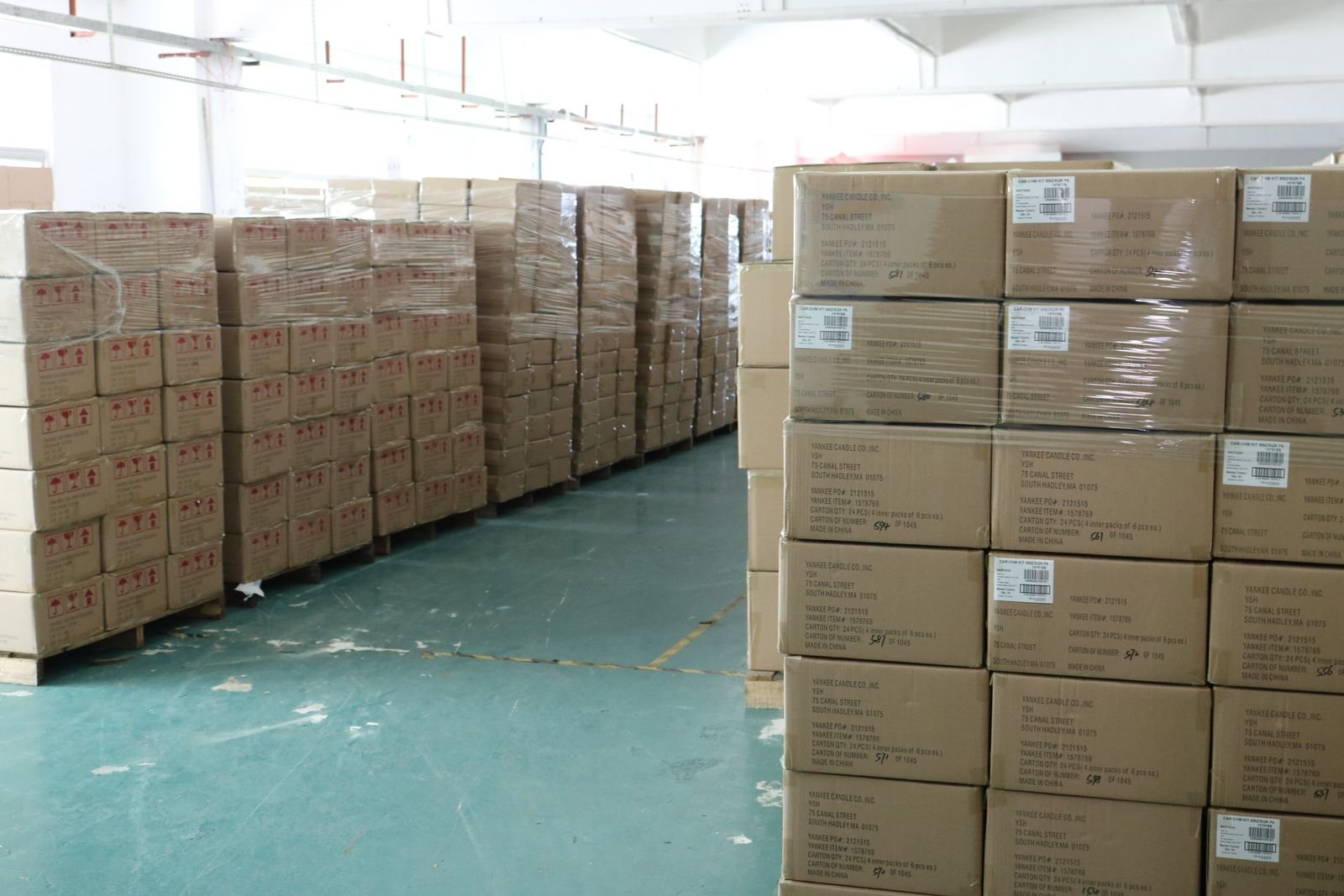
The three treatment routes, and what each one demands of the mill
Compliance is achieved by treatment, and the guidance recognises three routes. The choice between them is made at the packaging supplier, not at the metal factory, which is why a buyer who has never visited the packaging supplier should still know the questions to ask.
Heat treatment is the baseline. Wood packaging material is heated to 56°C for at least 30 continuous minutes throughout the entire profile of the wood, including its core. That phrasing matters more than it looks. A shallow heat that warms the surface and leaves the centre cool does not satisfy the standard, and the core is exactly where a wooden pallet keeps its heat. The bark can be removed before or after treatment, which is useful for mills that debark separately from treatment.
Dielectric heating is the second route, and it is the one that gets confused with the first because the temperatures look similar. Dielectric heating is for wood that is less than 20cm wide, including bark, when measured across the smallest dimension of the piece or stack. It must be heated to a minimum temperature of 60°C for one continuous minute throughout the entire profile of the wood, including its surface. The practical implication is a size limit: dielectric heating is available for narrower stock, and a wide solid timber pallet is generally out of scope for that route.
Fumigation is the third. It is carried out with methyl bromide or sulphuryl fluoride, and the bark is removed before fumigation because it can alter the effectiveness of the treatment. That ordering requirement is the practical trap here, since a mill that debarks after fumigation has produced a pallet that looks treated and is not compliant.
| Route | Core requirement | Size or material condition | What ends up on the pallet |
|---|---|---|---|
| Heat treatment | 56°C for at least 30 continuous minutes throughout the entire profile of the wood, including its core | No stated size limit; bark may be removed before or after treatment | Heat treatment mark with the treatment code for the applicable temperature and time combination |
| Dielectric heating | Minimum 60°C for one continuous minute throughout the entire profile of the wood, including its surface | Wood less than 20cm wide including bark, measured across the smallest dimension of the piece or stack | Heat treatment mark with the corresponding treatment code |
| Fumigation | Treated with methyl bromide or sulphuryl fluoride | Bark must be removed before fumigation, because bark can alter the effectiveness of the treatment | Fumigation mark with the treatment code |
All three routes have one condition in common, and it is the one most often ignored: wood packaging material must be made of debarked wood. The guidance allows an exception, and it is a narrow one. Any number of clearly distinct small pieces of bark may remain if the individual pieces are less than 3cm wide, of any length, or greater than 3cm wide but with a total surface area of less than 50cm². In practice this permits scattered flecks of bark on a planed surface and nothing more. A pallet with a band of bark around its edge does not qualify, and a pallet with bark along a sawn face does not qualify either.
The mark on the pallet is the certificate
The single most misunderstood point about ISPM 15 is that it does not work the way most quality documents work. There is no certificate to request, no report to chase, and no laboratory signature to verify. The guidance is unambiguous: wood packaging material that has a legible ISPM 15 mark meets the standard and does not need phytosanitary or treatment certificates, and certification cannot be used instead of the ISPM 15 mark applied to imports of wood packaging material.
What the mark has to show is also specified. All wood packaging material must show a mark with the 2-letter ISO country code assigned by the National Plant Protection Organisation of the country concerned. The mark identifies the producer and how the wood packaging material has been treated. So a buyer reading a pallet needs to extract three things from a small stamped mark: the country code, the producer identifier, and the treatment type and code.
Country code matters because treatment regimes differ by jurisdiction, and the mark tells the inspector whether the wood was processed under a scheme the importing country recognises. Producer identifier matters because it is the audit trail: it points back to the facility that marked the wood and the scheme that facility operates under. For the UK, the guidance notes that to produce ISPM 15-compliant packaging you must be a member of the UK Wood Packaging Material Marking Programme and have 6-monthly assessments of your facility, and that you must also register with the Forestry Commission as a professional operator to apply ISPM 15 marking. Other countries run equivalent schemes with their own registers, which is why the country code is the first thing to read on the mark.
For an exporter the practical question is simple, and it should be asked before the goods are packed rather than after: whose mark will be on this pallet, and who signed for it. A factory that sources packaging locally from a registered marker is in a completely different position from one that uses unmarked reclaimed timber, and the difference between those two situations is invisible until the container is sealed. A short supply chain also shortens the paper trail, which matters when the shipping documents are being assembled for customs clearance alongside the commercial invoice and packing list described in our guide to importing metal souvenirs, HS codes and incoterms.

Designing the pack for the journey it will actually take
Once the timber is legal, the second question is whether the carton survives the trip. This is where specifications written by people who have never handled a shipping unit tend to be thin, because a packaging specification and a legal packaging requirement are two different documents and they get merged into one.
ASTM D4169 is the standard practice that most international shipping specifications eventually reference, and its scope explains why. It provides a uniform basis of evaluating, in a laboratory, the ability of shipping units to withstand the distribution environment, and it does this by subjecting them to a test plan consisting of a sequence of anticipated hazard elements encountered in various distribution cycles. Two limitations in that scope deserve attention. It is explicitly not intended to supplant material specifications or existing preshipment test procedures, so a passing D4169 result does not override the material specification you wrote for the carton board. And the guidance on its use notes that the practice is normally referenced for shipping units rather than single parcels, with a companion practice, D7386, suggested for testing packages for single parcel shipments.
The sequence matters as much as the test. The significance section of D4169 states that the recommended test levels are based on available information on the shipping and handling environment and on current industry, government practice and experience, and that the tests should be performed sequentially on the same containers in the order given. For use as a performance test, the practice requires that the shipping unit tested remain unopened until the sequence of tests is completed. If it is used for other purposes, such as package development, it may be useful to open and inspect shipping units at various times throughout the sequence, but that may prohibit evaluating the influence of the container closure on container performance. Put plainly: a shipping unit that is opened and re-packed part-way through the sequence is no longer evidence of what a sealed unit will do. For a metal souvenir, where the closure is the foam insert and the outer carton, that is the detail most likely to invalidate a test report.
The ISTA test procedures cover the same ground in a format that is easier to specify in a purchase order, because the procedures are named by what they simulate rather than by a test sequence number. The association divides them into families. The 1-Series, comprising procedures 1A through 1H, are non-simulation integrity tests that challenge the strength of the product and package combination without simulating environmental occurrences, and they are described as useful screening tools, particularly when used as a consistent benchmark over time. Procedure 1A is the one most often specified, and it applies to packaged products weighing 150lb (68kg) or less. The 2-Series, procedures 2A to 2C, are partial simulation tests, more thorough than the 1-Series and useful for refining preliminary designs, but not intended to be predictive of shipping performance.
The 3-Series is the general simulation family, covering procedures 3A, 3B, 3E, 3F, 3H, 3K, 3L, 3N, 3M and 3P. These provide a simulation of the damage-producing motions, forces, conditions and sequences of transport environments, and the association describes them as a useful predictive tool to understand risk of damage. Then there are the 4AB enhanced simulation tests, which customise test plans so that the tests and their sequence closely tie to a user-defined pattern of distribution environment hazards, and the member performance tests 6-AMAZON.com and 6-SAMSCLUB, created by an ISTA member or in cooperation with ISTA to establish unique requirements or reflect their particular conditions of distribution.
Two development tests are also worth knowing about. Procedures 7D and 7E are used in the development of transport packages by comparing the relative performance of two or more container designs, and the association is careful about their limits: they are not intended to evaluate the protection afforded packaged products. That is exactly what a buyer comparing two carton designs for a metal souvenir wants to know, and it is also exactly what a buyer who quotes 7D as a shipping qualification has got wrong.
| Procedure family | What it simulates | Where it fits a metal souvenir programme | Common misuse |
|---|---|---|---|
| ISTA 1A to 1H (non-simulation integrity) | Nothing environmental; challenges the strength of the product and package combination | Early screening while the carton is still being designed, and as a consistent benchmark across production runs | Presented as proof of shipping performance, which it is not |
| ISTA 2A to 2C (partial simulation) | Part of the distribution hazard set | Refining a preliminary design before committing to tooling | Treated as predictive when it is explicitly not intended to be predictive |
| ISTA 3-Series (general simulation) | Damage-producing motions, forces, conditions and sequences of transport environments | Qualifying the pack for a defined distribution environment before shipment | Specified without stating the distribution environment, which makes the result uninterpretable |
| ISTA 4AB (enhanced simulation) | A user-defined pattern of distribution environment hazards | Programmes shipping through retail distribution networks with their own handling profile | Used where a standard 3-Series procedure would answer the question more cheaply |
| ISTA 6-AMAZON.com, 6-SAMSCLUB (member performance) | The particular distribution conditions of a member organisation | Programmes sold direct into a specific retailer’s fulfilment network | Assumed to apply to shipments going elsewhere |
| ISTA 7D, 7E (development) | Relative comparison between two or more container designs | Choosing between two carton or insert designs on the same product | Quoted as a qualification, which the association rules out |
| ASTM D4169 | Sequence of anticipated hazard elements across distribution cycles, in a laboratory | The laboratory basis for a shipping unit performance claim, with the shipping unit kept closed through the sequence | Used to override a material specification, which its scope rules out |
The association also maintains a test planning and reporting platform called PackSight for its laboratory members, and its Resource Book collects the 1, 2, 3 and 6 Series, 7D, a 7E overview, guidance on horizontal impact testing for unrestrained unitized loads, and the guidelines for selecting and using ISTA test procedures. If a supplier hands you a test report, the reference point to check is not the number of the procedure but whether the test plan matches the route the goods will actually take. A pack tested for parcel express is not a pack tested for ocean freight and a warehouse that stacks pallets twice their height.
Note also that a packaging test says nothing about whether the goods inside are the goods you ordered. Our guide to metal souvenir AQL inspection covers the separate question of how the pieces inside the carton are sampled and judged, and the two disciplines are commonly confused because both produce a report that arrives with a shipment.

Labelling the cartons so the goods can be sold on arrival
Packaging compliance and product identification meet on the outside of the carton, and for a buyer selling direct to retailers they are one problem rather than two. A consignment that arrives with no barcode on the cartons cannot be put through a retailer’s receiving system, which means it sits in a goods-in area, and a goods-in area is exactly where damage accumulates.
GS1 is the organisation behind the identifiers that retailers and marketplaces require, and its guidance on getting barcodes is unambiguous about the requirement: every product sold online or in stores needs a unique identification number, and GS1 provides the globally trusted barcodes used by retailers and marketplaces worldwide. The organisation describes itself as the only authorised provider of Global Trade Item Numbers for trading on Amazon and leading global retailers, and it states that the numbers it issues are unique to the product, searchable, verifiable and traceable on its global identifier database. That last combination is worth pausing on, because a number that is searchable and verifiable can be checked rather than trusted, which is a materially better position than a hand-marked carton number.
The rulebook behind those numbers is the GS1 General Specifications, described as the core standards document of the GS1 system, describing how GS1 barcodes and identification keys should be used. The current version listed by GS1 is 26.0, with a publication date of January 2026 and the next version planned for January 2027, so a specification that cites an older edition is worth checking rather than accepting. Two developments are relevant to physical goods. Barcodes are evolving, and 2D barcodes such as QR codes powered by GS1 link physical products to trusted digital information, so a buyer can attach richer product details, improve traceability, support regulatory requirements and create better experiences for consumers.
For metal souvenirs specifically, the practical point is that the identification work should happen at the packing stage, in the same pass that closes the carton, rather than being added afterwards at the customer’s warehouse. A carton label applied by hand in a goods-in area is a carton label that will be applied wrong. This is also where packaging and retail presentation meet: our guide to custom metal gifts packaging covers the consumer-facing packaging choices for the same product once it is on the shelf, and the two decisions have to be made together because a barcode label is a printed element on a printed element.
Where metal souvenirs are harder to pack than most cargo
Two properties of a cast metal souvenir change the packaging specification in ways that a generic carton drawing does not capture. The first is weight distribution. A zinc alloy souvenir is dense for its size, and that density means a carton which passes a drop test with paper contents inside it may still fail with metal inside it, because the inertial loads on the foam insert and on the closure scale with mass in a way that a paper-fill test does not model. The second is edge behaviour. Polished and plated metal edges chip and scratch rather than dent, and a scratch on a gold-plated surface is a rejection rather than a complaint.
That is why the insertion system matters more than the outer carton for this product category, and why it is worth specifying the insert as a separate line in the purchase order rather than leaving it to the packing team. Our own production facts are worth holding onto for the same reason: zinc alloy is our main material, with stainless steel, brass, bronze and iron also available; the finish range runs gold, silver, rose gold, antique brass, silver and copper, black nickel and dual tone; and branding can be applied by laser engraving, screen printing, embossing, debossing, moulded logo or enamel colour fill. Each of those finishes has a different sensitivity to abrasion in transit, which means one generic insert specification will not cover the range.
The other structural fact is that this is a packaging-heavy product at every scale. Our minimum order quantities run at 100 pieces on existing tooling, 500 pieces for a standard design using existing tooling, and 1,000 pieces for mostly fully custom die casting, with samples in 7 days and production in 15 to 20 days. A run of 1,000 custom cast pieces fills cartons. A run of 100 pieces on existing tooling does not, and the difference matters, because a pallet that is part-filled is a pallet that gets stacked badly and a carton that is under-filled is a carton whose foam insert does not engage. Specify the carton count and pallet count per order quantity rather than leaving it to be worked out at packing time, and note that our floor space, at 9,600 square metres with more than 200 staff and daily capacity of 30,000 pieces, means the packing operation is a scheduled stage with its own slot in the plan rather than something that happens after production ends.
Transport mode has its own packaging consequence. We ship by express, air and sea, and those three do not share a packaging specification. An air shipment is a handling-intensity question, with a short transit and a high frequency of transfers. A sea shipment is a duration question, where the dominant risks are moisture, salt and long-cycle stacking compression, and where the shipping unit may sit in a container for weeks. If the same specification is used for both, one of the two will be over-engineered and the other under-specified.
And because the export chain includes parties you do not contract with, the documentation has to travel with the goods rather than being chased afterwards. The direction of travel in international trade paperwork is set by the World Trade Organization’s landmark Trade Facilitation Agreement, which was concluded at the 2013 Bali Ministerial Conference and entered into force on 22 February 2017 after ratification by two-thirds of the WTO membership. It contains provisions for expediting the movement, release and clearance of goods, including goods in transit, and measures for effective cooperation between customs and other appropriate authorities. Every piece of paperwork that moves with the container rather than being chased afterwards is a small piece of that friction removed.
A rejected pallet, walked through end to end
To make the sequence concrete, here is how a packaging failure actually plays out, drawn from the rules above rather than from an invented case. The goods are finished at the factory and packed into cartons on Friday. The cartons are stacked on a pallet supplied by a local timber merchant, and dunnage is cut from offcuts in the workshop. Nothing is wrong with the timber, and nothing is wrong with the metal. The pallet is loaded into the container and sealed.
At the destination, the consignment is selected for a routine check because of its routing. The inspector asks for the wood packaging material. The mark is absent, because the pallet came from a supplier that was never registered with the national scheme, and a marking on a piece of scrap timber cannot be created on the spot. The guidance is unambiguous that certification cannot be used instead of the ISPM 15 mark, so a supplier who offers a certificate in place of a mark has not solved the problem, and it does not matter that the timber happens to have been heat treated. The inspector also notes bark on the dunnage, which fails the debarking condition regardless of treatment.
The outcome, per the guidance, is that the wood packaging material could be rejected or destroyed, and alternative arrangements for the transport of the goods are needed. That means the container has to be broken down, the goods moved into a compliant pallet, and the shipment re-presented. The metal souvenirs themselves are fine. The commercial damage is entirely in the delay and in the handling, and the handling is the part that threatens the finish: goods that have been unpacked and repacked get stacked differently and knocked differently, and on a plated souvenir a knock that the original pack would have absorbed becomes a scratch.
Every step of that sequence was preventable with information that existed before the container was sealed. Whether the pallet came from a registered marker was knowable on Friday. Whether the dunnage was debarked was knowable on Friday. Whether the packing supplier holds the mark for the right country code was knowable on Friday. That is the practical argument for specifying export packaging as part of the purchase order rather than treating it as the packing team’s discretion.
The same reasoning applies in the other direction. A pack that is over-engineered for the route costs more than it needs to and adds volume to the shipment; a pack that is under-specified costs more than it needs to when a claim arrives. Specifying the destination country, the transport mode, the packing material, the pallet specification with its ISPM 15 marking requirement, the carton and insert design with the test procedure that qualifies it, and the labelling requirement for the cartons is not paperwork for its own sake. It is the difference between a consignment that moves through a border and a consignment that stops in one.
Our own operation is set up to support that level of specification. Zinc alloy is our principal material with stainless steel, brass, bronze and iron also available; finishes cover gold, silver, rose gold, antique brass, silver and copper, black nickel and dual tone; branding is available through laser engraving, screen printing, embossing, debossing, moulded logo and enamel colour fill. Minimum order quantities are 100 pieces on existing tooling, 500 pieces for a standard design on existing tooling and 1,000 pieces for mostly fully custom die casting, with samples in 7 days and production in 15 to 20 days, shipping by express, air or sea. The factory covers 9,600 square metres with more than 200 staff and daily capacity of 30,000 pieces. Our Individuelles Souvenir-Sortiment aus Metall covers the product formats these programmes are built on. For packaging specifications, packaging questions and carton and pallet drawings for review, write to sales@kingtopgift.com.