
Country of origin marking is one of the few compliance duties that sits with the importer rather than with the factory, yet it is usually discovered at the border, when the container has already been unloaded and the charge has already been calculated. For custom metal souvenirs the exposure is unusually sharp, because souvenir products almost always carry place names, and a place name printed on a cast metal item is exactly the fact pattern that the US marking rules single out. This guide works through what the marking rules actually say, what a factory has to be told to do, and what has to be written into the purchase order so that a metal souvenir order does not arrive with an avoidable customs problem attached.
Why the marking obligation sits with the importer
The general US rule is stated in 19 CFR 134.11, which quotes the statute it implements. Section 304 of the Tariff Act of 1930 requires that every article of foreign origin, or its container, imported into the United States “shall be marked in a conspicuous place as legibly, indelibly, and permanently as the nature of the article (or container) will permit, in such manner as to indicate to an ultimate purchaser in the United States the English name of the country of origin of the article, at the time of importation into the Customs territory of the United States.”
Four words in that sentence do the practical work. Conspicuous means the mark has to be findable on the product in the retail context, not buried on the back of a blister card. Legibly, indelibly and permanently means it has to survive handling, which rules out marks that wear off under a pocket or fade under a shop window. Ultimate purchaser identifies who the mark is protecting, and the answer is the person standing in the shop, not the importer in the dock. And at the time of importation fixes the moment at which the requirement bites, which is before the buyer has any chance to fix a problem discovered in the warehouse.
The practical reading is that the importer of record carries the obligation. A factory in Dongguan can produce a perfectly compliant article, but if the factory never learns that the article must carry a specific mark in a specific place, the importer has a gap it cannot close with a telephone call. That is why the marking requirement needs to appear in the enquiry and in the purchase order, not in a message sent after the tool has been cut.
What 19 CFR Part 134 requires, section by section
The rule is shorter than most importers expect, and most of the difficulty comes from reading it as a general labelling rule rather than as a set of specific, testable conditions. The sections below are the ones that determine what has to appear on a metal souvenir and where.
| Section | What it requires | What it means for a cast metal souvenir |
|---|---|---|
| 134.11 | Every article of foreign origin, or its container, must be marked conspicuously, legibly, indelibly and permanently with the English name of the country of origin, at the time of importation | The mark has to exist on the article or, if the article cannot be marked, on the container, and it has to be there before the goods are released |
| 134.45 | The marking must include the full English name of the country of origin unless another marking is specifically authorised | Not “PRC”, not “China” abbreviated as a logo or a stylised mark. The full English country name is the default expectation |
| 134.46 | Where a foreign country name, “U.S.A.”, “American” or any city or location name appears on the article and may mislead the ultimate purchaser as to origin, the country of origin must appear legibly and permanently in close proximity and at least in comparable size | This is the rule that a souvenir cannot escape. A magnet reading “Dubai” or “Rome” needs a legible “Made in China” next to it |
| 134.47 | Where a trademark, trade name or souvenir marking includes the name of a location in the United States, “United States” or “America”, the article must be legibly, conspicuously and permanently marked with the country of origin preceded by “Made in”, “Product of” or similar words | Souvenir products carrying a US place name fall under a specific clause written for souvenirs. It is the single most relevant provision for a metal souvenir exporter |
| 134.41 | Marking on metal articles is suggested to be die sunk, molded in or etched, with marking worked into the article at the time of manufacture the general rule | The regulation names the three methods that hold up in use, and it favours marks applied during manufacture over marks applied afterwards |
| 134.32 | Articles incapable of being marked are excepted from the requirement | An exception of last resort. It is not a shortcut for a small part that would simply carry a mark on the reverse |
| 134.35 | Where a US manufacturer converts an imported article into a different article with a different name, character or use, the US manufacturer is treated as the ultimate purchaser and the article is excepted, with the outermost container still marked | Relevant when a US buyer assembles or finishes imported souvenir blanks into its own product |
| 134.26 | An importer repacking an article into retail containers must certify that the original marking is not obscured, or else mark the new container | Directly affects how a blister-packed or carded souvenir is packed at the importer’s end |
| 134.2 | Articles not marked as required are subject to additional duties of 10 percent of the final appraised value | The financial consequence of a missing or deficient mark |
| 134.4 | Intentional removal, defacement, destruction or alteration of a required marking may result in criminal penalties of up to $5,000 and/or imprisonment for 1 year | Relevant whenever a buyer is tempted to remove an existing mark for resale reasons |
Two of those rows deserve emphasis because they are the ones that surprise buyers. First, 134.45 expects the full English country name, not a two-letter abbreviation, unless a different marking has been specifically authorised and published. Second, 134.46 does not leave room for inference: when a place name appears that may mislead the purchaser as to the actual country of origin, the country name has to be in close proximity and at least of comparable size. A small mark hidden in a corner next to a large “Dubai” does not satisfy it.
The clause written for souvenirs: 19 CFR 134.47
134.47 is short and it is specific. The text of the section reads: “When as part of a trademark or trade name or as part of a souvenir marking, the name of a location in the United States or ‘United States’ or ‘America’ appear, the article shall be legibly, conspicuously, and permanently marked to indicate the name of the country of origin of the article preceded by ‘Made in,’ ‘Product of,’ or other similar words, in close proximity or in some other conspicuous location.”
Three features of that wording matter for a metal gift programme. The first is that it applies “as part of a souvenir marking”, which means the rule is triggered by the souvenir nature of the marking itself rather than by any deception. The second is that it names “the name of a location in the United States”, so a magnet reading “New York” or a keychain reading “Florida” is covered even though the product itself carries no commercial trademark. The third is that it offers an alternative to proximity: the origin marking may be placed “in some other conspicuous location”. For a small metal souvenir with a crowded face, that is the more workable option, but it has to be a location an ordinary shopper would look at.
The practical read for an overseas metal gift manufacturer is that a souvenir built around a place name needs an origin mark that is unambiguous at shelf distance. On a zinc alloy fridge magnet, that means a separate raised or engraved text block rather than a sub-millimetre etched line, because the retail conditions include sunlight, condensation from a drinks fridge, and being handled in a paper bag.
Marking methods that survive a souvenir programme
134.41 addresses the method question directly, and its wording is helpful for a factory quotation. It states that “as a general rule, marking requirements are best met by marking worked into the article at the time of manufacture”, and gives the metal-specific example that “it is suggested that the country of origin on metal articles be die sunk, molded in or etched”.
Those three methods behave very differently in production, and the difference shows up months later in a retailer’s returns process.
Die sunk means the mark is pressed into the metal as part of the forming operation, typically on the reverse face of a cast part. The letterforms are physically below the surrounding surface, so plating, polishing and handling treat the mark like the rest of the part. It is the most durable option on a zinc alloy casting and the one most likely to still be legible after the piece has been in a pocket for a summer.
Molded in puts the mark into the mould itself, so it is present on every shot produced from that tool with no secondary operation. On a product where the origin text is part of the design, this is efficient: the mark is produced at the same rate as the part and never needs to be checked on a separate station. The constraint is that the mark is locked into the tool, which means changing it means re-cutting the tool.
Etched is a surface treatment. On metal it is quick and cheap and it is the usual choice for prototypes and for short runs where tooling cost matters. The weakness is that etching removes or roughens material, and on a plated product the finish step has to be handled carefully so that the etched text does not read as a defect or trap plating residue.
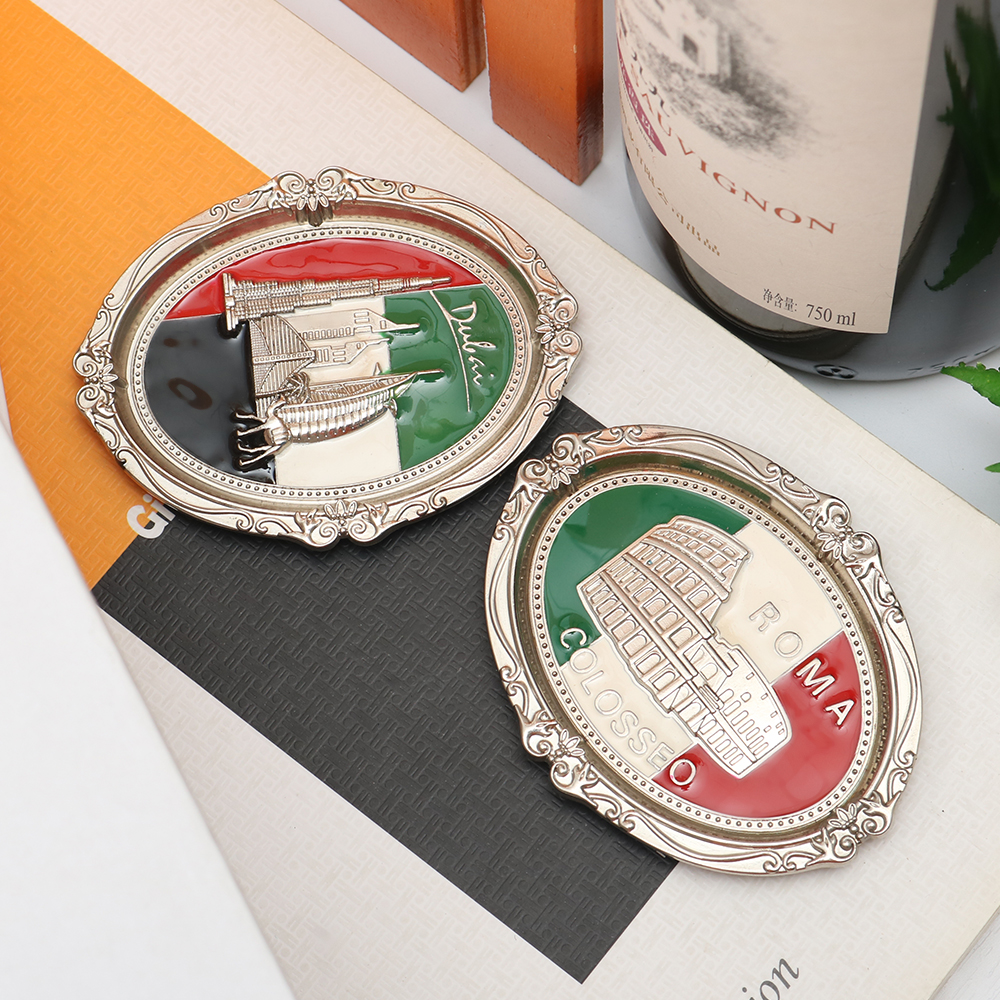
The other decoration processes used on metal gifts do not replace any of these. Laser engraving, screen printing, embossing, debossing, a molded logo and enamel colour fill are all legitimate ways to put a brand or a place name on a metal souvenir, and any of them can sit alongside an origin mark. What they cannot do is substitute for the origin mark, and a mark that a plating or polishing line removes is a mark the importer does not have.
The sequencing question is therefore worth raising at enquiry stage. A design that puts the place name on the front face and the country of origin on the reverse face, cast into the part, is straightforward. A design that wants the country of origin on the front, beside the place name, has to survive a plating cycle and an enamel firing, which changes how the text has to be specified. Plating options on metal gifts include gold, silver, rose gold, antique brass, antique silver, antique copper, black nickel and dual tone, and each of those finishes treats the surface differently enough that text specification and finish specification should be reviewed together rather than separately.
Where the marking has to sit
134.46 covers the geometry of the mark, and it is the section that most often produces a failed retail consignment. The rule reads: “In any case in which the words ‘United States,’ or ‘American,’ the letters ‘U.S.A.,’ any variation of such words or letters, or the name of any city or location in the United States, or the name of any foreign country or locality other than the country or locality in which the article was manufactured or produced appear on an imported article or its container, and those words, letters or names may mislead or deceive the ultimate purchaser as to the actual country of origin of the article, there shall appear legibly and permanently in close proximity to such words, letters or name, and in at least a comparable size, the name of the country of origin preceded by ‘Made in,’ ‘Product of,’ or other words of similar meaning.”
Three conditions have to be satisfied at once. The marking must be in close proximity to the misleading word. It must be at least of comparable size. And it must be preceded by “Made in”, “Product of” or words of similar meaning, so a bare country name is not what the rule asks for.
Applied to a metal souvenir, this produces a clear specification. A round souvenir coin with “SAN FRANCISCO” at the top and a small “CHINA” underneath, with no qualifying words, does not work. “Made in China” set in a comparable size, close to the place name, on the same face or on the reverse directly opposite it, works. Where the front face is fully occupied by artwork, 134.47 provides the alternative of another conspicuous location, and on a coin or a pendant that is usually the reverse.
Note also that the rule reaches the container as well as the article. A souvenir shipped in a printed backing card that says “New York” puts the card inside the scope of the same requirement.
Exceptions, and the ones that create more risk than they remove
There are genuine exceptions, and they are worth understanding because a buyer who reaches for the wrong one ends up with a worse position than the one they started with.
134.32 excepts “articles that are incapable of being marked”, with further exceptions listed in the same subpart. This is a factual test about the article, not about its size or its commercial convenience. A very small metal component that carries no design surface and no packaging is the sort of thing this is aimed at. A souvenir that has a back face is not incapable of being marked.
134.35 addresses a different situation. Where an article is used in the United States in manufacture and the result is an article with a different name, character or use, the US manufacturer is treated as the ultimate purchaser and the article is excepted, with the outermost container marked instead. For a buyer who imports souvenir blanks and assembles them into its own retail product, this is the relevant provision, and it should be raised with a customs broker rather than assumed.
134.26 is the one that lands on retail packaging. If an article is repacked into retail containers such as blister packs after release from customs custody, the importer must certify that the repacking does not obscure or conceal the country of origin marking on the article, or else the new container must be marked. The importer must also notify in writing any subsequent purchaser or repacker that any repacking must conform to the requirements. For a metal souvenir line that arrives as loose castings and is carded and packed in a Western warehouse, this is a routine obligation that is easy to overlook and easy to get wrong by putting the blister card over the reverse face.

What it costs when the marking is wrong
The consequences are financial before they are legal. Under 19 CFR 134.2, articles not marked as required “shall be subject to additional duties of 10 percent of the final appraised value unless exported or destroyed under Customs supervision prior to liquidation of the entry”, and the provision makes clear that the 10 percent is assessable “either” for failure to mark the article or container to indicate the English name of the country of origin “or to include words or symbols required to prevent deception or mistake.”
That second limb is the one that catches souvenir programmes. A mark that says “CHINA” without “Made in” adjacent to the place name is not a partial compliance. It is a failure to include the required words, and it attracts the same 10 percent as no mark at all.
The second consequence is the one that should shape policy rather than merely a buyer’s risk appetite. 134.4 provides that any intentional removal, defacement, destruction or alteration of a required marking, done to conceal the information, “may result in criminal penalties of up to $5,000 and/or imprisonment for 1 year”. This is why a correct answer to a request to remove or cover an existing origin mark is a refusal with a written explanation, and why the instruction belongs in the purchase order as a positive obligation rather than as something handled informally between a buyer and a merchandiser.
The EU and UK frameworks answer a different question
Buyers often merge US marking rules with European origin rules because both are called “country of origin”. They answer different questions, and mixing them up produces either over-compliance or a wrong conclusion about the paperwork.
The US rules above are about a physical mark on the product, read by an ultimate purchaser. The European rules are about the legal origin of the goods for customs purposes, and they come in two forms. Preferential origin is used to claim a lower duty rate under a trade agreement, and it is defined by specific product-specific rules. Non-preferential origin applies when no preference is available, and it is the general framework for customs purposes, statistical reporting, and trade defence measures such as anti-dumping investigations. The WTO gateway on rules of origin sets out the distinction directly, and notes that the non-preferential framework applies where no preferential treatment is claimed, and that the rules also matter for quotas, trade remedies and origin labelling obligations.
Within the EU, the Union Customs Code governs non-preferential origin. Article 60 provides that a product originating in a country is wholly obtained there, and otherwise has a last, substantial, economically justified processing or working in that country, with the product not being considered wholly obtained if the economic value of the processing is less than half of its ex-works value. Article 61 governs the proof of origin, including the statement on origin made by the exporter, and the principle that a third-country origin certificate may not be required where the origin is established by other means. The Commission’s published guidance on non-preferential rules of origin sets out the implementing provisions, including the treatment of minimal operations and the list rules in Annex 22-01 to the Delegated Regulation.
In the UK, the framing published by HMRC is equally direct. Origin is where the goods were grown, produced or manufactured, which is not necessarily where they were shipped from or where they were bought, and the rules distinguish goods that are wholly obtained from goods that are sufficiently worked or processed. The guidance also notes that preferential and non-preferential origin can apply to the same shipment at the same time, depending on the purpose for which origin is being established.
For a metal gift factory the distinction has an operational consequence. Non-preferential origin for a cast zinc alloy souvenir produced in Dongguan from locally sourced alloy and imported blanks is a question about the substantial transformation of materials, not about where the design came from. Preferential origin for a specific tariff programme is a different calculation with different rules. A factory that has taken the raw material and cast it into a finished article has a straightforward answer, and it is worth having that answer written down with the supporting process description rather than left to be reconstructed after a customs query.
What to put into the enquiry and the purchase order
The marking requirement is satisfied or lost at the specification stage, and the specification is set long before anyone sees a sample. A workable instruction contains the following elements, and each of them answers a question that would otherwise be answered differently by different factories.
Who decides the mark text. State that the country of origin marking is to be “Made in China” in English, or the exact alternative wording required, and state that the importer’s own wording is not to be substituted without written agreement. A factory that is left to choose will sometimes use an abbreviation, because abbreviations are common in export packing marks and in older tooling.
Where the mark goes. Specify the face, or the reverse, and specify that it must be in close proximity to any place name, at a comparable size, and preceded by “Made in” or “Product of”. This is the sentence that turns 134.46 into a drawing instruction.
Which method. State whether the mark is to be cast in, die sunk, etched, or applied by another process, and require the supplier to say which method will be used before the tool is cut. A mark that is cast in cannot be moved later without a new tool, and a mark that is etched cannot be moved later without re-finishing the part.
Where it sits relative to the finish. Confirm whether the marked face is plated, polished or enamelled after marking, and get the supplier to confirm that the mark will still be legible at the end of the finishing route. This is a production question and it is the factory’s to answer.
Size of type and placement tolerance. Give a minimum legible size for the marked text on the smallest size in the order, not on the hero size. A souvenir programme usually contains several sizes, and the smallest one is where the mark gets squeezed.
Sample approval. Require the marked sample to be approved before mass production, which links the marking to the existing approval step rather than creating a separate one. Our own sampling lead time is 7 days and production runs 15 to 20 days after approval, so a marking instruction added after approval will not fit the schedule.
Packaging. State that retail or export packaging must not obscure the article’s origin mark, and that any backing card bearing a place name must itself carry the country of origin in the required form. This is the point at which the 134.26 certification obligation starts.
No alteration. Add a line prohibiting the removal, covering, overprinting or substitution of the origin mark, and stating that the importer is the party that determines whether any request to do so will be granted. This keeps the decision with the party that carries the legal exposure.
Buyers who want a broader view of the paperwork that sits alongside the marking can look at our guide to HS codes and Incoterms for imported metal souvenirs, and readers who want to separate marking from product safety should note that our article on Requisitos de conformidad de los recuerdos metálicos covers chemical and product safety rules rather than customs marking. Where a place name on the product is also a protected brand, the trademark licensing guide for metal souvenirs covers the clearance side. Marking compliance can be added to the inspection scope through our quality control service, and where a marking operation adds a step to the order, its cost belongs in the same conversation as custom metal gift pricing.
Acceptance checklist
Run this list on the first marked sample of each new design, and again on the first packed carton of each production run. It takes about ten minutes and it covers the failure modes that actually generate customs correspondence.
| Check | How to verify | Pass condition |
|---|---|---|
| Text form | Read the mark on the sample against the purchase order | Full English country name preceded by “Made in” or “Product of” or equivalent wording |
| Proximity | Locate every place name, trade name and location word on the article and its packaging | Every place name has the origin mark in close proximity, or the mark sits in another conspicuous location under 134.47 |
| Relative size | Compare the height of the origin text with the height of the adjacent place name | Origin text is at least of comparable size, not smaller and set in fine detail |
| Legibility at distance | View the marked sample at arm’s length and under retail lighting | The text can be read without picking the item up |
| Durability | Run the mark over a fingertip and inspect the edges of the letters | No flaking, no residue, no edge lift |
| Method confirmation | Ask the factory which method was used and at which production stage | The stated method matches the purchase order, and the mark is finished after, or protected from, the plating route |
| Smallest size | Repeat the check on the smallest size in the run, not only the hero size | Legible at the same viewing distance as the hero size |
| Packaging not obscuring | Check the blister card, backing card and polybag against the article | No packaging element covers the mark, and any card with a place name carries its own origin text |
| No substitution | Compare the production sample with the approved sample | Identical text, position and method, with no abbreviation introduced in production |
| Record kept | File the approved sample and its photographs against the order | A dated approval record exists, showing text, position and method |
| Repacking instruction | Brief the warehouse that will card and pack the goods | The written instruction states that the article mark may not be covered, and that a covered mark requires marking of the new container |
One last practical point. The mark that satisfies these checks is also the cheapest one to implement, because it is designed in rather than added on. A country of origin that is cast into the reverse of a zinc alloy souvenir during the same shot that makes the front costs almost nothing in the tool and nothing in the finishing line. The same mark applied afterwards, at a size large enough to survive retail scrutiny, on a plated surface, is a new operation with its own setup, its own inspection and its own failure rate. The regulation does not care which route is used. The production plan does, and the second route is where the cost and the risk both sit.