
A wine stopper is not a keychain with a different shape. It is a closure: a multi-part assembly whose metal body has to hold a fixed relationship to a soft seal, whose outer form has to mate with a bottle neck that the factory does not control, and whose surface finish touches a beverage that a regulation can reach. That single fact changes where the engineering risk sits, which documents a buyer has to ask for before an order is placed, and how approval has to be signed off. What follows is the manufacturing route a custom wine stopper actually takes through an OEM workshop, the decisions that belong to the brand rather than to the factory, and the paperwork that has to exist before the first bottle is filled. It is written for buyers who have already decided that metal is the direction and now need to know what to write into the purchase order.
Why a wine stopper is a different manufacturing problem from a keychain
A flat charm or a keychain is a single piece of metal. One tool, one material, one finish, one logo operation, and the whole product can be inspected by looking at it. The dimension that matters most is the thickness of the sheet or the overall footprint, and the design freedom is close to total. A custom wine stopper is not like that, and the difference is not stylistic.
The stopper does two jobs at once. It has to seal: a metal part on its own will not hold a closure against a pressurised headspace inside a bottle, so a stopper that actually stops the wine needs an elastomer or polymer insert, a tapered plug, or a threaded engagement with a bottle neck. And it has to present: the same object sits on the neck of a bottle in a photograph, carries a brand mark, and is handled at a table. Those two jobs pull in opposite directions, because the material that seals well is a soft polymer while the material that carries a crisp logo and holds a plating layer is a hard alloy. Every wine stopper on the market is a negotiation between those two pulls.
For the buyer this produces a set of decisions that never appear on a flat product order:
- Which part touches the wine. A stopper that sits on the outside of the neck and only closes the pour opening touches no liquid. A stopper that enters the neck and forms the seal does. That single line decides whether the product is treated as a food contact article by the market it is sold into.
- Who controls the mating geometry. The factory controls the metal. The bottle neck is somebody else’s part, and its thread form and outside diameter vary by bottle style and by market. A stopper that has to work across a range of necks cannot be optimised for one of them.
- How many parts carry independent risk. A body, an insert, and possibly a pourer or closure ring means three suppliers, three lead times, three incoming-inspection checks, and a tolerance stack across parts that a single-piece product never has.
- Which operation adds the logo. A mark on a flat surface is one decision. A mark that has to sit on a curved shoulder, or that has to survive an insert being pressed into the same region, is a different problem.
None of this makes a wine stopper a difficult product to make. It makes it a different product to specify. Our comparison of cork and metal wine stoppers handles the material question at a higher level; this article stays on the manufacturing route and on what has to be in the purchase order.
| Decision point | Flat charm or keychain | Custom wine stopper | What the buyer has to pin down |
|---|---|---|---|
| Sealing | Not applicable | Insert, taper or thread engagement | Insert material and interface, by quotation |
| Contact with the product | None | Possible contact with wine | Which part touches the liquid, in writing |
| Interface with another part | None | Neck, ring or chain fitting | The bottle neck standard or the fitting spec |
| Logo placement | Flat face | Shoulder, crown or side | Mark area, size and process per part |
| Finish control | Whole visible face | Body plus separate insert | Finish for body and for insert separately |
| Tooling | One tool | Tool for the metal body, plus the insert | Which tooling is charged and which is amortised |
The three construction routes an OEM factory will quote
When a buyer asks for a quote on a custom metal wine stopper, a competent factory will come back with a small number of construction options rather than a single price. These are the routes that appear most often, and the differences between them are structural rather than cosmetic.
Route one: a metal body with a threaded or tapered plug
The body itself carries the closure function, either by engaging a bottle neck or by tapering into it. There is no separate soft component, which removes one supplier and one tolerance interface. What it costs is material and weight, and what it gains is a closure that can be described and inspected as a single machined feature. This route is the simplest to specify and the easiest to reason about from a compliance point of view, because there is no polymer in the assembly.
Route two: a metal body with a separate soft insert
The body provides the mass, the appearance and the logo surface; a moulded elastomer or polymer insert provides the seal. This is the most common route for a promotional or gift-grade stopper, because the metal body can carry a heavy relief logo and a decorative finish while the insert does the sealing. The cost is a second supplier, a second minimum order quantity, and a quality question that has to be settled in advance: whether the insert arrives from the buyer, from a supplier nominated by the factory, or as a factory-sourced part, because that choice changes who signs off the material compliance file.
Route three: a combined stopper and pourer
The body carries both a closure and a dispensing channel. Mechanically this is the most demanding route, because the channel has to be sealed against the same insert material, and because the pour path and the seal path are competing for the same volume of metal. It also raises the compliance question in its most acute form, since a product that dispenses wine has a liquid path, not just a contact surface. A buyer who does not need dispensing should not pay the engineering and compliance cost of this route, and a factory that quotes it without asking what it is for is not asking the right questions.
Which route a given project should take is decided by how the stopper will be used. A gift-shop item that decorates a bottle and is removed for pouring needs different engineering from a closure that is meant to hold an opened bottle for hours on a table. The factory cannot infer this from a drawing, and the buyer should state it explicitly in the brief.
Material and finish: what the factory can commit to
The material families that a metal gift factory can genuinely commit to are a short list, and it is worth knowing it before the first email. At our factory the principal material is zinc alloy, with stainless steel, brass and bronze, and iron also available. Finishes across those materials include gold, silver and rose gold plating, antique brass, antique silver and antique copper, black nickel, and dual tone combinations. Logo application can be done by laser engraving, screen printing, embossing, debossing, moulded logo and enamel colour fill.
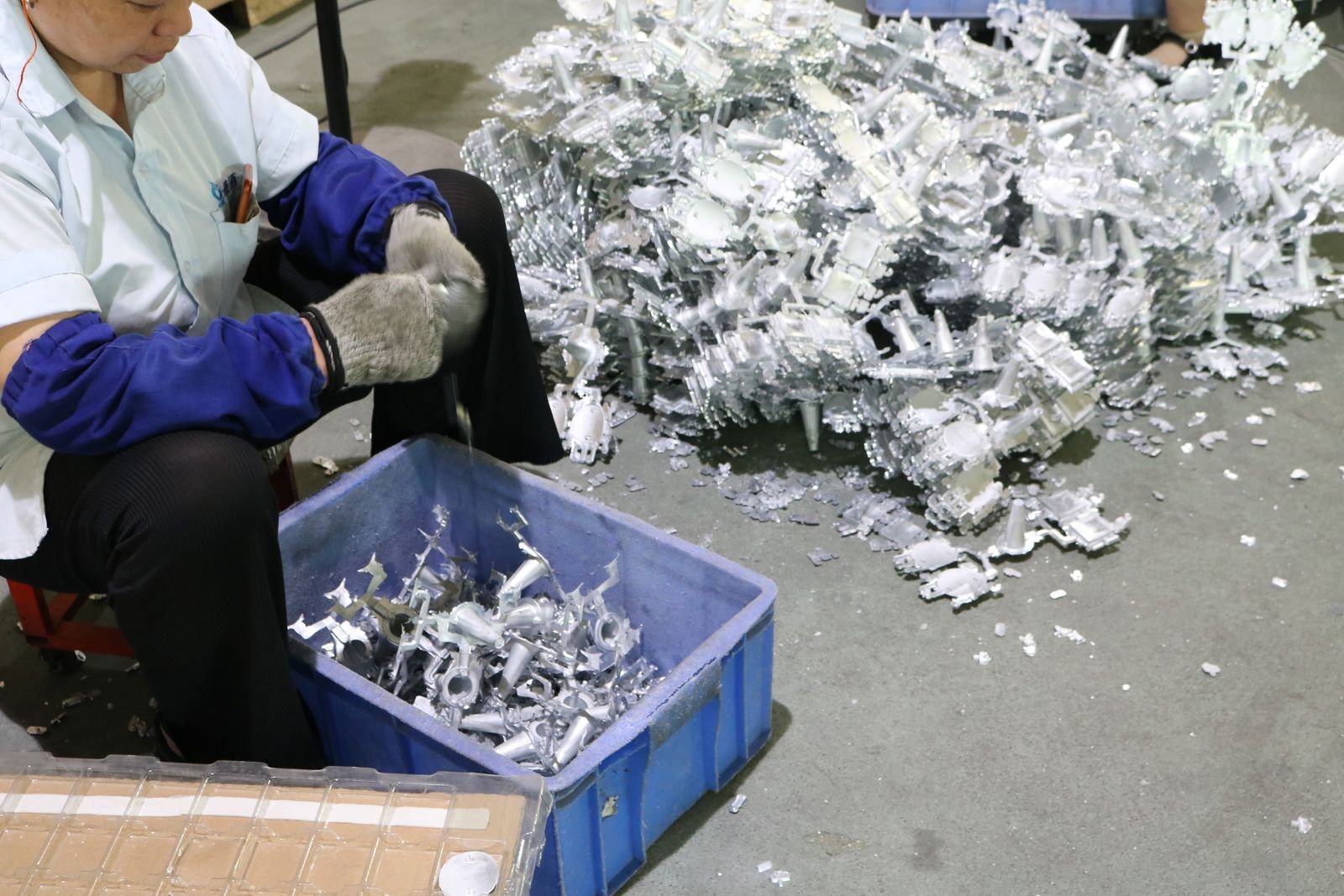
Two points of discipline matter here, and both are learned the hard way. First, none of these combinations is automatically available on every product. Whether a particular body can carry a particular finish, and whether a particular insert can be pressed into a particular alloy, depends on the geometry. The answer has to come from the quotation and the pre-production sample, not from a catalogue. Second, a finish is a process step with its own failure modes, not a colour swatch. The image below shows plating being checked on finished parts, which is the point in the route where plating problems are still correctable; after the parts are assembled, the same defects become scrap.
On the raw material side, the alloy is specified per order rather than per catalogue. The composition of the specific alloy used on a given run has to be written into the purchase order, because it is the alloy, not the product name, that determines how the part behaves in the bottle and how it responds to plating and to any later polishing. Our article on 3D zinc alloy wine stoppers covers the product side of the same decision, and the general question of how alloy grades are specified and how casting tolerance is documented is treated in our guide to zinc alloy grades and die casting tolerance.
The manufacturing route from 3D file to approved sample
Once the construction route and the material are settled, the order follows a fairly rigid sequence. Knowing the sequence is what allows a buyer to ask for a realistic date and to understand which part of the timeline is under the factory’s control.
Design and engineering. The brief is turned into a 3D model, and the model is reviewed for manufacturability: parting line, draft, section thickness and the feasibility of the chosen logo process on the chosen surface. A model that has never been reviewed for casting is a model that comes back with defects at the sample stage.
Tooling. A die is cut for the body. This is the single largest up-front cost in the project and the item most often left vague in a purchase order. Two questions decide who owns it: whether the tool is paid for as a one-off charge or amortised across the order, and what happens to it if the buyer never repeats the order. Our guide to the prototype and sample approval process sets out how that sign-off is normally structured.
Casting. Molten alloy is injected into the die under pressure. The casting workshop is the stage where cycle time is set, and therefore where the production lead time is decided. Tool wear across repeated orders is a normal engineering topic, not a fault, and it is worth asking how the factory manages tool life across repeat batches rather than assuming the first tool will run indefinitely.

Trimming, deburring and polishing. Gates and flash are removed and the surface is brought to the finish the plating step needs. Under-polished parts will show under a plating layer, so this stage is a precondition of the next one, not an optional extra.
Plating and finishing. The finish is applied, then the logo. The order of the two is a decision with visible consequences: a mark applied before plating can be partly buried by it, while a mark applied afterwards is at risk from handling during plating if the part is already finished. For a decorative piece the usual answer is to bring the logo into the tooling itself, as a moulded or embossed feature, and then plate over it, which is why moulded logo and embossing both appear in the list of available processes.
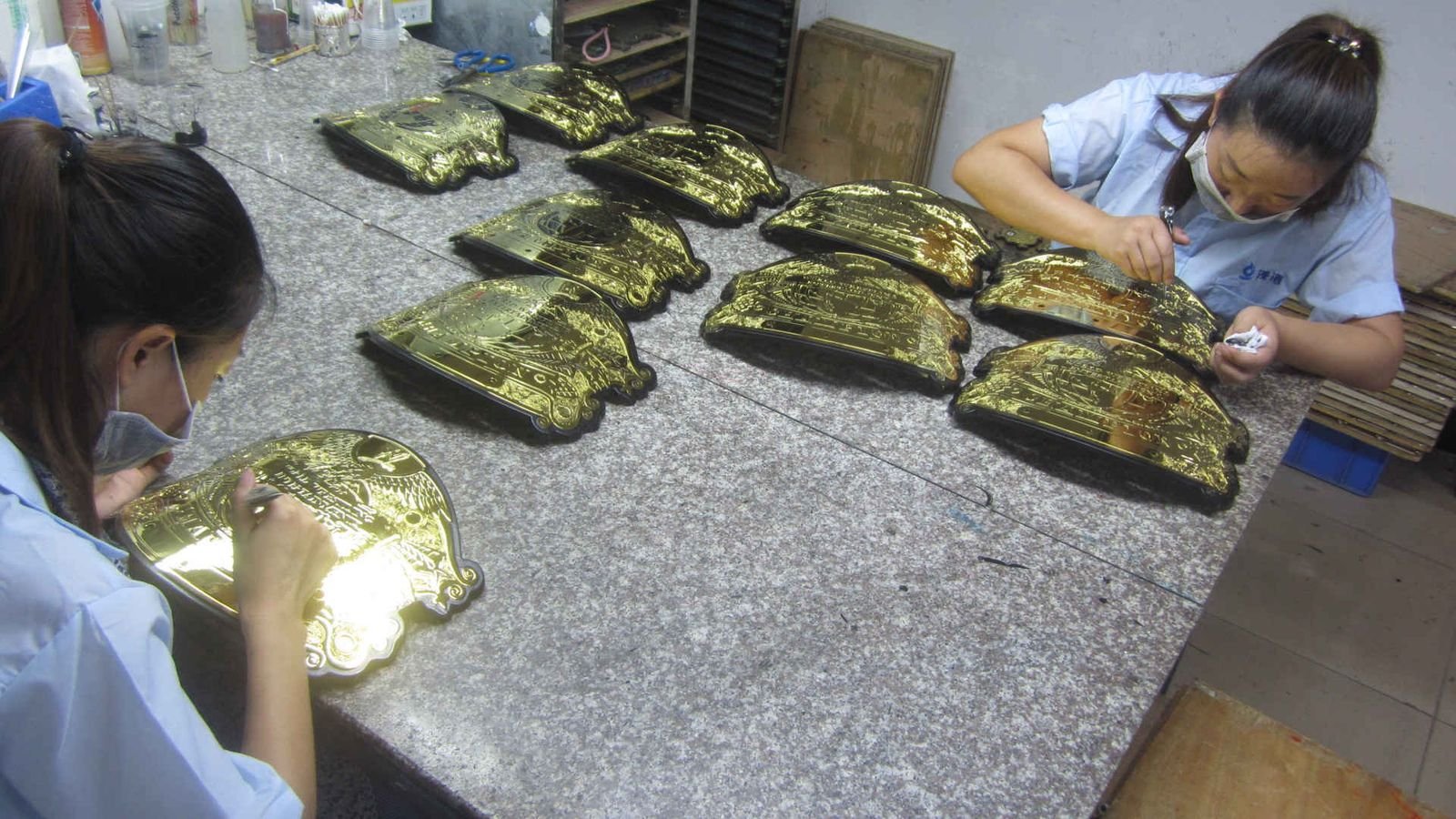
Assembly. The metal body and the insert are brought together. This is where a multi-part assembly either works or does not, and it is the stage that cannot be skipped by approving a photograph of a finished body. The insert has to seat in the actual body, and the assembled unit has to be tested against a real bottle neck.
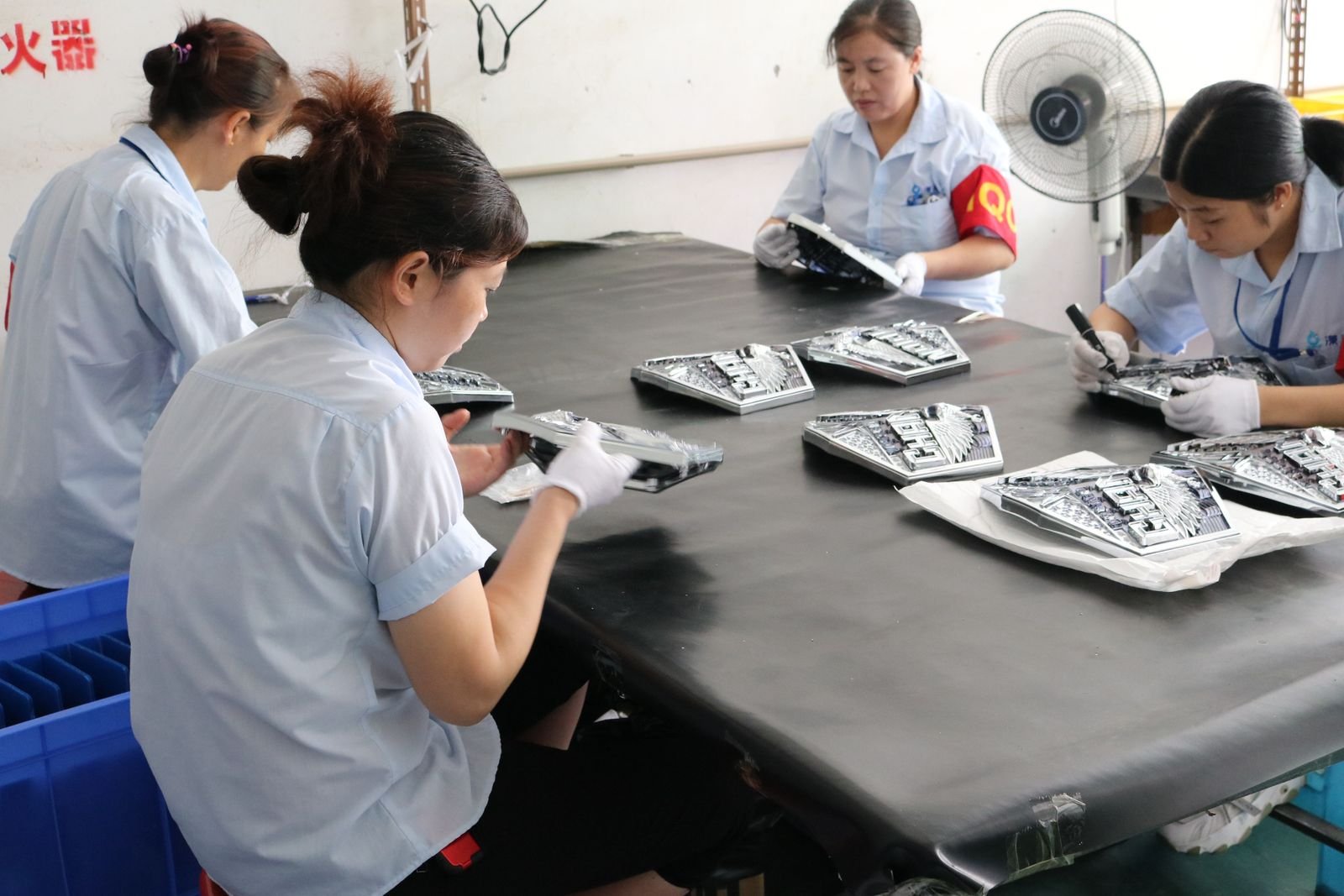
Inspection. Dimensional checks, surface checks and a functional check of the assembled closure. The acceptance criteria should exist as a written document before production starts, not be negotiated after a batch has shipped. Where a brand has no inspection regime of its own, the buyer can specify that the factory apply a defined sampling plan and report against it, which is the subject of our AQL inspection guide for metal souvenirs.
Packaging. A stopper that is a gift has to arrive as a gift. Bag, box, insert card and logo treatment are production items with their own lead time, and the packaging artwork should be approved at the same moment as the product sample, not after it.
Building the compliance file before you place the order
Most metal souvenirs are decorative objects. A wine stopper is frequently not, and that difference creates a documentation obligation that has to be settled before the order rather than after it. This section is about the framework and about who owns each part of it. The detailed list of documents a factory can supply is handled separately in our guide to food contact rules for metal souvenirs.
In the European Union, the framework applies to the whole assembly. Regulation (EC) No 1935/2004 sets out the general requirements for materials and articles intended to come into contact with food. Article 3 requires that materials and articles be manufactured in compliance with good manufacturing practice so that, under normal or foreseeable conditions of use, they do not transfer their constituents to food in quantities that could endanger human health, bring about an unacceptable change in the composition of the food, or bring about a deterioration in its organoleptic characteristics. The same article requires that labelling, advertising and presentation not mislead the consumer, which is worth noting for any stopper sold with a claim attached to it.
Good manufacturing practice for food contact materials is set by Commission Regulation (EC) No 2023/2006, which lays down the rules for the material groups listed in Annex I of Regulation 1935/2004 and for their combinations. Its Article 2 makes the point that matters most for an importer: the rules apply to all sectors and to all stages of manufacture, processing and distribution, up to but excluding the production of starting substances. A metal body that is only assembled into a stopper in another country is still inside that chain.
The European Commission summarises the position for buyers in its food contact materials pages: all food contact materials must comply with Regulation 1935/2004, must be manufactured in accordance with good manufacturing practice under Regulation 2023/2006, and are additionally subject to specific Union legislation on certain materials, including plastic and ceramics, as well as to national legislation on other materials. The last clause is the one that surprises people. Metals and alloys do not have a single harmonised Union-level material regulation of the type that applies to plastics, so in practice the buyer ends up working with the national rules of each target market and with the technical guides that the industry has built in the gap.
Labelling and traceability are not optional extras. Article 15 of Regulation 1935/2004 requires that materials and articles which are not yet in contact with food when placed on the market are accompanied by a specific indication of their intended use, and the article itself gives “wine bottle” as an example of such an indication. It also requires the name or trade name and the address of the manufacturer, processor or seller responsible for placing the material on the market, together with adequate labelling or identification for traceability. Article 17 then requires that traceability be ensured at all stages, so that defective products can be recalled and responsibility attributed, and that business operators hold systems and procedures identifying the businesses from which and to which materials are supplied, with that information available to competent authorities on demand. For a buyer importing from China, the practical consequence is that the factory’s records are part of the compliance chain, not just its commercial paperwork.
In the United States, the route depends on what is new. 21 CFR Part 170 Subpart D is titled Premarket Notifications and contains the food contact substance notification provisions: section 170.100 on submission of a premarket notification for a food contact substance to the FDA, 170.101 on the information required in that notification, 170.104 on FDA’s action on a notification, 170.105 on when FDA determines that a notification is no longer effective, and 170.106 on notifications for food contact substance formulations. Subpart B of the same part contains section 170.39, the threshold of regulation for substances used in food-contact articles. The practical question a buyer asks the factory is simple: for each material in the assembly, does it already have a cleared status, or does it require a notification, and who is the notifier.
National practice fills the remaining space. Because the EU-level material rules are incomplete for metals, national enforcement and the sector’s own technical guidance are what a brand actually meets. The Contact Alimentaire standards and guidelines hub sets out the arrangement for France in a way that generalises across the Union: the national rules implement Article 3 of Regulation 1935/2004 and Regulation 2023/2006, and beneath that sit professional guides, among them a guide to good hygiene and manufacturing practices for metal cans, packaging and closures for foodstuffs under metals and alloys, and the International Code of Cork Stopper Practices under cork. The transferable lesson is that a compliance file for a metal wine stopper is assembled from the general framework, the good manufacturing practice rules, the national rules of the destination market, and the technical guides the sector treats as the working reference.
| Document | Who can produce it | What it must cover |
|---|---|---|
| Material composition statement | Factory, from the alloy and insert specification | The actual alloy and insert used on the order, not the material family |
| Good manufacturing practice conformity | Usine | Manufacture in line with Regulation 2023/2006 and the destination market rules |
| Declaration of suitability for food contact | Factory, on the brand’s specification | The assembly as built, including the insert and any surface treatment |
| Test reports on specific components | Factory or an appointed laboratory | The component and the test method actually used |
| Traceability and batch records | Usine | Identification of suppliers and of the batch, retained and producible on demand |
| Labelling and identification of use | Brand, on factory-supplied artwork | Indication of use, responsible party details, and traceability marking |
| Market entry decision | Brand, with its own regulatory advice | Which markets the product is placed on and under which rules |
MOQ, lead time and the true cost of a multi-part assembly
The commercial numbers for a custom wine stopper follow the same structure as other metal gift orders, and they are worth stating plainly because they are the figures that decide whether a project is viable.
The minimum order quantity has three tiers. One hundred pieces is available where the order uses existing moulds. Five hundred pieces applies where a standard design is produced with existing moulds. One thousand pieces applies to most fully custom die castings, which is the normal case for a wine stopper that has been designed for a brand. Sampling takes seven days and mass production takes fifteen to twenty days. Shipping moves by express, air or sea.
Those figures describe the metal. A multi-part assembly adds to them in a way that is easy to miss at quotation stage. The insert is sourced separately, and it carries its own minimum and its own lead time, and it is frequently longer than the metal. Assembly adds a handling step. Packaging artwork has its own approval cycle, and if the packaging is printed rather than plain, its own production lead time. A buyer who asks for “fifteen to twenty days” and receives a promise that covers only the metal will discover the difference at the shipping date.
The practical response is to ask for a schedule that separates the metal from the insert, from assembly and from packaging, and to confirm which of the three minimum order quantities applies to each component separately. If the insert supplier will not sell five hundred inserts but the metal order is for a thousand pieces, the insert becomes the binding constraint on the whole order, and that needs to be known before the purchase order is signed. Our overview of custom wine stoppers is a reasonable starting point for the product itself.
Procurement acceptance checklist
The table below is the artefact to leave behind after the technical negotiation. Each line is a question to be answered in writing, and each has a reason for being there that is either a manufacturing risk or a legal one. A supplier that answers all of them in a single document has a mature process; a supplier that answers them one email at a time, only under pressure, is telling the buyer something important about the order that is about to be placed.
| No. | Check item | What a satisfactory answer contains | Reason |
|---|---|---|---|
| 1 | Which part contacts the wine | A drawing marking the seal interface | Decides whether food contact rules apply at all |
| 2 | Construction route | Body and insert specified as separate items | Fixes the number of suppliers and the tolerance stack |
| 3 | Alloy and insert specification | Composition of the actual material on the order | Alloy family names do not specify behaviour |
| 4 | Insert source and owner | Named supplier and who approves it | Determines who signs the material file |
| 5 | Logo method per surface | Process named for each face and mark area | A mark on a shoulder is not a mark on a flat face |
| 6 | Finish definition | Finish named for the body and for the insert separately | A plated body and a moulded insert are different items |
| 7 | Insert MOQ and lead time | Numbers, separate from the metal figures | Usually the binding constraint on the order |
| 8 | Tooling cost and ownership | Charged or amortised, and the retention term | Largest up-front cost and a repeat-order lever |
| 9 | Sample approval method | Pre-production sample, assembly and fit test, sign-off party | A photograph cannot approve a seal |
| 10 | Inspection criteria | Sampling plan and defect classification in writing | Defines what a claim can later be based on |
| 11 | Material compliance documents | Composition statement, GMP conformity, declaration of suitability | Article 3 of Regulation 1935/2004 and good manufacturing practice |
| 12 | Traceability records | Supplier identification and batch records, retained | Article 17 of Regulation 1935/2004 requires traceability at all stages |
| 13 | Labelling responsibility | Who supplies the artwork and who signs it off | Article 15 obligations on indication of use and on the responsible party |
| 14 | Destination market rules | Named markets and the rules applied per market | Metals fall to national rules rather than one Union measure |
| 15 | Packaging approval date | Artwork approval inside the quoted schedule | Packaging is usually the last thing to be missed |
A metal gift factory can supply a great deal of this file: composition statements, good manufacturing practice conformity, a declaration of suitability for food contact against the brand’s own specification, component test reports, and batch records for traceability. What the factory cannot do is make the market entry decision, accept legal responsibility for the brand’s labelling, or convert a component report into clearance for a finished assembly. Those decisions stay with the brand, and the practical test of a supplier is how clearly they mark that boundary rather than blur it. If you want to open the conversation, the enquiry address is sales@kingtopgift.com.