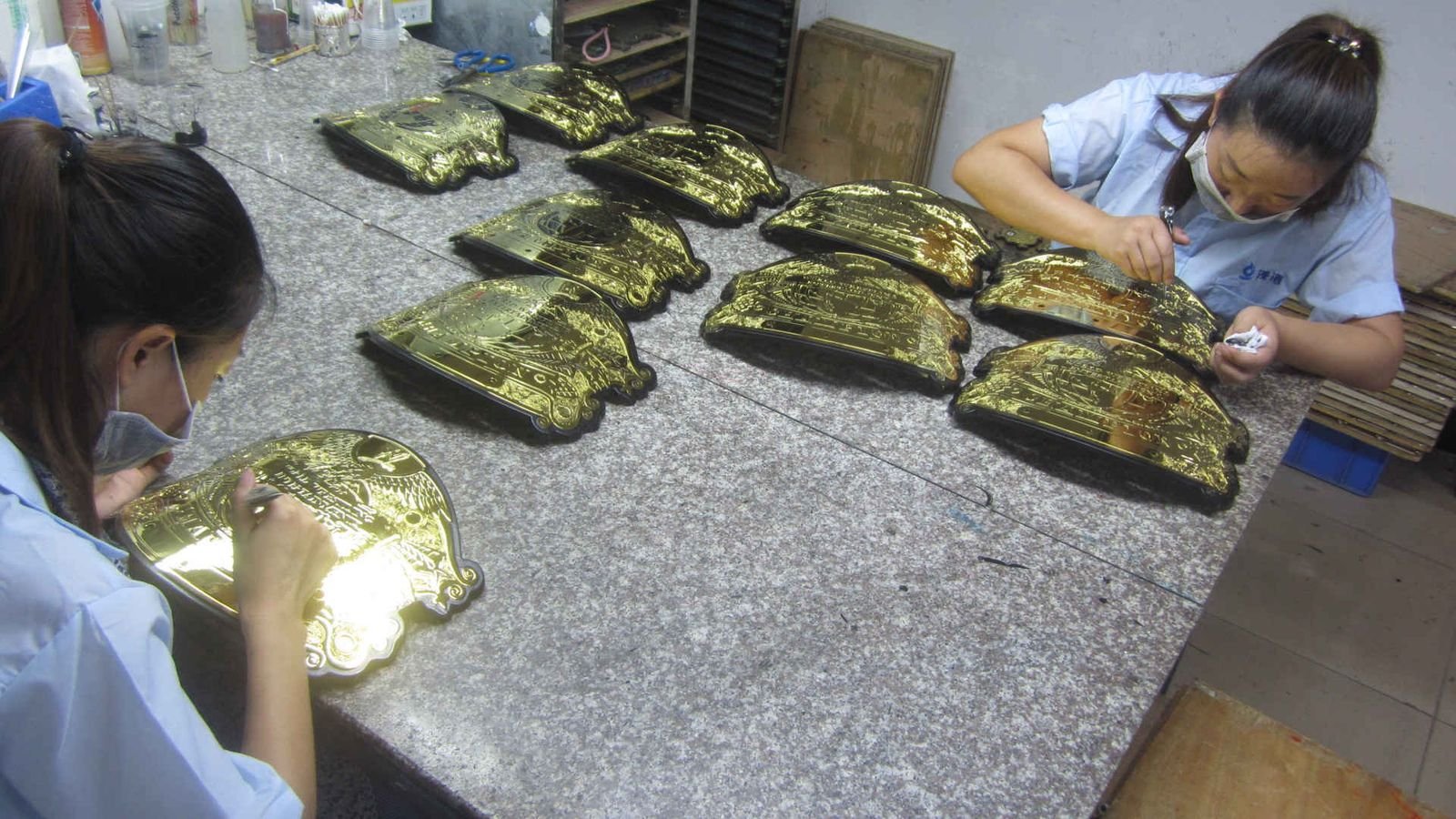
A metal bag charm is a small metal object attached to something the customer owns and carries every day. It is handled by people who never read the packaging, it is loaded with the weight of a bag, and it is expected to look new after a season of use. That combination produces a narrow set of ways for charms to fail, and almost all of them are decided in the specification rather than in the factory. This guide sets out the four failure modes that matter for custom metal bag charms, what causes each of them, and the decisions that keep them out of your returns.

Four ways a metal bag charm fails in service
Across a bag charm programme, the failures that come back are remarkably consistent. The attachment comes loose and the charm is lost, often because the charm was lost somewhere rather than because it broke. The plating wears through where the charm is held, because that is where fingers and fabric rub. The enamel colour chips away at an edge, because enamel is a separate material sitting on metal and it has no tolerance for a sharp corner or an impact. And the charm damages the bag rather than the other way round, because a hard metal edge against a coated fabric or a leather panel will mark it.
Each of those failures has the same character: it is invisible on the sample, it is a consequence of a design decision that was never written down, and it appears weeks after the goods reach the customer. None of them can be closed by a better inspection at the end of the production run, because by then the design is fixed and the tooling is paid for.
The other thing these failures share is that they are cheap to prevent. Each one corresponds to a parameter on the drawing or a sentence in the purchase specification: an edge radius, a minimum wall thickness, a marked wear zone, an agreed test method with an agreed acceptance. This is why durability work belongs at the brief stage rather than in the sample stage.
Failure mode 1: the attachment lets go
The attachment is the most common failure point in a charm programme, because it is the only part of the assembly that carries a load into a structure that was not designed for it. A charm hanging from a bag loop or a strap ring transfers the weight of the charm into a point on the bag, and everything in that path has to hold: the hardware, the hole or boss in the charm, and the way that feature was formed in the metal.
Three specific mechanisms account for most of the failures. A screw eye can rotate in the charm and the charm turns edge-on, which looks like a manufacturing defect but is a geometry problem: the boss around the eye needs enough material around it to resist rotation, and a small eye in a small charm has very little. A jump ring or split ring can open under load, which is a matter of the ring gauge and the wire diameter rather than of the charm. And a moulded or cast attachment can separate at the root if the section there is thinner than the load path implies.
The fix is mostly dimensional. Give the attachment feature a defined section, a defined boss diameter, a defined reinforcement, and a stated hole size with a stated fit for the hardware that goes into it. The hardware itself is a separate decision with its own specification, and we set out the connector types, the load path and the fit questions in our guide to metal bag charm hardware.
One further point matters for a charm that is expected to be carried on a strap or a bag loop: the charm hangs, so it swings. A swing applies a load in a direction the static view of the charm does not show, and it is why an attachment that has been checked for weight in a static test can still behave differently in a shop.
Failure mode 2: the plating wears through where it is held
A plated charm does not wear evenly. It wears where fingers touch it, where the charm rubs against another charm, where it sits against the hardware, and where the surface is convex enough that a fabric rubs across it rather than over it. The plating goes first at edges and corners, because that is where the coating is thinnest and where the substrate is most exposed.
Plating sits on a polished base, so the polish step comes first, and the polishing is what removes fine detail and rounds every edge slightly. That is the point at which a buyer can influence the result: a radius at the edge of a face, and a decision about which surfaces are plated at all, both change the wear picture. A charm that is handled by its outer edge should not have its brightest plating on that edge, because that is exactly where it will be rubbed first.
Salt spray testing is the usual way to ask about plating durability, and it is worth being exact about what it tells you. ASTM B117 is the standard practice for operating salt spray fog apparatus, defining the chamber, the salt solution and the evaluation of results. The exposure period and the acceptance criteria are not fixed by the practice; they are agreed for the part in question. A purchase specification that names the method, the exposure, the evaluation area and the reference sample is worth considerably more than a general statement that the part is salt spray tested, because it lets two parties reach the same conclusion later.
Note also what a salt spray result does not cover. It simulates a salt-laden atmosphere over time; it does not simulate the abrasion of a hand, a lining, or a zipper. Wear from handling is a design question, not a test result, and it has to be answered on the drawing.
Failure mode 3: the enamel chips off
Enamel colour fill puts a second material on a metal part. It is cured and polished, and it is not bonded to the metal in the way a plating is, which means the enamel layer and the metal under it respond differently to impact, to bending and to thermal change.
Chipping happens at edges and corners, because that is where the enamel layer thins out and where the impact energy goes. It also happens where the part was flexed, because enamel is less tolerant of a bending load than the metal carrying it. The design responses are the same ones that protect plating: a radius at the enamel boundary rather than a sharp corner, enough section under the coloured area so the part does not flex in service, and attention to the edge of the coloured field, since the boundary of the colour is where the layer ends and the substrate begins.
The checking question is the same one that applies to any two-material part: what does the customer see when a chip appears? On a small charm, a chip at the edge of a colour field is visible from across a table, which is why a buyer who expects a charm to be handled should decide whether the colour boundary is placed where a chip would be least conspicuous, or whether the coloured area is small enough that a chip does not change the read of the part.
Failure mode 4: the charm damages the bag
This failure runs in the opposite direction and it is the one that generates the most complaints, because the customer blames the bag. A hard metal edge against a coated canvas, a leather panel or a printed surface will mark it, and the mark appears as a scratch or a discoloration that the customer associates with the accessory rather than with the bag.
Three design decisions reduce it. Break every edge, because an unbroken edge cuts fabric and a broken edge slides across it. Keep the charm’s mass and its contact point away from the load path of the bag, so the charm does not press into one spot. And decide what the charm is allowed to touch, because a charm with a deliberately sharp decorative point is a different product from one without it, whichever is prettier.
There is a related question about the bag itself. A charm attached to a strap ring hangs and loads that ring, and on a bag with a decorative eyelet or a plated hardware plate, the load eventually shows at the bag end rather than at the charm end. If your programme includes a charm that is intended to be attached to a specific bag, that is a specification to write down.
The compliance question arrives with the failure mode
Durability and compliance are often handled as separate conversations, and for charms they are the same conversation. A charm that comes off a bag and falls into the hands of a small child is a different risk question from a charm that stays on the bag, and which one you have depends on how the product is sold and marketed, not only on its size.
In the United States, the size test in 16 CFR 1501.4 applies to toys and other articles intended for use by children under three years of age. The rule states that such an article shall not be small enough to fit entirely within a cylinder of the dimensions shown in Figure 1, and that if the article fits entirely within the cylinder in any orientation it fails the test procedure, with detached components tested the same way. The full section is available at 16 CFR 1501.4. A charm sold as a children’s accessory, or marketed in a way that makes that plausible, has to be assessed against it, and that assessment is easier to do on the drawing than after production.
For the European Union, the framework is Regulation (EU) 2023/988 on general product safety, whose English text is published by the Publications Office and can be read at the official manifestation of the Regulation. Article 9 sets the obligations of manufacturers, requiring that products placed on the market be designed and manufactured in accordance with the general safety requirement in Article 5, and that before placing products on the market manufacturers carry out an internal risk analysis and draw up technical documentation containing at least a general description of the product and its essential characteristics relevant for assessing its safety. Recital 33 explains that the technical documentation should be based on that internal risk analysis, with the amount of information proportionate to the complexity of the product. That risk analysis is the natural place to record how the charm behaves under foreseeable use, and a durability brief feeds directly into it.
How to write durability into the specification
Durability becomes real when it is written as numbers and methods rather than as a wish. The parameters that matter for a metal bag charm are a manageable set.
Geometry. Minimum wall thickness at the body, the section at the attachment root, the radius at every edge that a user can touch, and the radius at the boundary of any colour field. Casting tolerances for these features follow the general dimensional and geometrical tolerances and machining allowance grades in ISO 8062-3:2023, which applies plus and minus tolerances to indicated dimensions, so the drawing has to indicate them.
Finish zones. Which surfaces are plated, which are left as base metal, and which are designated as wear surfaces where a coating failure is acceptable and expected. This is a conversation to have before the plating order is placed.
Test method and acceptance. For a salt spray exposure, name the practice, the exposure and the evaluation area. For the attachment, state the load case and the acceptance, whether that is a pull test or a cycle test. For the part as a whole, state what is inspected at the end of the run and against which reference.
The reference sample. One approved sample, sealed, photographed under fixed light, kept for the life of the programme, and used to judge every subsequent delivery. A charm programme that runs over several seasons will drift, and the reference is what stops the drift from becoming a dispute.
What a factory can and cannot promise
It is worth being direct about this, because a durability claim is often asked for in a form nobody can honour. A factory can commit to a material, a process route, a drawing, a finish reference, an inspection standard and a test method. It cannot promise that a charm will not chip in two years, because that depends on how the customer uses it, what it is attached to, and what happens to it afterwards.
What a good supplier will do instead is narrow the uncertainty: state the alloy and the finish, show the sample that was approved, describe the inspection that will be applied, and agree the test that will be run. The buyer’s part of the job is to write the acceptance criteria that make those statements checkable, and to keep the record.
A durability review before the order is released
The sequence below is the one we would walk through before a charm programme is released into production. It is short on purpose, and each line has a document behind it.
| Step | Question to answer | Evidence to hold |
|---|---|---|
| 1. Use classification | Is the charm marketed for children, and does the small parts test apply | Marketing brief and the size assessment |
| 2. Load path | Which feature carries the charm’s weight into the bag | Drawing showing the attachment and its reinforcement |
| 3. Touch points | Which surfaces are handled, and what happens to the finish there | Marked drawing with wear zones |
| 4. Edge treatment | Is every edge a radius rather than a corner | Drawing with minimum radii |
| 5. Two-material zones | Where enamel meets metal, and how that boundary is radiused | Artwork with the colour boundary dimensioned |
| 6. Test method | Which corrosion and load tests apply, for how long, with what acceptance | Test clause in the purchase order |
| 7. Reference sample | Which sample approves finish, colour and construction | Signed sample, sealed and photographed |
| 8. Incoming check | How each delivery is compared to the reference | Inspection instruction issued with the order |
Send the artwork, the quantity per design, the target market and the date you are working to, and we will come back with the construction we would recommend for the use you have in mind, the drawing we need from you and the testing we propose. Write to our team or to sales@kingtopgift.com, and we will tell you where the design as drawn will not survive real use rather than finding out after the season. The styles and attachments available for charm programmes are set out in our guide to custom metal bag charm styles, and the wider range is in custom bag charms.