
A medal is judged on its face, and its face is judged on the relief. Whether the raised design catches light, whether the texture reads from arm’s length, whether the recessed areas hold colour without the enamel sitting proud of the metal: all of it is decided by how the relief was specified, not by how good the artwork is.
Buyers send artwork that looks finished and then receive a sample where the relief has softened, the fine linework has filled, or the parting line has appeared across the most visible part of the design. That outcome is almost never a factory quality problem.
A relief specification has to settle three separate questions: how the relief will be produced, how much of the design the production method can hold, and what the finished piece is allowed to vary by. A buyer who answers all three before the tool is cut gets a medal that can be re-ordered two years later. A buyer who answers only the first gets a medal that only exists once.
This guide is written for the people who buy medals, badges and coin-shaped recognition pieces: event organisers, club and association buyers, corporate recognition programme managers, promotional product distributors and souvenir wholesalers.
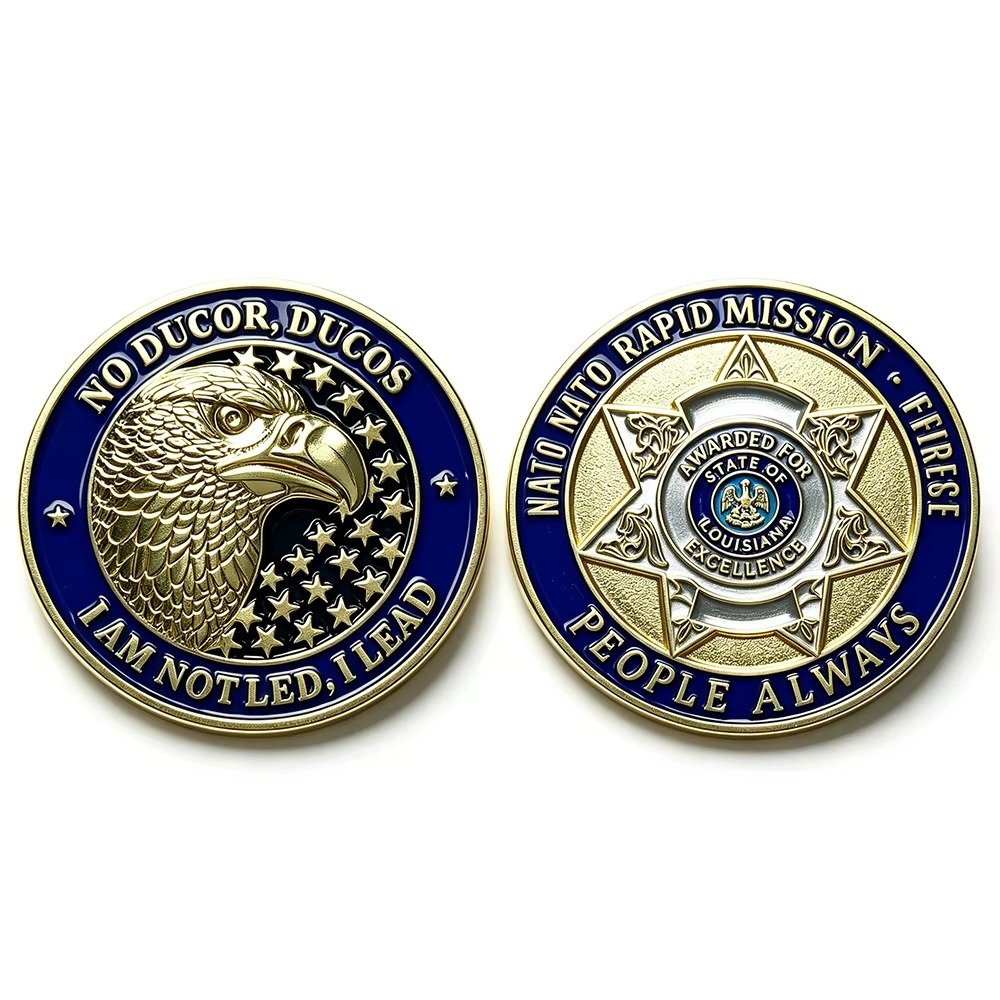
What a relief specification actually has to settle
Three questions sit underneath every relief decision. The first is the production method, because it determines the tooling, the cost and the achievable detail. The second is the detail budget, which is the part of the artwork that the chosen method cannot hold and which therefore has to be redesigned before, not after, the tool is cut.
A buyer who answers these three separately will find that the second question is usually the one that was skipped, and it is the one that decides whether the first sample is a success or a restart.
Three production methods for a raised design
| Method | How the relief is formed | What it holds | Where the cost sits |
|---|---|---|---|
| Struck | A blank is struck between two hardened dies | A clean, crisp relief with a defined rim and a flat field; the sharpest result of the three | Dies are the main cost and they are matched to the blank size, so the design is locked to that size |
| Die cast | Melted alloy is injected into a cavity that contains the relief | Volume and sculpted form; the relief is usually shallower than a struck piece and softer at the edges | Tooling plus metal content, because the piece is solid |
| Machined from a blank or bar | The relief is cut from a solid blank by milling | The highest achievable detail, because nothing is constrained by a cavity | Unit cost and lead time; normally reserved for prototypes, small runs and premium pieces |
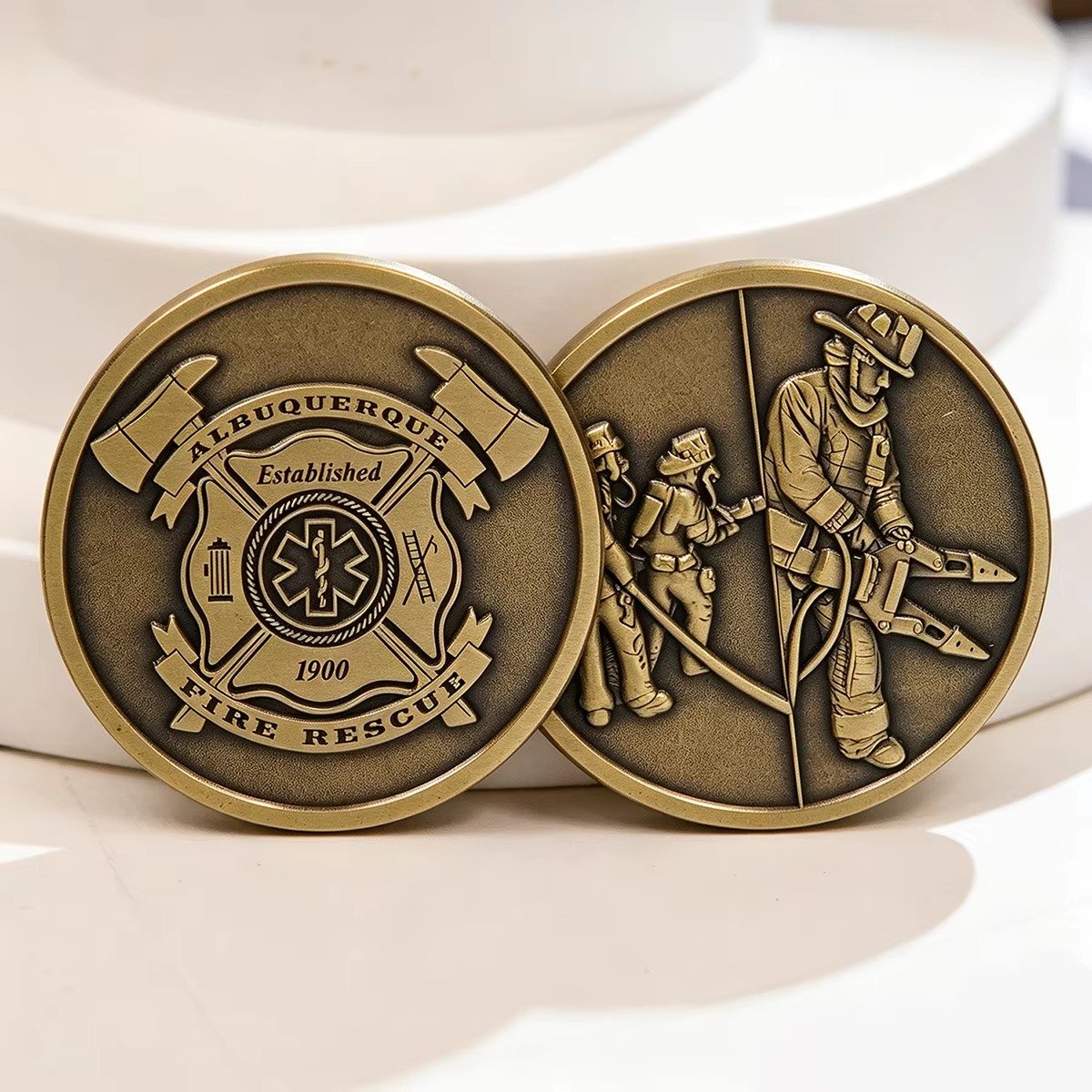
Struck and die cast are the two routes that carry volume. Struck is the traditional choice for a coin-shaped recognition piece because the relief is crisper and the field stays flat, which is what makes enamel colours read properly.
The machined route is worth knowing about even when it is not the production route, because a machined prototype is a useful way to test a design in three dimensions before committing to a tool. It is also a poor way to judge the production result, because a machined edge and a cast edge do not look the same.
Depth: why the number is not the whole answer
Relief depth is usually the first number a buyer asks for, and it is usually asked in the wrong frame. Depth alone does not determine how a relief reads.
The ratio matters because the same depth reads very differently on two sizes. A relief that looks bold on a large medal looks shallow on a small one, and the buyer who approved a photograph of the large version will not recognise the small one.
Light is the third factor and it is the one most often left out of the conversation. Relief reads by contrast between a surface that faces the light and a surface that does not. That means the orientation of the design relative to the piece matters: a design that reads well on a medallion lying flat may disappear on the same medallion hanging vertically under shop lighting.
The practical rule is to specify depth relative to the design and let the factory set the absolute figure for the size and route chosen, and to approve the result on a physical sample under the lighting it will actually meet. A depth number in a purchase order without those two conditions is a number nobody can check.
Detail that survives the production method
Three geometric constraints decide whether a detail can be made at all. Draft is the taper on a wall that allows the tool to release; without it, a wall either will not draw or will break. Undercuts are features that trap the tool, and they need a side action in the tool, which adds cost and leaves a witness line on the visible face.
The parting line is the constraint buyers most often miss, because it is invisible on a flat graphic and unavoidable on a round piece. A medal is round, so a parting line has to run somewhere. It can run across the face, which splits the design, or it can run around the edge, which is the usual choice for a struck piece and keeps the face continuous.
The design consequences are concrete. Text running across the face needs to be reviewed against the parting line position. Fine recessed detail needs to be reviewed against the polish step, which rounds every edge it touches.
One further point applies to any relief that is meant to carry colour: the boundary between a metal area and an enamel area needs enough metal left between two colour fields that the polishing step will not break through. That minimum is set by the process, not by the artwork, so the artwork needs to be checked against it rather than the other way round.
Dimensional and geometrical tolerances for cast metal
Buyers who want a repeatable medal need a tolerance position, and the reference most metal gift buyers will meet is ISO 8062-3:2023, the standard on geometrical product specifications for dimensional and geometrical tolerances for moulded parts. It specifies general dimensional and geometrical tolerances as well as machining allowance grades for castings using plus or minus tolerances for indicated dimensions as delivered to the purchaser, and it applies to castings in all cast metals and their alloys produced by various casting manufacturing processes.
Two features of the standard matter to a buyer. The first is its scope limit: it does not apply to 3D CAD models used without indicated dimensions. In other words, a model without dimensions carries no tolerance position at all, and a buyer who sends an undimensioned file has not specified a product. The second is what it covers.
That is the practical lesson from the standard: it gives the buyer the general framework for the body of the medal, and it leaves the relief itself to be specified on the drawing. The two need to be handled separately, which is why a good medal drawing carries both a general tolerance callout for the body and specific callouts for the relief features.
For the alloy itself, ASTM B86-23, the standard specification for zinc and zinc-aluminium foundry and die castings is the reference for a cast zinc alloy medal.

Plating and the relief surface
A relief that reads well in bare metal can disappear under plating, because plating adds a layer that softens the edge and changes how light is reflected. The sequence used for a bright decorative plating is broadly consistent: the body is cleaned, a copper strike is laid down, then bright acid copper, then semi-bright or bright nickel, and finally the visible top layer, which for a chrome-style bright finish is chromium.
The durability question is separate from the appearance question, and the reference for it is ISO 9227:2017. It specifies the apparatus, reagents and procedure for neutral salt spray, acetic acid salt spray and copper-accelerated acetic acid salt spray tests to assess the corrosion resistance of metallic materials with or without protective coatings.
The standard is explicit about two limits that a buyer should hold on to. It does not specify the dimensions or types of test specimens, the exposure period to be used for a particular product, or the interpretation of results, and it says such details come from the appropriate product specifications. And the salt spray methods are not intended for comparative testing as a means of ranking different materials relative to each other for corrosion resistance, nor as a means of predicting long-term corrosion resistance of the tested material.

Enamel and the relief cavity
Relief and enamel work together, and the cavity is where they meet. A recessed area in the design can be filled with colour, and the fill has to be deep enough to sit below the surrounding metal and flat enough to be polished back without the metal being thinned to the point of failure.
Two practical rules follow. A cavity that is too wide relative to its depth will not hold the colour cleanly, and a cavity that is too shallow will fill above the surface and leave a lip that cannot be polished away. And a design that places a cavity right on the parting line produces a seam that no finishing step removes.

The colour itself has to be specified as a reference rather than a description. “Dark blue” is not a production instruction, because the same name covers a range of results that vary between suppliers. A physical colour chip, agreed against a sample, is what makes a repeat order match.
The legal boundary for coin-shaped pieces
Recognition coins occupy an awkward position in United States law, because a coin-shaped object with an emblem and a finish resembles currency closely enough that the resemblance itself becomes the legal question. 18 U.S. Code § 486 is the provision to read.
Two elements of that wording decide what a buyer can and cannot do. The first is the intent requirement: the provision addresses coins intended for use as current money. A recognition coin made for a team, a school or a company is not that.
This is a legal boundary rather than a manufacturing one, and a buyer should treat it as a design input rather than a formality. Avoiding it means the piece should carry the identity of the organisation it was made for, and should not be made to look like currency. A school crest, a company logo, a team name and a year all move a piece away from the resemblance question.
Skin contact: the nickel release question
A medal that hangs around a neck, a badge that is pinned to a shirt and a piece sold as jewellery are different products from a medal that sits in a presentation case, and the difference shows up in the European material rules. Directive 94/27/EC adds entry 28 to Annex I of Directive 76/769/EEC, covering nickel, CAS number 7440-0-20, and its compounds.
The entry prohibits nickel in post assemblies inserted into pierced ears unless the assembly is homogeneous and the nickel concentration, expressed as mass of nickel to total mass, is less than 0.05 per cent. It prohibits nickel in products intended to come into direct and prolonged contact with the skin, and the examples given include earrings, necklaces, bracelets and chains, anklets, finger rings, wrist-watch cases, watch straps and tighteners, and rivet buttons, tighteners, rivets, zippers and metal marks when these are used in garments. For those products, the rate of nickel release from the parts coming into direct and prolonged contact with the skin must not be greater than 0.5 micrograms per square centimetre per week.
The practical reading for a medal programme is a question about intended use. A medal in a case that is worn on a ribbon over clothing, or an event badge on a lanyard, is not a skin contact product in the way a necklace pendant is. A medal sold as jewellery, or a badge that is fixed to the skin or to a garment through a metal mark, is.
The specification checklist
| Item | What to record | Why it has to be on the drawing |
|---|---|---|
| Production route | Struck, die cast or machined, and the size the tool is built for | It determines the detail budget and the tooling cost, and it is locked once the tool is cut |
| Parting line position | Where the tool seam runs on the face or around the edge | A seam across the main design cannot be removed later |
| Relief description | Depth relative to size, the smallest feature, and the features that are simplified | Detail that the method cannot hold has to be designed away on the drawing |
| Body tolerances | A general tolerance callout for the linear and geometrical dimensions | ISO 8062-3 gives the framework for the body but not for the relief |
| Relief tolerances | Specific callouts for the features that carry the design | Relief is a surface condition and needs its own statement |
| Finish | Named finish, plus a physical colour reference | A colour word carries no obligation to match and no basis for a repeat order |
| Enamel | Colour references, cavity areas, and the fill boundary against the metal web | The cavity geometry and the fill level have to be agreed together |
| Legal position | How the identity of the organisation appears on the face, and the intended use | It determines whether the piece is a presentation piece, a garment accessory or jewellery |
A drawing carrying these eight items is a specification. A drawing carrying the artwork and a colour name is a request for a quotation, and the two produce different orders.
Frequently asked questions
Can a struck design be reproduced in die cast?
Not identically. Struck produces a crisper relief and a flatter field because the metal is displaced rather than filled. A design that depends on a hard edge between a raised area and a flat field will look softer in a die cast version, and a colour fill that relies on that flat field will read differently. Moving between routes is possible as a variant, but it needs a new sample and a new colour refere
How much relief detail is enough for a medal that is viewed at a distance?
Enough to separate the major elements and to hold the eye, and no more. Detail that is finer than the viewing distance adds cost through the tool without adding to the read.
Does plating change the look of the relief?
Yes, it can. Plating adds a layer over the metal, and a very fine edge will be rounded by the plating build. A bright finish also increases the contrast between faces, which usually helps a relief read, while an antique finish reduces contrast and can soften the separation between the raised and recessed areas. Approve the finish on a plated sample, not on a bare metal
What to send with your enquiry
Send the artwork as vector files, the intended size, the production route you have in mind or the ones you want compared, the named finish with a colour reference, the enamel colour references, the marking or ribbon attachment, the quantities, the market you are selling into and the documents you need.
For a quotation against your own artwork, or for a relief specification drafted on your design with the tolerance and finish positions set out, send the files to the Kingtop manufacturing team at sales@kingtopgift.com. The custom medals and badges range and the zinc alloy sports medal show the same specification approach applied across different finishes and uses.