
Hard enamel and soft enamel are not two grades of the same product. They are two different manufacturing routes, and they produce pins that behave differently in the hand, on the shelf, and in the fulfilment centre. The choice between them decides your minimum line width, your colour tolerance, your unit cost and your lead time, and it cannot be reversed after the tooling is cut. This guide sets out what each process actually involves, the numbers that determine whether your artwork will survive it, and how to decide which one your order needs.
Brand accessory buyers usually arrive at this decision with a colour swatch and a logo, and without much else. Then they learn that a badge with a hairline detail and a bright coral fill cannot be made in hard enamel, that matching a specific Pantone across two processes is not realistic, and that the option which looks the most premium is also the one that takes longest and costs most.
None of that is a problem, provided it is settled before the order. Every question below has an answer, and every answer is knowable in advance.
The Two Finishes, Described by the Process That Makes Them
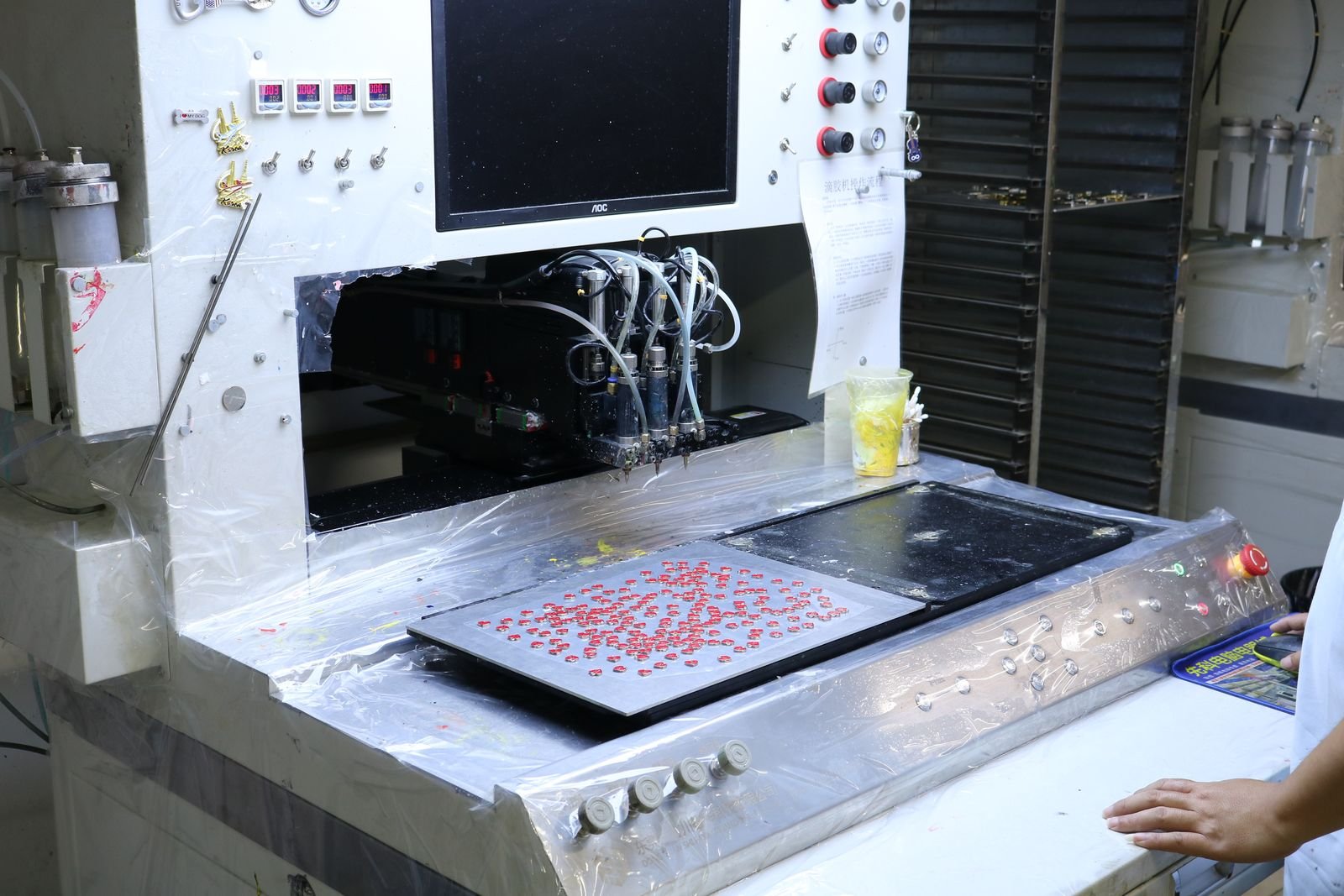
The clearest way to explain the difference is to follow the product through the factory, because the divergence is in the sequence of operations, not in the materials used.
Soft enamel: plate first, fill second, cure gently
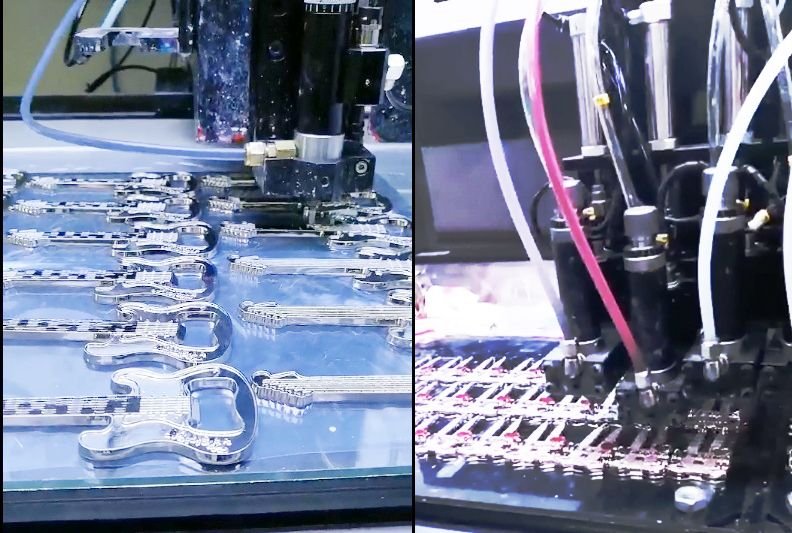
A soft enamel badge starts as a stamped metal base. The base is electroplated first, in the final colour and finish the buyer wants, and only then is liquid enamel poured into the recessed areas between the raised metal lines. Because the paint is not overfilled, the metal lines stand above it and act as natural dams between colours.
The piece is then cured at a comparatively low temperature, in the region of 140 to 180 degrees Celsius, which is enough to set the paint without disturbing the plating underneath. The result is the characteristic texture: run your thumb across it and you can feel the ridges. The recesses sit measurably below the metal surface, typically something like 0.15 to 0.25 millimetres.
That texture is the trade. Soft enamel holds sharper detail than hard enamel because nothing is ground back, and it accepts the widest range of plating and substrate options. What it gives up is surface hardness. The recesses are exposed, and a hard object dragged across a soft enamel badge will mark it.
Hard enamel: fill first, fire hot, grind flat
Hard enamel runs the sequence in the opposite order. The metal base is stamped with recessed cavities bounded by raised walls, and enamel paste is dispensed into each cavity until it is deliberately overfilled, sitting proud of the metal. The piece is then fired, one colour at a time, at temperatures in the region of 760 to 800 degrees Celsius, which vitrifies the enamel into a solid glass-like material.
After firing, the overfilled surface is taken back to level. Multiple passes of rotary carborundum stone grinding scrape away the excess until the enamel and the metal are flush, and the piece is then polished, usually with diamond compound. Only after the colours are complete is the metal plated, and the piece gets a final polish.
The outcome is a surface that is genuinely flat and glass-like, with no measurable step between colour and metal. It is markedly more durable, it is what makes hard enamel read as a premium product, and it is also why the process takes longer: every colour is a separate firing, and every firing is followed by grinding.
Metro Pins’ technical comparison of the two finishes and Made by Cooper’s explanation of the sequences are both worth reading in full if you are writing a specification. Glory Awards’ piece on why the same Pantone code looks different in each process goes further on the colour question covered below.
The Numbers That Decide Your Order
Minimum metal line width is the constraint that breaks artwork
Hard enamel is ground flat. Everything that stands above the final surface, which means every metal line, gets abraded. A line thinner than about 0.25 millimetres will not survive that grinding: it collapses, bends or bevels away, and the colours on either side of it start to bleed into each other. Soft enamel is never ground, so it can hold lines as fine as about 0.15 millimetres.
This is the single most common reason an artwork file comes back with a revision request, and it is worth checking before the file is sent rather than after the sample arrives. If your logo contains hairline serifs, microtext, a date set in a thin font, or the outline of a feather, hard enamel is the wrong process for that artwork and no amount of sampling will change it.
Thickness, and the five percent that grinding takes off
Both finishes are commonly produced at around 1.5 millimetres thick on a 1.5 inch item, and that dimension is a useful anchor when comparing quotes. One consequence is worth noting: because hard enamel is polished back, the finished piece ends up roughly five percent thinner than the pressed blank. Suppliers quote finished dimensions, so a buyer specifying a thickness on the blank rather than on the finished piece will end up with goods that miss the number by a measurable margin.
Substrate and plating options differ
Soft enamel can be die-struck in iron, copper, brass, spin-cast pewter and three-dimensional sculpted zinc alloy, and it accepts every plating style, including dyed black metal, colour metal coatings and rainbow anodising. Hard enamel is more restricted: it works best in solid brass, bronze and die-cast zinc alloy, and it requires a flatter design geometry, because there is no room for a deep, sharp relief once the piece has to be ground back to a single plane.

Why the Pantone Book Will Disappoint You
Enamel is a mineral pigment suspended in glass frit. It is not a printing ink and it does not behave like one. The colour that arrives in the customer’s hand depends on how thickly the enamel was laid down, how hot it was fired, and how much material was removed during polishing.
The practical consequence is that the same Pantone code produces visibly different results in hard and soft enamel, and hard enamel generally reads deeper and richer because the layer is thicker and the surface reflects light more cleanly. Buyers who ask for “Pantone 186 C” and receive something slightly deeper than the book are not being short-changed. They are seeing the physics of the process.
Some colour families are more forgiving than others, and the pattern is consistent enough to plan around.
- Neons and fluorescents do not survive the kiln. They are effectively unavailable in hard enamel, and attempting them is a sure route to a rejected sample.
- Bright yellows shift the most, tending towards mustard or golden. Start a shade lighter than the target, or approve a physical sample first.
- Pastels and light tints lose their softness in the kiln. Soft enamel handles them far better.
- Reds and oranges go deeper, which most buyers prefer.
- Navy, black and deep greens have nowhere to move and suit hard enamel well.
- White can pick up a faint warm tint in the firing, which matters if pure white is part of the brand specification.
The reliable answer to all of this is to request fired swatches. Suppliers who work in this field publish actual enamel colour chips fired on their own metal under controlled lighting, rather than screen-printed Pantone references, and asking for those chips costs nothing and settles the question in one round. Pantone’s own guidance on colour and production is a reasonable reference for building a brief that a factory can act on, though the finished enamel chip remains the final arbiter.
Cost, Lead Time and Where the Trade-Off Sits
| Factor | Hard enamel | Soft enamel |
|---|---|---|
| Surface | Polished flat, glass-like, no measurable step | Textured, with recesses below the raised metal lines |
| Firing temperature | Approximately 760 to 800 degrees Celsius | Approximately 140 to 180 degrees Celsius |
| Minimum metal line width | About 0.25 mm | About 0.15 mm |
| Effect of process on thickness | About 5 percent thinner after grinding and polishing | Minimal loss, no grinding stage |
| Colour behaviour | Reads deeper; neons and fluorescents unavailable | Brighter and truer to the code; pastels handled well |
| Durability | Exceptionally hard, resists scratching and abrasion | Good, but recesses can be marked by hard objects |
| Relative unit cost | Higher; typically 15 to 25 percent above soft enamel | Lower |
| Lead time | Longer, due to multiple firing and grinding stages | Shorter, suitable for urgent orders |
| Best suited to | Luxury brand merchandise, corporate recognition, military and service awards, high-traffic keychains | Convention giveaways, festival merchandise, sports badges, fine-detail artwork |
The Epoxy Middle Path
There is a compromise that solves a specific problem, and it is worth knowing about before you default to one process. A clear epoxy resin dome can be applied over a soft enamel piece. The result looks like hard enamel, because it is smooth and glossy and sits level with the metal lines, but the underlying construction is still soft enamel, which means the fine detail that soft enamel can hold is preserved.
It is not identical to hard enamel. It will not wear the same way, and the dome has a slight yellowing tendency over time that a fired glass enamel does not have. For a badge with genuinely fine detail, a brand colour that has to stay bright, and a price point that rules out hard enamel, it is a reasonable and widely used answer.
How to Brief an Artist So the File Comes Back Right
Most of the friction in an enamel order comes from the artwork, and most of it is avoidable. The brief should state the process, the minimum line width, and the substrate, because the artist cannot draw to a process that has not been chosen.
Hard enamel badge, 38 mm, solid brass, gold plating. Minimum metal line width 0.25 mm. No text below 6 pt. Vector artwork only, with all effects outlined, and a separate version of the artwork showing the minimum line width guide overlaid so the artist can check every element against it.
Asking for a proof that carries the line width guide, or for the vector file with the guide visible in a separate layer, catches the problem in an email rather than on a physical sample. It is the cheapest control in the whole process.
Which One Should You Specify
If you are still undecided, the decision tree runs like this.
Does your artwork contain lines thinner than about 0.25 mm, hairline serifs, or microtext? If yes, you are in soft enamel, or you redesign for hard enamel. There is no third option, and grinding will not be negotiated.
Is any part of the colour range neon, fluorescent, or a very light pastel? If yes, you are in soft enamel. If the piece also has to be extremely bright and very smooth at the same time, you are looking at soft enamel with an epoxy dome.
Is the badge going to be handled hard, worn daily, or sold as a premium item? If yes, you are in hard enamel. It costs more and takes longer, and it is the reason a hard enamel badge feels different in the hand from the moment it is picked up.
Is the order time-critical, or is the price the deciding factor? If either, you are in soft enamel. The savings are real, roughly 15 to 25 percent per unit across standard runs, and the lead time is shorter.
Does the brand identity depend on an exact colour matching a digital swatch? If yes, be careful. No enamel process matches a screen exactly, and the further the target colour is from what the kiln preserves, the wider the gap. The only reliable answer is a fired chip approved against the real product.
For the wider picture of where pins sit in a metal accessory programme, our オーダーメイドの金属製お土産シリーズ covers the cast souvenir formats that typically sit alongside pins, while custom souvenir enamel pins and enamel lapel pins show the two shapes most often ordered in these processes, and custom school badges and academic pins covers the institutional work where colour accuracy tends to matter most.