
Most metal souvenir purchase agreements describe what the goods will look like and what they will cost. Far fewer describe what happens after the container lands and the buyer finds a batch of plated keychains that do not match the approved sample. That gap is where disputes live. In the United Kingdom, the Sale of Goods Act 1979 implies a right to examine the goods, a definition of acceptance, and a damages rule that most importers have never read. In the United States, the Uniform Commercial Code does something different: it puts the burden of proof on the buyer and makes late notice of breach a complete bar to any remedy. Both systems mean the same thing for a buyer ordering custom metal souvenirs from China. The clauses you write before the deposit decide whether you can reject a non-conforming order, and the notice window you set before shipment decides whether you can still claim anything at all.

Why a Metal Souvenir Order Is a Contract of Sale, Not a Service
Custom metal souvenirs are made to the buyer’s drawing. That is why buyers sometimes assume the contract is a work-and-materials agreement rather than a sale of goods, and the assumption matters, because it changes the default rules that apply when the goods arrive wrong.
Under the Sale of Goods Act 1979, a contract of sale is one where the seller transfers or agrees to transfer the property in goods to the buyer for a money consideration, called the price. What you actually receive from a metal gift factory is goods: a physical batch of zinc alloy, brass, stainless steel or iron pieces with a defined finish, a defined quantity and a defined delivery date. The fact that the pieces are made to your artwork does not convert the transaction into a contract for work and materials. The distinction has a practical consequence: where the contract is a sale, the statutory implied terms described in this article apply unless the contract says otherwise.
The same point applies under the United States Uniform Commercial Code. Article 2 governs “transactions in goods,” and a transaction of goods is a transaction where the seller transfers or agrees to transfer the property in the goods to the buyer for a money consideration. A buyer importing souvenirs should assume Article 2 applies and that any departure from its default rules has to be written down. Section 2-719 is the provision buyers most often need, because it is the one that lets parties agree to limit remedies. It provides that the agreement may provide for remedies in addition to or in substitution for those provided in Article 2, and may limit or alter the measure of damages recoverable, for example by limiting the buyer’s remedies to return of the goods and repayment of the price, or to repair and replacement of non-conforming goods or parts. It also confirms that a remedy is optional unless the parties expressly agree it is exclusive, in which case it becomes the sole remedy.
Read that together with section 2-719(2) and the practical picture is clear. You can agree that replacement is the exclusive remedy for plating defects. You can agree that the buyer’s recovery on a quality claim is capped at the value of the goods. But if the exclusive remedy fails of its essential purpose, section 2-719(2) provides that remedy may be had as provided in the Act. A clause that limits you to replacement of a batch that cannot be made to the approved sample is a clause that has failed of its essential purpose.
Section 2-719(3) is the other half of the picture and it is friendlier than buyers expect. Consequential damages may be limited or excluded unless the limitation or exclusion is unconscionable. Limitation of consequential damages for injury to the person in the case of consumer goods is prima facie unconscionable, but limitation of damages where the loss is commercial is not. A B2B purchase of metal souvenirs is a commercial loss. A clause that excludes lost retail profit, demurrage and re-freight costs is generally enforceable between commercial parties. That makes the drafting of the clause itself the important part, because you are permitted to write it, and the boundary is the line between commercial and consumer loss.
Three Contract Terms That Decide Every Claim
The statutes supply default rules. Your contract supplies the specification, the sample, the inspection window, the notice period and the cap. Five elements do most of the work, and buyers who write them explicitly avoid nearly all of the disputes this article is about.
Conformity by description
Section 13 of the Sale of Goods Act 1979 is short and unforgiving. Where there is a contract for the sale of goods by description, there is an implied term that the goods will correspond with the description, and in England and Wales and Northern Ireland that term is a condition. If the sale is by sample as well as by description, it is not sufficient that the bulk of the goods corresponds with the sample if the goods do not also correspond with the description. A sale of goods is not prevented from being a sale by description by reason only that, being exposed for sale or hire, they are selected by the buyer.
For a metal souvenir order, “description” is whatever your purchase order and spec sheet say. If the order says “gold plated, 38 mm, PMS 186 C enamel fill, 2 mm loop”, then a batch of 38 mm pieces in antique brass with a different enamel is not a variation within tolerance. It is a delivery that does not correspond with the description. Because section 13(1A) makes the term a condition in England, Wales and Northern Ireland, the buyer’s remedies for breach are more favourable than those available for a mere warranty.
Two drafting habits pay for themselves. First, attach the approved sample to the agreement and state that the bulk must correspond with the sample in quality. Second, list the measurable attributes in the contract body itself: material, dimensions, plating colour, plating thickness where specified, logo process, enamel colour reference, and packaging. The more of the description is written down, the stronger the section 13 position. What is not written down is what gets argued about later.
Conformity by sample, and the defects you could not have seen
Section 15 of the Sale of Goods Act 1979 deals with sale by sample. A contract of sale is a contract for sale by sample where there is an express or implied term to that effect. In such a contract there is an implied term that the bulk will correspond with the sample in quality, and that the goods will be free from any defect making their quality unsatisfactory which would not be apparent on reasonable examination of the sample. In England and Wales and Northern Ireland those terms are conditions.
That last clause is the one buyers should read twice. It cuts both ways. It protects you from defects that only show up in the bulk and were invisible in the sample, which is exactly the failure mode that matters in metal souvenirs. A plating bath that drifts, an enamel fill that runs into a recessed line, a die that wears at the corners and rounds a fine detail. But it also means that if a defect would have been apparent on a reasonable examination of the sample, section 15 does not help you. Approving a sample carelessly is a real risk, and it is why a documented sample approval step protects both sides.
Not every order is a sale by sample. If you never mention a sample, section 15 may not apply at all. Whether the contract is by sample, by description, or both, is worth deciding on the face of the document, because the two routes protect against different defects.
Implied quality and the assumption that gets you
Section 14 of the Sale of Goods Act 1979 is where the biggest surprises live. Where the seller sells goods in the course of a business, there is an implied term that the goods supplied under the contract are of satisfactory quality. Section 14(2A) defines that test: goods are of satisfactory quality if they meet the standard that a reasonable person would regard as satisfactory, taking account of any description of the goods, the price if relevant, and all the other relevant circumstances.
Section 14(2B) then widens the net. The quality of goods includes their state and condition, and the following are in appropriate cases aspects of the quality of goods: fitness for all the purposes for which goods of the kind in question are commonly supplied, appearance and finish, freedom from minor defects, safety, and durability.
Read that list against a metal souvenir order. Appearance and finish is squarely in play for a gold-plated medallion or an enamel-filled pin. Freedom from minor defects is in play for a keychain with a rough edge or a pin with a burr. Durability is in play for a bottle opener. Fitness for the purposes for which goods of the kind are commonly supplied is in play for a wine stopper that must seal. The reasonable-person standard is the other half of the difficulty. A buyer who pays a premium price for a souvenir set is buying an appearance product, and the reasonable person in that transaction is attentive.
Section 14(2C) then removes the term to the extent of three carve-outs. The implied term does not extend to any matter making the quality of goods unsatisfactory which is specifically drawn to the buyer’s attention before the contract is made, or which, where the buyer examines the goods before the contract is made, that examination ought to reveal, or, in the case of a contract for sale by sample, which would have been apparent on a reasonable examination of the sample. Every one of those carve-outs is a drafting opportunity. If the factory states in the quotation that the plating is a bright gold tone rather than a mirror finish, a later complaint that it is not a mirror finish has been answered in advance. If the buyer has inspected the goods before contracting, matters that inspection ought to have revealed fall outside the implied term.
Section 14(3) is the provision most useful to a buyer with a genuine technical requirement. Where the seller sells goods in the course of a business and the buyer, expressly or by implication, makes known to the seller any particular purpose for which the goods are being bought, there is an implied term that the goods supplied under the contract are reasonably fit for that purpose, whether or not that is a purpose for which such goods are commonly supplied, except where the circumstances show that the buyer does not rely, or that it is unreasonable for him to rely, on the skill or judgment of the seller. In England and Wales and Northern Ireland, sections 14(2) and 14(3) are conditions.
This is where a metal souvenir buyer gets real leverage, and where the factory gets real risk. If your goods must survive a coastal tourist attraction, or sit in a gift shop window for a season, or be dishwasher-safe as a bottle opener, say so in the order. If you state the particular purpose and the factory agrees to it, the goods must be reasonably fit for that purpose. The qualification in the last clause of 14(3) matters as well: the fitness term does not apply where it is unreasonable for the buyer to rely on the seller’s skill and judgment. A buyer who specifies everything down to the millimetre, including the alloy grade and the plating thickness, is making it harder to argue that reliance on the factory’s judgment was reasonable. Backing off the technical detail and stating the end use instead is often the stronger position.
The Inspection Right and the Acceptance Clock
Everything above is about what the goods must be. The next question is when you lose the right to say they are not. Two statutes answer it, and both start from the same practical fact: once you accept the goods, rejection is no longer available.
Section 34 of the Sale of Goods Act 1979 is the provision that protects the buyer’s right to look. Unless otherwise agreed, when the seller tenders delivery of goods to the buyer, the seller is bound on request to afford the buyer a reasonable opportunity of examining the goods for the purpose of ascertaining whether they are in conformity with the contract and, in the case of a contract for sale by sample, of comparing the bulk with the sample. Section 16 reinforces the timing point: where there is a contract for the sale of unascertained goods, no property passes to the buyer unless and until the goods are ascertained.
Section 35 of the Sale of Goods Act 1979 then defines acceptance, and this is where most importers lose money without realising it. The buyer is deemed to have accepted the goods, subject to subsection (2), when he intimates to the seller that he has accepted them, or when the goods have been delivered to him and he does any act in relation to them which is inconsistent with the ownership of the seller. Where goods are delivered to the buyer and he has not previously examined them, he is not deemed to have accepted them under subsection (1) until he has had a reasonable opportunity of examining them for the purpose of ascertaining whether they are in conformity with the contract and, in the case of a contract for sale by sample, of comparing the bulk with the sample.
Two further provisions are worth quoting in full into your contract, because they are the ones that decide real disputes. Section 35(4) provides that the buyer is also deemed to have accepted the goods when, after the lapse of a reasonable time, he retains the goods without intimating to the seller that he has rejected them. Section 35(5) makes the questions material in determining whether a reasonable time has elapsed include whether the buyer has had a reasonable opportunity of examining the goods for the purpose mentioned in subsection (2). And section 35(6) says the buyer is not by virtue of this section deemed to have accepted the goods merely because he asks for, or agrees to, their repair by or under an arrangement with the seller, or because the goods are delivered to another under a sub-sale or other disposition.
That last provision matters for metal souvenirs specifically. Section 35(7) also deals with the commercial unit: where the contract is for the sale of goods making one or more commercial units, a buyer accepting any goods included in a unit is deemed to have accepted all the goods making the unit, and “commercial unit” means a unit division of which would materially impair the value of the goods or the character of the unit. A 500-piece souvenir set sold as a boxed set, where the lid and the medallion are only meaningful together, is a commercial unit. Accepting the medallions because they look right can accept the boxes too.
What follows for practice is straightforward. Section 35(2) and (5) give you a reasonable opportunity to examine, and they make that opportunity a condition of deemed acceptance. If you want to inspect a shipment on arrival rather than weeks later, say so in the contract, specify the number of days for inspection after delivery, and require that the goods be held unwrapped and segregated pending inspection. Section 35(6)(a) protects a request for repair from being read as acceptance, but only if you actually make the request in writing and identify the defects. Silence, or a casual email, is not a request for repair.
For the American side of the same transaction, the UCC is built on the same skeleton with one decisive difference. Under section 2-607(2), acceptance of goods by the buyer precludes rejection of the goods accepted and, if made with knowledge of a non-conformity, cannot be revoked because of it, unless the acceptance was on the reasonable assumption that the non-conformity would be seasonably cured. But acceptance does not of itself impair any other remedy provided by the Article for non-conformity. In other words, the buyer keeps damages and the right to cover, and loses rejection.
Then section 2-607 does the damage. Where a tender has been accepted, the buyer must within a reasonable time after he discovers or should have discovered any breach notify the seller of breach or be barred from any remedy. Under UCC section 2-607, that requirement is set out in full, together with the rule that the burden is on the buyer to establish any breach with respect to the goods accepted, and the separate written notice obligation that applies if the buyer is sued for breach of warranty or other obligation for which the seller is answerable over.
Two things follow. First, “reasonable time” is doing the work of a limitation period, and it is not defined in the statute. A buyer who discovers a plating defect in month three and writes to the factory in month nine may be out of time. Second, the burden of proof is on the buyer. An importer who says “the goods do not look like the sample” must be able to show it, with photographs under defined lighting, against the approved sample, using a method both sides understood. This is why the sample reference and the colour tolerance method belong in the contract, and why the same standard of evidence should govern the factory’s own internal inspection.

What You Can Recover When the Goods Are Wrong
Two damages rules matter, and they sit in different places. Section 51 of the Sale of Goods Act 1979 deals with non-delivery: where the seller fails to deliver, the buyer may recover damages, and the measure is the difference between the contract price and the market price of the goods at the time the buyer ought to have accepted them, or, if no time was fixed, at the time of the breach. That is the rule that addresses a factory that takes the deposit and never ships.
Section 53 addresses the more common case, a breach of warranty. Where there is a breach of warranty by the seller, or where the buyer elects or is compelled to treat any breach of a condition on the part of the seller as a breach of warranty, the buyer is not by reason only of such breach of warranty entitled to reject the goods, but he may set up against the seller the breach of warranty in diminution or extinction of the price, or maintain an action against the seller for damages for the breach of warranty. The measure of damages for breach of warranty is the estimated loss directly and naturally resulting, in the ordinary course of events, from the breach of warranty. In the case of breach of warranty of quality, such loss is prima facie the difference between the value of the goods at the time of delivery to the buyer and the value they would have had if they had fulfilled the warranty. Section 53(4) adds that setting up the breach in diminution or extinction of the price does not prevent the buyer from maintaining an action for the same breach if he has suffered further damage.
Section 53 is the provision that explains why the timing of acceptance is decisive. Before acceptance, a condition breach lets you reject the goods and get your money back for the shipment you cannot use. After acceptance, the same defect converts into a money claim measured by the value difference. If a batch of souvenirs is worth 40 per cent less than the ordered goods because the plating is off-colour, section 53(3) points at that 40 per cent as the prima facie measure. That is a price-reduction claim, not a return of the order.
Under the UCC the equivalent figures sit in section 2-714 for buyer’s damages on seller’s breach and section 2-719 for agreed remedies and caps. A well-drafted purchase agreement should not rely on the statutory defaults alone. The section 2-719 route gives you a lawful place to write the cap, the exclusive remedy and the repair-and-replace mechanism into the contract, and section 2-719(2) tells the court what happens when that mechanism does not work.
Building the Clause Set That Protects the Order
The following is a working clause set for a B2B metal souvenir purchase. It is written to be adapted, not copied wholesale, and each item links back to the rule it implements.
| Clause | What to write | Rule it implements |
|---|---|---|
| Description of goods | Material, size, weight, plating colour, plating thickness if specified, logo process, enamel colour reference, quantity per size | Sale of Goods Act 1979 s.13 correspondence with description |
| Sample | Identify the approved sample by reference, state it is retained by buyer, and make conformity to sample an obligation | Sale of Goods Act 1979 s.15 sale by sample |
| Particular purpose | State the end use, for example coastal outdoor display or dishwasher use as a bottle opener, and confirm the seller accepts it | Sale of Goods Act 1979 s.14(3) fitness for purpose |
| Inspection period | Number of days from delivery for examination, goods held unwrapped and segregated, no deemed acceptance until the period ends | Sale of Goods Act 1979 s.34 and s.35(2), (5) |
| Notice of breach | Written notice within a stated number of days of discovery, listing defects, defects that cannot be seen on reasonable examination of the sample | Sale of Goods Act 1979 s.15(2)(c); UCC 2-607(3) |
| Evidence standard | Photographs under named lighting against the retained sample, plus measurement method for dimensional and colour claims | UCC 2-607(4) burden on buyer |
| Remedies | Repair, replacement or price reduction, and whether exclusive; cap on damages; carve out for failure of essential purpose | UCC 2-719(1), (2), (3) |
| Commercial unit | State whether sets, lids and stands are sold as one commercial unit | Sale of Goods Act 1979 s.35(7) |
| Risk and delivery | Name the Incoterm and the named place, and confirm whether risk passes on delivery or on shipment | ICC Incoterms 2020 rules on cost, risk and obligations |
On the Incoterms point, the International Chamber of Commerce describes Incoterms 2020 as eleven rules plus guidance for selecting the right term, giving a clear allocation of cost, risk, and obligations, and used in global trade contracts since 1936 with the most recent update in 2020. The reason it belongs in this article is that risk and acceptance are different questions, and a contract that conflates them creates a gap. Incoterms decides who carries the risk of loss in transit. The Sale of Goods Act and the UCC decide what you may do when the goods arrive and fail to match the contract. If the goods are lost at sea, you never get to the acceptance question. If the goods arrive and are wrong, the Incoterm is already spent, and your remedy sits in the contract and the sale of goods law.
There is a second reason to name the Incoterm precisely. The ICC explains that under Incoterms 2020 the CIP rule now requires a higher level of insurance cover, compliant with Institute Cargo Clauses (A) or similar clauses, where the CIF rule retained Institute Cargo Clauses (C) as the default. For a shipment of plated metal souvenirs where the value is concentrated in the finish rather than in the weight, the difference in cover between those two levels is the difference between recovering a scratched shipment and carrying the loss yourself. Insurance is not a contract term, but the Incoterm you choose determines which policy applies.
How This Works Against the Factory’s Own Process
None of this is adversarial. A contract that states what conformity means, when the buyer inspects and how notice is given is easier for a factory to work with than a vague one, because the factory knows in advance what it is being asked to prove. The clause set also forces the factory’s internal documentation to match what the buyer will be able to show later.
At Kingtop the process that supports these clauses is straightforward. Sampling takes 7 days, so an approval step has to be scheduled rather than assumed. Mass production runs 15 to 20 days, and the shipping method, express, air or sea, changes how much inspection time the buyer actually gets before the goods are in store. Minimum order quantities are 100 pieces on existing moulds, 500 pieces for a standard design built on existing moulds, and 1,000 pieces for a fully custom die casting, which determines how many samples it is worth approving against a single colour reference. The custom metal gift MOQ guide sets out the same tiers in more detail.
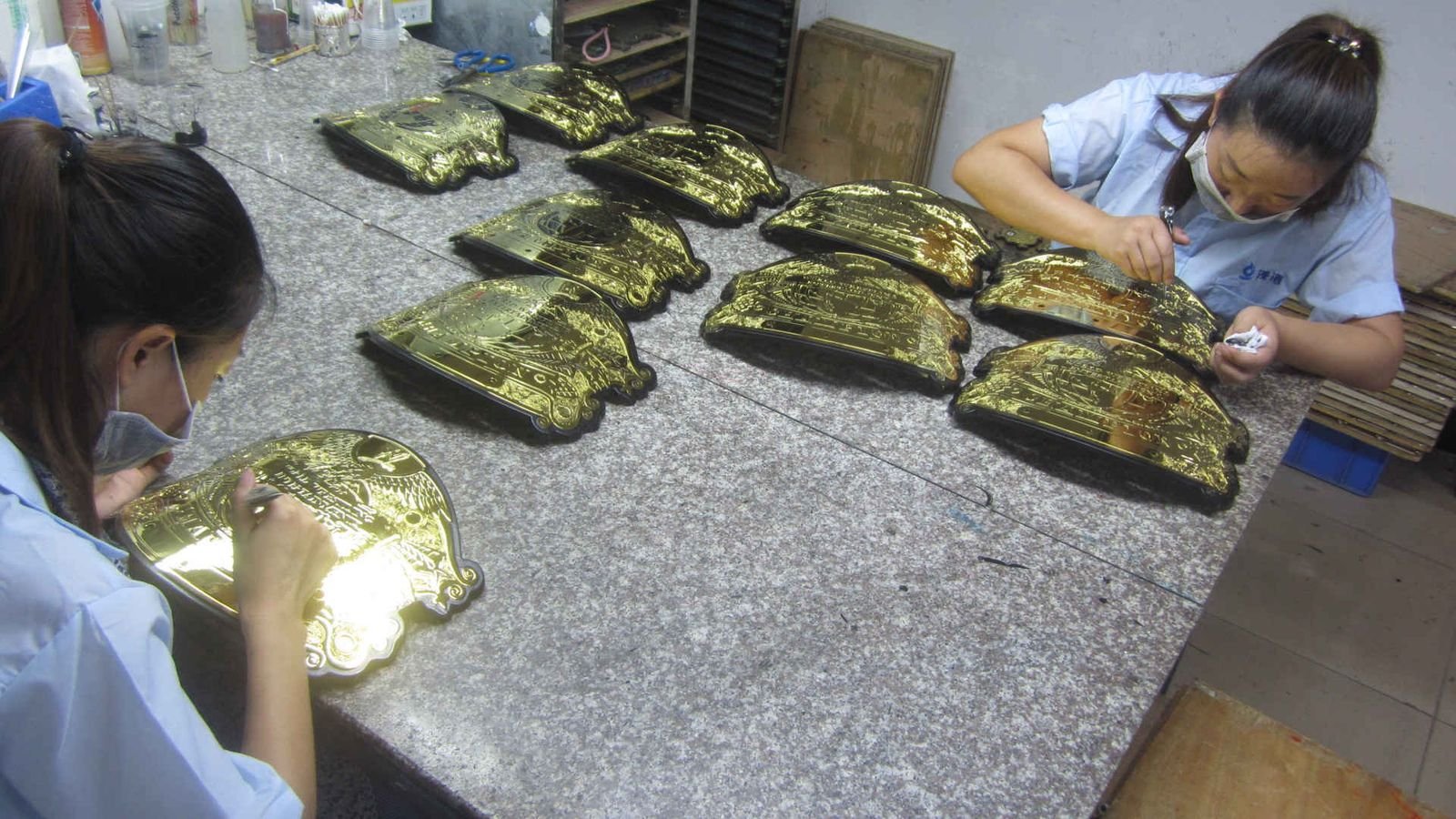
On the material side, the main body is zinc alloy, with stainless steel, brass and bronze, and iron also available. Plating options include gold, silver, rose gold, antique brass, antique silver, antique copper, black nickel and dual tone. Logo processes include laser engraving, screen printing, embossing, debossing, moulded logo and enamel colour fill. Each of these has a different tolerance story, and each one belongs in the description under section 13. The factory runs a 9,600 square metre plant with more than 200 employees and a daily capacity of 30,000 pieces, and finished goods can be checked against the retained sample on the inspection line before packing. Where the contract requires alloy verification, the spectrometer used for composition testing gives a measurement rather than an opinion, which is exactly what a buyer needs when the burden of proof sits on their side.
The practical point is that an importer who wants the strongest position on a claim should build the evidence trail before the goods ship, not after. Request a photographed inspection against the retained sample. Request composition verification where the specification calls for it. Agree the colour reference and the measurement method in advance. Ask for the sample to be sealed and returned with the goods. Each of these is cheap at order stage and effectively impossible after a container has been distributed to customers. The AQL inspection guide for metal souvenirs covers how sample sizes and accept numbers are set for that inspection, and the factory quality control process describes what is checked before shipment.

Common Failure Patterns and Their Contract Fix
Four patterns account for most of the disputes in this category, and each one has a clause-level fix.
The approval that was never documented. A buyer approves a photo of a sample, or approves verbally on a call, and later disputes the colour. Because section 15(2)(c) only protects against defects that would not be apparent on reasonable examination of the sample, and because the buyer holds the burden of proof, an undocumented approval weakens the claim badly. Fix: name the sample in the agreement, require the buyer to confirm approval in writing against a numbered reference, and require the sample to be retained by the buyer.
The inspection that started too late. Goods arrive, sit in a warehouse through the peak season, and are reviewed in January. Section 35(4) and (5) make the reasonable time question turn on whether the buyer had a reasonable opportunity to examine the goods. Fix: a fixed number of days from delivery, a requirement that goods remain unwrapped and segregated, and an express statement that acceptance is not deemed until the inspection period closes.
The notice that was oral. A buyer phones the factory to complain, then waits two months for the email. Under UCC 2-607(3) the buyer must notify the seller of breach within a reasonable time or be barred from any remedy, and section 2-607(5) requires written notice where third-party litigation is involved. Fix: require written notice to a named contact, list the defects, and set a calendar deadline. Agree the same point in the contract so the buyer’s notice period is a contractual term rather than an argument about the statutory default.
The remedy clause that over-reached. A buyer writes that the seller’s only obligation is replacement, then discovers the defect cannot be remedied by replacement because the plating bath itself is off. Section 2-719(2) provides that where circumstances cause an exclusive or limited remedy to fail of its essential purpose, remedy may be had as provided in the Act. Fix: build the failure-of-essential-purpose carve-out into the clause from the start, and add a second-tier remedy such as refund or price reduction.
Two further patterns are worth noting for importers specifically. Retaining goods without rejecting them after a reasonable time is deemed acceptance under section 35(4), and section 35(7) means accepting part of a commercial unit accepts the whole. And because a request for repair does not itself constitute acceptance under section 35(6)(a), the repair request should always be written down and should not be accompanied by language that accepts the goods. A record of what was agreed at order stage also protects the factory: the B2B RFQ template for custom metal gifts shows the specification detail worth fixing before a contract is signed, and the HS code and Incoterms import guide covers the delivery terms that belong in the same document.
Clause Risk Allocation Reference Table
The table below maps each contract clause to the risk it controls, the loss if it is missing, and the rule that fills the gap when you have not written the clause yourself. It is the summary to take into the negotiation.
| Clause | Risk controlled | If omitted | Default rule |
|---|---|---|---|
| Goods description | Whether the delivered goods are the goods ordered | Dispute over whether plating tone and colour count as the same | SGA 1979 s.13 correspondence with description, a condition in England, Wales and Northern Ireland |
| Approved sample | Defects visible only in the bulk | Loses the s.15 route for defects invisible in the sample | SGA 1979 s.15, bulk must correspond with sample in quality |
| Particular purpose | Fitness for the actual end use | Only general satisfactory quality applies | SGA 1979 s.14(3) fitness for particular purpose, a condition in England, Wales and Northern Ireland |
| Inspection period | Whether acceptance has been deemed | Argument over what counts as a reasonable time | SGA 1979 s.35(2), (4) and (5) |
| Written notice period | Whether the remedy survives at all | Risk of being barred entirely under UCC 2-607(3) | UCC 2-607(3)(a) reasonable time after discovery |
| Evidence method | Whether the buyer can discharge the burden | Oral opinion loses to a documented production record | UCC 2-607(4) burden on the buyer to establish breach |
| Remedies and cap | What recovery is available and how much | Full statutory measure applies, including lost profit on commercial loss | UCC 2-719(1) and (3), subject to the failure of essential purpose in 2-719(2) |
| Commercial unit status | Whether partial acceptance accepts the set | Partial acceptance may take the whole set | SGA 1979 s.35(7) commercial unit deemed acceptance |
| Incoterm and named place | Who carries risk in transit and which insurance applies | Unallocated transit risk and a possible insurance gap | ICC Incoterms 2020 allocation of cost, risk and obligations |
| Non-conformity definition | What counts as a defect at all | Every shipment becomes arguable | SGA 1979 s.14(2A) reasonable person standard, plus s.14(2B) aspects of quality |
Two closing notes. First, this article describes the general framework, not advice on a specific transaction. The law that applies to your order depends on the governing law clause, the forum, and where the buyer is established, and a well-drafted agreement should name all three. Second, if the contract is silent on a point, the statute fills the gap and the gap is rarely in your favour, which is the practical reason to write it out. Where a clause is not worth the negotiation time, at least write the inspection period, the written notice period and the description of the goods, because those three carry the most weight in the shortest time.
For specific quotations on tooling, plating, sampling and production scheduling for a particular souvenir programme, contact Kingtop Metal Product at sales@kingtopgift.com, with the artwork, quantity and required delivery date in the first message. Specifications, minimum order quantities and prices for a given design are confirmed per order and quoted individually.