
A custom medal is one of the few promotional products where the buyer is not choosing between suppliers at the same price. The artwork is sculpted, the relief is machined into a die, and the piece is finished by hand or in a plating bath. Two factories can both quote “a 50 mm gold medal” and deliver products that fail in completely different ways: one that reads as a pressed token with flat artwork and a soft rim, the other that reads as an award with legible relief, a clean parting line and a finish that survives handling.
The question that separates a good medal order from a bad one is not “how much does it cost” but “how many independent decisions does the specification contain”. A specification that resolves relief depth, base thickness, the finishing sequence and the attachment method produces a comparable quote. A specification that says “gold medal, 50 mm, our logo” produces a price that nobody can defend.
This guide is written for the people who specify medals: sports event organisers running a season of races, schools and academies ordering academic badges, associations issuing member recognition, and brands running a corporate award or loyalty programme. It follows the order through the stages that actually decide the outcome, from the point where a relief level is chosen to the point where the finished piece is inspected against a reference sample.
Everything written here describes verified production facts and published standards. Where a number is quoted, it comes from the standard or official source cited alongside it. Where a decision depends on your specific product, your artwork and your quotation, this guide says so rather than filling the gap with an estimate.

Relief level is the first decision, and it sets every constraint that follows
A medal’s relief level describes how far the design stands off the base metal. It is not a decorative preference; it determines which manufacturing process can produce the piece at all, and how much metal has to be removed later to make the face flat enough to carry colour.
| Relief level | What the buyer sees | Tooling implication |
|---|---|---|
| Flat or stamped | Design pressed into the surface as a shallow, single-plane form | Press tool rather than a die-cast cavity; the least demanding tooling |
| Partially raised | Design stands proud of the surface without reaching the rim height | Die-cast with a shallower cavity; a middle route between stamping and full relief |
| Full relief | Design is fully modelled and rises to the level of the rim | Deep cavity die; the most demanding tool and the longest route to a repeatable finish |
Three practical consequences follow from this choice, and they are worth understanding before any artwork is drawn.
First, base thickness is a consequence, not a free parameter. A face carrying deep relief needs a thicker blank underneath it; the material has to exist for the raised areas to be supported. A buyer who fixes the diameter and the relief depth, and leaves thickness to the factory, gets a thicker part than they budgeted for. A buyer who fixes thickness and then asks for relief the thickness cannot carry gets a redesign after the tool is cut, and the cost of that redesign lands on the schedule.
Second, deep relief changes how colour behaves on the face. When a recessed area is filled with enamel and then ground flat, the grinding removes a measurable amount of the metal that was left standing proud around each colour field. Enamel process comparison for pins, including the approximate percentage of thickness removed during grinding, is covered in our guide to hard enamel and soft enamel. That reference matters here because the same geometry rules apply to a medal face.
Third, edge treatment and the reverse of the medal need to be designed, not defaulted. A medal that is handed out and worn on a lanyard is handled along its rim. The rim that finishes a lapel pin will not necessarily finish a 60 mm award, and a medal that reads as premium from the front can look unfinished from the side.
Material choice is a specification, not a family name
Buyers frequently ask for “zinc alloy” and stop there. Zinc alloy is a family, and the alloy inside the family is what determines castability, weight, how the plating behaves and what the piece can be used for.
ASTM B86-23, the ASTM standard for zinc and zinc-aluminum alloy castings, is the reference specification for this material family. Its Scope section states that the specification covers commercial zinc, zinc-aluminum castings and continuous cast bar stock, and lists eight alloy compositions under their common, traditional, ASTM A and UNS designations: Alloy 3 (Zamak 3, AG 40A, UNS Z33525), Alloy 7 (Zamak 7, AG 40B, Z33527), Alloy 5 (Zamak 5, AC 41A, Z35533), Alloy 2 (Zamak 2, AC 43A, Z35545), ZA-8 (Z35638), ZA-12 (Z35633), ZA-27 (Z35841) and ACuZinc 5 (Z46541). The Scope text of the same document separately summarises the list as seven compositions, so the eight-designation table is the one to work from.
Section 1.2 of that standard tells the buyer which of those alloys are relevant to a die-cast medal: Z33525, Z33527, Z35533 and Z35545 are used primarily in the manufacture of pressure die castings, while the zinc-aluminum alloys Z35638, Z35633 and Z35841 are used in the manufacture of both foundry and pressure die castings, and are also fabricated into continuous cast bar stock used for prototyping and screw machine stock. That last point matters commercially. Continuous cast bar is a legitimate prototyping route, which means a design can be evaluated in near-final material before a production tool is committed to.
Two other material families appear regularly in medal programmes, and each carries a different implication:
- Brass and bronze. A copper-based base with a warmer colour that deepens under antique finishes, heavier in the hand, and generally quoted for premium coins, service medals and recognition awards.
- Stainless steel. A bright steel base suited to flat and shallow-relief forms, lapel pins and academic badges, and to programmes where a bright uncoated metallic look is the intent.
Specify the alloy by designation, not by family name, and ask what the incoming material is verified against. The same factory that quotes a specific alloy and the same factory that quotes “zinc alloy” are quoting different contracts. For our own process verification, alloy composition is checked with a spectrometer in-house, a step you can see described in our metal gifts quality control overview.
Dimensional tolerances: reference a standard instead of guessing
Buyers who write “plus or minus 0.2 mm” into a purchase order are, more often than not, asserting a number that has no relationship to the process. The cleaner approach is to reference a published tolerance standard and let the drawing carry the indicated dimensions.
ISO 8062-3:2023, titled “Geometrical product specifications (GPS) — Dimensional and geometrical tolerances for moulded parts — Part 3: General dimensional and geometrical tolerances and machining allowances for castings using ± tolerances for indicated dimensions”, is the standard written for exactly this purpose. Its official catalogue entry states that it specifies general dimensional and geometrical tolerances as well as machining allowance grades for castings using ± tolerances for indicated dimensions as delivered to the purchaser according to ISO/TS 8062-2, and that it is applicable for tolerancing of dimensions and geometry of castings in all cast metals and their alloys produced by various casting manufacturing processes.
Two clauses in the abstract are worth reading before you point to the standard. The document applies to both general dimensional and general geometrical tolerances, referred to in or near the title block of the drawing, unless otherwise specified and where specifically referred to on the drawing by one of the references in Clause 11. And it does not apply to 3D CAD models used without indicated dimensions. That last point is the practical reason your artwork needs a dimensioned drawing rather than a mesh file: the standard operates on indicated dimensions, and a model without them is outside its scope.
The standard also defines its own coverage boundary, which is what makes it usable as a reference in a contract. The dimensional tolerances it covers are tolerances for linear dimensions. The geometrical tolerances it covers are straightness, flatness, roundness, parallelism, perpendicularity, symmetry and coaxiality. It does not cover other position tolerances, angular dimensional tolerances or cylindricity tolerances.
So when you write your tolerance clause, the standard gives you a defensible framework for the linear and the listed geometrical characteristics. For anything outside that list, you need a specific agreement with the factory rather than an assumption that the standard covers it.

The finishing sequence is where medals are won and lost
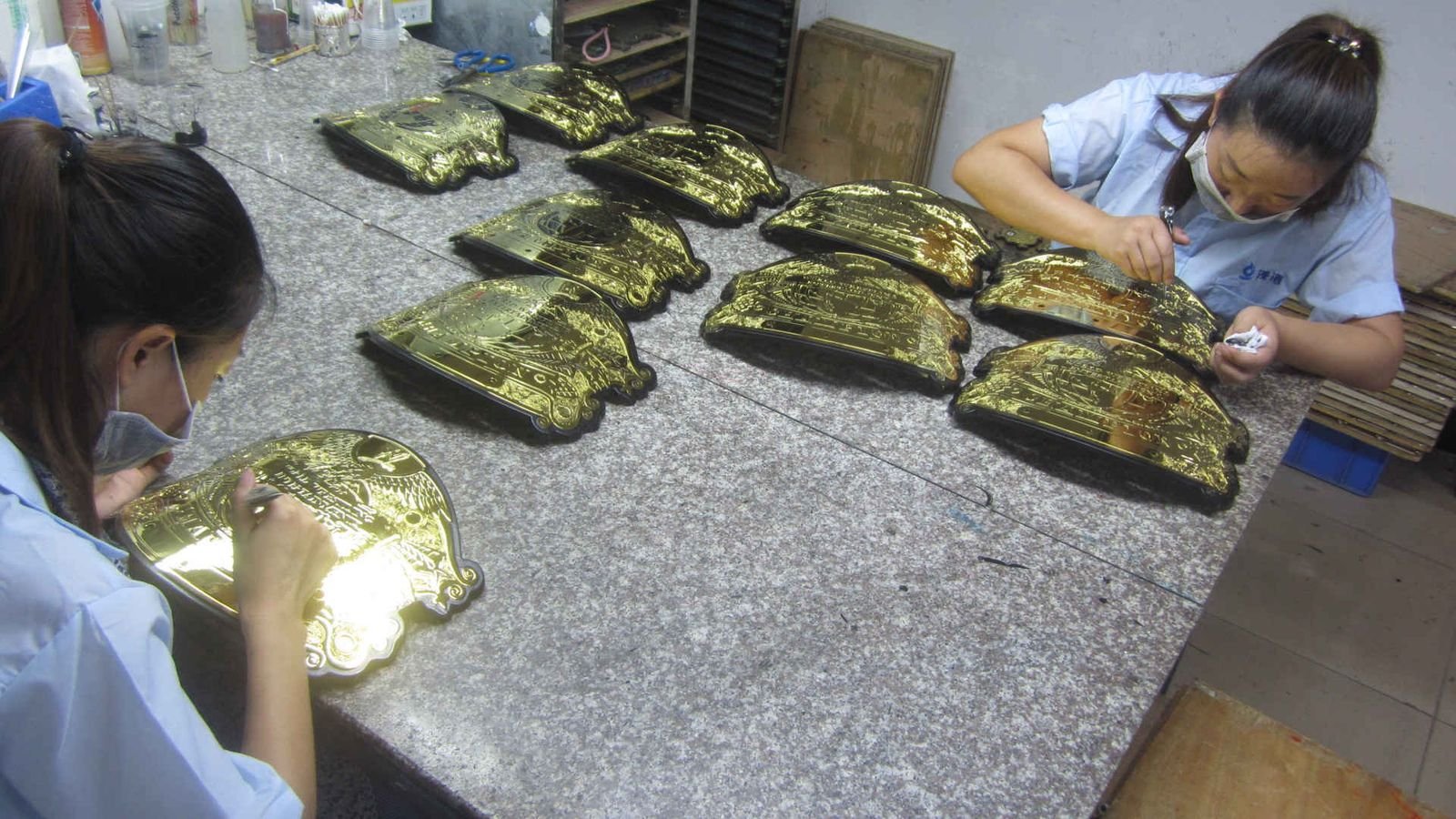
A cast medal is a rough, gate-marked piece with a dull surface. Everything a buyer recognises about a finished medal is added after the casting, and each step can be specified.
The typical sequence runs: cast, remove gate and flash, tumble and deburr, polish, plate or enamel, assemble the attachment, inspect. Two decisions inside that sequence carry disproportionate risk.
Plate thickness and sequence are a plating specification
For a decorative plated medal, the finish is a multi-layer system rather than a single metal. The sequence for bright decorative chromium on a zinc-alloy base typically runs through alkaline cleaning, a thin copper strike, a bright acid copper layer, a semi-bright or bright nickel layer and finally chromium. Each layer has a role: the strike protects the zinc substrate from attack in the copper bath, the copper layer builds thickness, the nickel layer provides the barrier that prevents the copper from showing through, and the chromium is the visible surface.
The point for a buyer is that “gold plated” is not a specification. A quote should say which finish family is being applied and, if the piece is a two-tone or dual-tone design, that a second plating pass is included and priced. A dual-tone medal is two finishes on one piece, and it is a different operation from a single-finish medal, not a colour choice.
Salt spray testing is a defined method with a defined boundary
Buyers often ask how long a gold medal will keep its colour. The honest answer is that no factory can promise a lifespan in years, because the answer depends on wear, sweat, salt and storage. What can be defined is a test method and a duration.
ASTM B117 is the salt spray (fog) test practice that the industry refers to. Its Scope states that the practice covers the apparatus, procedure and conditions required to create and maintain the salt spray (fog) test environment, with suitable apparatus described in Appendix X1. Scope 1.2 sets the boundary that matters for anyone writing a purchase order: the practice does not prescribe the type of test specimen or exposure periods to be used for a specific product, nor the interpretation to be given to the results. Section 1.4 adds that the standard does not purport to address all of the safety concerns associated with its use, and that it is the responsibility of the user to establish appropriate safety and health practices and determine the applicability of regulatory limitations prior to use.
Read together, those clauses mean a salt spray result is evidence about a defined test condition, not a warranty. A quotation that says “passes 48-hour salt spray” is describing a test, not promising a service life. If you need a service-life commitment, that is a coating specification question to settle with your plating supplier, and it should be written down with the test condition attached.
Attachments and edges decide how the medal is actually used
A medal is rarely a standalone object. It is worn on a lanyard, pinned to a shirt, mounted on a trophy, or carried on a ribbon. The attachment method is therefore part of the product, not a hardware detail, and it is one of the most common sources of disappointment in medal orders.
| Attachment | How it is used | Specification point |
|---|---|---|
| Jump ring, split ring or chain | Connects the medal to a lanyard, badge reel or keyring | Ring gauge and the wire diameter, stated in the order |
| Screw or rivet fixing | Permanent fixing for a badge intended for display | Adds an assembly operation and a second material in the tolerance stack |
| Rope edge or reed edge | A textured rim, often used on coin-shaped awards | Adds a finishing operation and changes the side profile |
| Rounded or raised lip | Protects the face and frames the relief | Requires a modified die, so it is a tooling decision |
For lanyard-mounted medals, the single most common failure is not the medal. It is the ring. A ring that is too small for the lanyard hook, or too large for the hole in the medal, produces a medal that swings, turns face-down, or detaches in a pocket. Specify the ring gauge and the attachment hole size, and ask for a sample assembled with the actual lanyard hardware rather than a ring from stock.
Edge treatment deserves the same attention. A rope or reed edge adds a finishing operation and a visible rim; a raised lip protects the face during stacking and transport, but requires a modified die. Both change the tool, and both change the price. They are worth deciding at the specification stage, not after the first sample arrives.
Colour and enamel processes on a medal face
Medals and badges that carry colour use the same two processes as enamel pins, and the choice is governed by the same variables: line width in the artwork, number of colours, and the surface you want at the end.
Our comparison of hard and soft enamel sets out the sequences in detail. In brief, hard enamel is filled and fired at high temperature, then ground flat for a glass-like surface; soft enamel is plated first, filled second and cured gently, leaving a textured surface with recessed colour below the raised metal lines. The practical constraint is the minimum metal line width the artwork can carry, and the firing temperature the process can tolerate. Where a medal also carries a plating finish underneath the colour, the sequence has to be compatible, which is a question for the factory rather than the designer.
For our production line, colour filling and firing are visible stages rather than abstractions. You can see the automatic enamel colouring machine and the enamel colour filling detail on our custom medals and badges capability pages, alongside finished examples.
What a compliance file for a medal actually contains
Medals land in markets under different rules depending on who they are for and how they are worn. A school badge worn by children, a medal worn against the skin, and a trophy piece displayed on a shelf are three different products under three different regimes. This section covers the ones that come up most often in buyer questionnaires.
Nickel release for anything worn against the skin
Directive 94/27/EC, which amended Directive 76/769/EEC for the twelfth time, restricts the marketing and use of certain dangerous substances. Its recital identifies the reason: the presence of nickel in certain objects coming into direct and prolonged contact with the skin may cause sensitisation of humans to nickel and may lead to allergic reactions.
The Annex entry on nickel, CAS 7440-0-20, EINECS 2311114, is the operative text. For products intended to come into direct and prolonged contact with the skin, the Annex lists items including rivet buttons, tighteners, rivets, zippers and metal marks, and sets a limit on the rate of nickel release from the parts of these products coming into direct and prolonged contact with the skin of 0,5 µg/cm²/week. A second clause covers non-nickel coatings: products listed in that point which have a non-nickel coating are permitted only where the coating is sufficient to ensure that the nickel release rate will not exceed 0,5 µg/cm²/week for a period of at least two years of normal use of the product. The Annex closes by stating that products subject to those points may not be placed on the market unless they conform to the requirements set out in them.
For a medal programme this translates into a practical question: if the piece has a rivet, a clasp or a mark that touches skin, does the specification identify a compliant finish, and does the supplier commit to the release rate rather than to a vague phrase like “nickel free”?
The General Product Safety Regulation and the documentation behind a medal
Regulation (EU) 2023/988, the General Product Safety Regulation, applies to consumer products placed on the EU market. Its obligations on manufacturers are the part that changes what a buyer has to ask for. Article 9 requires manufacturers to ensure that products have been designed and manufactured in accordance with the general safety requirement, to carry out an internal risk analysis before placing products on the market, and to draw up technical documentation containing at least a general description of the product and its essential characteristics relevant for assessing its safety. Where appropriate with regard to possible risks, that documentation must also contain an analysis of the possible risks and the solutions adopted to eliminate or mitigate them, including the outcome of any reports related to tests conducted by the manufacturer or by another party on their behalf, and the list of relevant European standards applied to meet the general safety requirement. Where standards have only been partly applied, the manufacturer must identify the parts which have been applied.
The same article requires manufacturers to keep the technical documentation up to date and to keep it at the disposal of market surveillance authorities for 10 years after the product has been placed on the market. Products must bear a type, batch or serial number, or other element enabling identification, which is easily visible and legible for consumers, or, where the size or nature of the product does not allow it, the information must be provided on the packaging or in an accompanying document. Manufacturers must indicate their name, registered trade name or registered trade mark, postal and electronic address, and must ensure the product is accompanied by clear instructions and safety information in a language easily understood by consumers in the Member State where it is made available on the market.
For a buyer, this gives a concrete document request. The medal supplier should be able to show you a technical file for the medal that contains the risk analysis, the applicable standards list and the batch identification scheme. For a series product, the same file should also show that procedures are in place to keep series production in conformity.
If the medal is intended for children, the toy safety regime applies instead. The European Commission’s page on harmonised standards for toy safety explains that since 1 December 2018 the references to harmonised standards are published in, and withdrawn from, the Official Journal of the European Union by means of Commission implementing decisions, and identifies Decision (EU) 2023/740 of 4 April 2023 as the base decision, together with later amendments. The specific standards that apply depend on the product and the market, so this needs to be established per order rather than assumed.
Den school and academic badges product page shows the badge formats that schools and academies order most often, and is a useful reference when you are deciding what an award set for students should contain.
Sample approval: what each stage can and cannot prove
Medal orders usually move through several sample stages, and buyers frequently treat them as interchangeable. They are not. Each stage answers a different question, and treating a digital render as proof of a finish is a common and expensive mistake.
| Stage | What it settles | What it cannot settle |
|---|---|---|
| Model or render | Whether the artwork reads correctly and can be released from a mould | Anything about the cast surface, colour or weight |
| Cast sample | Whether the form fills, releases and feels right at selling size | Plating, colour or assembly |
| Finished sample | Colour, finish, logo process and assembly | Consistency across the production batch |
| Pre-production sample | That the assembled, packed unit matches the approved reference | The production batch itself |
When the pre-production sample is approved, three things should happen on the same day: the approved sample is retained as the golden sample reference, a defect classification is agreed, and the AQL acceptance clause is written into the purchase order with the inspection point defined. Our AQL inspection guide for metal souvenirs covers the sampling mechanics, including the ISO 2859-1 tables and switching rules, so the clause you write can be applied by an inspector without interpretation.
The golden sample is the part buyers under-use. A physical reference unit, signed and retained by both parties, resolves arguments about colour and finish far faster than a specification paragraph, because it is the actual object that was approved. Keep it in a bag, keep it away from the production floor, and use it at the pre-shipment inspection.

MOQ, tooling and the cost structure of a medal order
Quantity, not complexity, is the single largest driver of the unit price on a medal order. But the tooling route interacts with quantity in a way buyers should plan for rather than discover at quotation.
The general structure across our metal gift programme runs across three bands: MOQ tiers at 100, 500 and 1000 pieces, with sampling at 7 days and production at 15 to 20 days, shipping by express, air or sea, and a 9,600 m² plant with over 200 staff and daily capacity of 30,000 pieces. The mechanics of what those bands mean for a buyer are set out in our MOQ explainer.
For medals specifically, the tooling decision is binary and consequential. A new die for a new shape is a one-time tooling fee, quoted per design, and it moves the order into the higher quantity band where the tool is amortised across the run. Using an existing shape with your own logo keeps the order in a lower band. Which route is right depends on whether the shape itself is the message. For a one-off event medal where the event name and year carry the meaning, an existing shape with custom artwork is often sufficient and keeps the order accessible. For a medal that is itself the product, a new tool with volume behind it is the route that makes sense.
Two cost items that are regularly omitted from a first quotation and then appear as variations are worth pricing explicitly from the start. A dual-tone finish adds a second plating pass, and a rope or reed edge adds a finishing operation. Both are decisions, and both are cheaper to decide early.
Questions to ask a medal manufacturer before you order
The questions below are the ones that most often reveal that two quotes are not comparable, because they are answering different questions.
- Which alloy designation is the quote based on, and what is the incoming material verified against?
- Is the die new for this order, and is the tooling fee quoted separately from the unit price?
- Which tolerance standard does the drawing reference, and which dimensions carry an indicated tolerance?
- How many plating passes are included, and is a dual-tone finish priced as a second pass?
- Is the enamel process hard or soft, and what is the minimum metal line width in the artwork?
- What ring, clasp or fixing is fitted, and is the sample assembled with our actual lanyard hardware?
- What is the edge treatment, and does it require a modified die?
- Which test reports can be provided, and on which components were they produced?
- Is there a technical documentation file for this product, and can it be produced on request?
- Who retains ownership of the die, and what happens to it at the end of the order?
The last question is worth raising earlier than buyers usually do. Tool ownership is a contract term, not a footnote. Our custom metal keychain manufacturing guide covers the same contractual ground for a related product format, including how to put tooling ownership and inspection rights into writing rather than leaving them to custom practice.
Procurement acceptance checklist for a custom medal order
The table below is the closing checklist for this guide. Each row is a question whose answer should exist in writing before the order is released to production, and each points to the evidence that settles it.
| Check item | What a satisfactory answer contains | Evidence that settles it |
|---|---|---|
| Relief level and base thickness | A named relief level with the thickness that supports it | Dimensioned drawing with indicated tolerances |
| Alloy designation | The specific alloy and the reference specification | Material verification record against the alloy specification |
| Tolerance framework | A named tolerance standard applied to the drawing | Drawing reference to the standard, with Clause 11 references where used |
| Finish sequence | Plating family, number of passes and any dual-tone second pass | Written finish specification with the approved sample as reference |
| Salt spray condition | Test method and duration quoted as a test, not a service life | Test report tied to the batch |
| Enamel process and artwork limits | Process named and minimum line width stated | Artwork checked against the stated limit before tooling |
| Attachment and ring gauge | Ring gauge, wire diameter and attachment hole size | Assembled sample using the actual lanyard hardware |
| Edge treatment | Rim treatment named and its tooling consequence stated | Modified die confirmation where applicable |
| Skin-contact compliance | Whether the piece contacts skin and, if so, the nickel release commitment | Test report against the release rate limit for the affected parts |
| Technical documentation | A documentation file with risk analysis and standards list | File produced on request, with 10-year retention confirmed |
| Batch identification | A visible type, batch or serial number, or packaging-level identification | Marked sample and packaging artwork |
| Sample reference | A retained golden sample, agreed defect classification and an AQL clause | Signed sample record and the purchase order clause |
| Tool ownership | Who owns the die and on what terms it is released | Written clause in the purchase order |
A medal order that arrives with these thirteen rows answered is an order that can be produced twice, inspected by a third party and defended by both sides. That is the standard this guide is written against: not the lowest quotation, but the one where every decision that changes the outcome is written down before the die is cut.
To talk through a specific medal programme — the artwork you have, the quantity you need, the market you are shipping into — send the artwork and the quantity to our manufacturing team at the custom metal souvenirs contact page, or email sales@kingtopgift.com. We will come back with the specification questions that your design leaves open, and a quote that separates tooling, per-unit cost and finishing so you can see where the money goes.