
A metal keychain is not a shape with a hole in it. It is a die-cast body, a plated surface, a stamped or moulded logo, and a mechanical attachment that has to survive being pulled, twisted and dropped on a bag for years. Buyers who treat the order as “give us this 3D file and a logo” end up paying twice: once for the metal and tooling, and again for a second production run after the attachment fails in the field. The purpose of this guide is to walk through how a custom metal keychain actually moves from a file to an approved sample to a repeatable order, and to identify the specific points where a purchase order has to be precise enough to prevent the second run.
The four things that cause a metal keychain order to be made twice are a changed file, an unspecified attachment, an approval that did not name what was approved, and a sample that was only looked at rather than tested. All four are closed before production starts, at the cost of a conversation. All four are open after production starts, at the cost of a shipment.
The factory facts referenced throughout are the confirmed Kingtop production facts: zinc alloy is the main material, with stainless steel, brass and bronze, and iron available as alternative material families; confirmed finishes include gold, silver, rose gold, antique brass, antique silver, antique copper, black nickel and dual tone; confirmed logo methods are laser engraving, screen printing, embossing, debossing, moulded logo and enamel colour fill; MOQ runs at three tiers of 100, 500 and 1,000 pieces; sampling takes 7 days and mass production 15–20 days; the factory covers 9,600 square metres with over 200 staff and daily capacity of 30,000 pieces. Anything beyond these facts — a specific alloy grade, a plating thickness, a price, or a lead time for a particular attachment — has to come from the product page or a quotation for the exact item.

What actually happens between the 3D file and the first sample
The manufacturing route for a custom metal keychain is not mysterious to a factory, but it is not a single step either, and buyers who compress it into one step create ambiguity at every stage. The route runs: file review and manufacturability feedback, tooling or pattern making, casting, finishing, logo application, assembly of the attachment, and then a sample that has to be approved before production. Each stage has its own acceptance criteria, and each stage can produce a different version of the product if the criteria are not written down.
File review comes first. A factory will look at the 3D file and tell you what it would change, and the list of changes is where most of the value of talking to a manufacturer actually sits. A 0.4 mm wall in a draft angle that is too shallow will not fill. A detail that is 0.2 mm above the parting line will flash or be cut off. A logo that sits in a flat area with no draft is a logo that will have to be engraved after plating rather than moulded in, which changes both the cost and the appearance. Undercuts, thin gaps between prongs, and small enclosed holes are all things that a die caster will flag in days and that a buyer will normally not see until the sample. The question to ask a factory is not “can you make this” but “what would you change about this file, and why”.
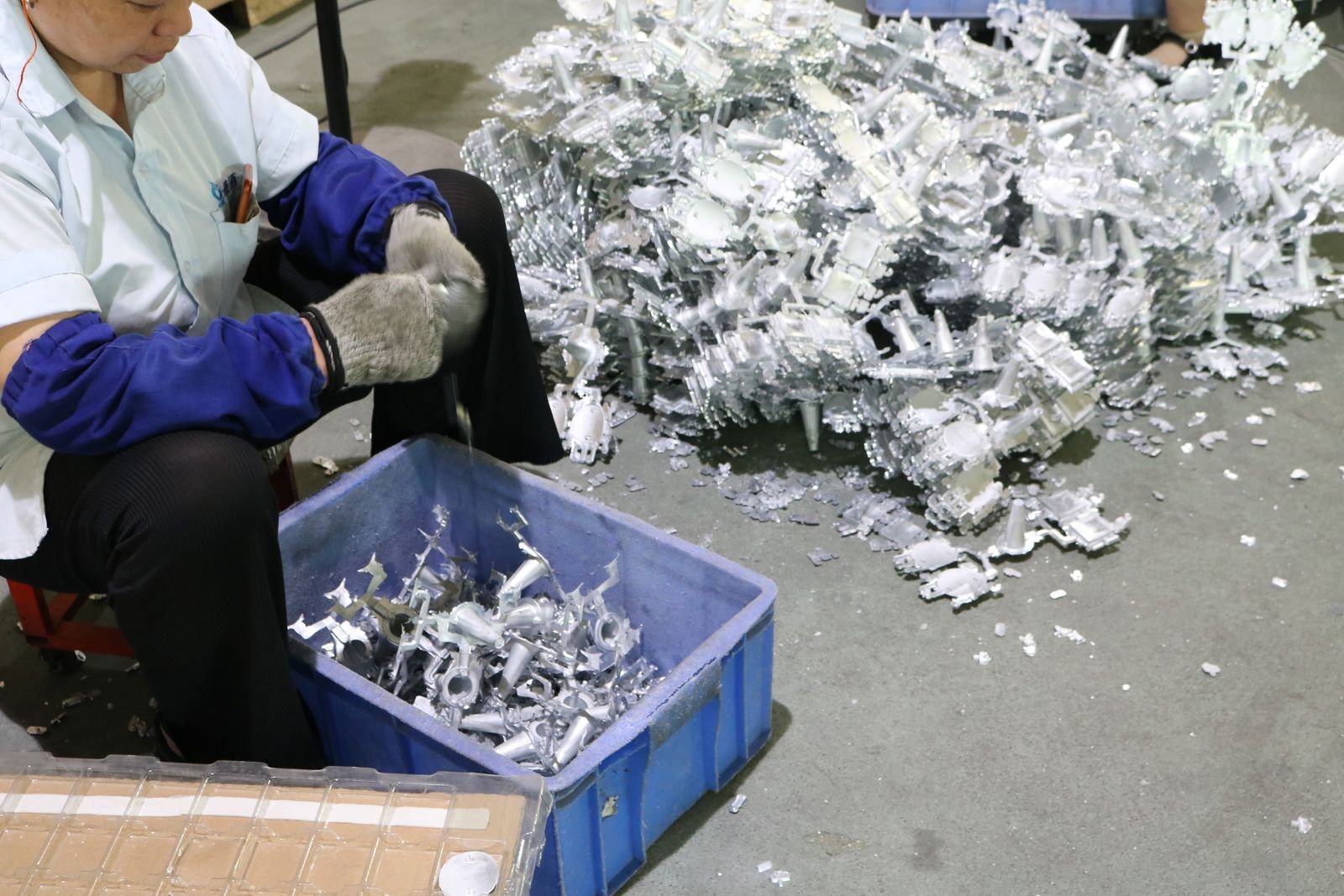
Tooling and casting follow. Zinc alloy keychain bodies are die cast, which means a steel die has to be cut for the shape. The die is what makes the cost per piece fall as the quantity rises, which is why the three MOQ tiers at Kingtop — 100, 500 and 1,000 pieces — sit on a curve that reflects tooling amortisation rather than a flat unit price. Stainless steel parts are commonly machined rather than cast, and brass and bronze parts can go either way depending on the shape and the finish. This is the practical reason a factory will ask about quantity before it answers questions about tooling: the same file is a different manufacturing route at 100 pieces and at 10,000 pieces.
The material choice interacts with the finish in a way that buyers regularly underestimate. Zinc alloy takes a plating layer cleanly and reproduces fine detail, which is why it dominates promotional metal gifts, but it is a zinc-based alloy and is not the same thing as stainless steel. Where a keychain will be carried against skin, or where the buyer wants a corrosion-resistant product for a marine or outdoor use, the material decision changes and so does the finishing route. The material families and finishes the factory actually runs are worth confirming before a file is submitted rather than after.
Why the attachment is the part that decides whether the product survives
If you have seen a keychain come apart, the metal body was almost never the failure point. It was the ring, the split ring, the chain, the clasp or the connector between the charm and the body. The attachment is a separate purchased part that arrives on its own lead time, it is the most common source of a shipping delay, and it is the part that the buyer most often leaves unspecified — which means the factory picks a reasonable one and the buyer discovers it at the inspection stage.
There are three decisions to make, and all three need to be on the purchase order rather than in an email. The first is the attachment type: split ring, jump ring, chain, lobster clasp, screw eye, or a custom connector. The second is the material of the attachment, which does not have to match the body — a plated steel ring on a zinc alloy body is normal, and specifying the ring as a separate line item with its own material makes it possible to price and to replace. The third is the dimension, and here the relevant constraint is not the nominal size but the clearance between the attachment and the body. An attachment that is slightly too tight will not pass through the moulded eye; one that is slightly too loose will rattle and will let the charm turn over in a display case.
For a buyer, the useful move is to specify the attachment the way you would specify the body: with a type, a material, a size and a quantity that matches the order. Where the attachment is meant to carry the charm on a handbag rather than on a key ring, the load path is different and the choice should reflect that, and it becomes a fashion accessory hardware question rather than a keychain one.
Logo application changes the tooling, not just the artwork
Kingtop runs six confirmed logo methods: laser engraving, screen printing, embossing, debossing, moulded logo and enamel colour fill. These are not six cosmetic options sitting on top of an unchanged part. Each one implies a different tooling decision, and some of them are only available if the geometry was designed for them from the start.
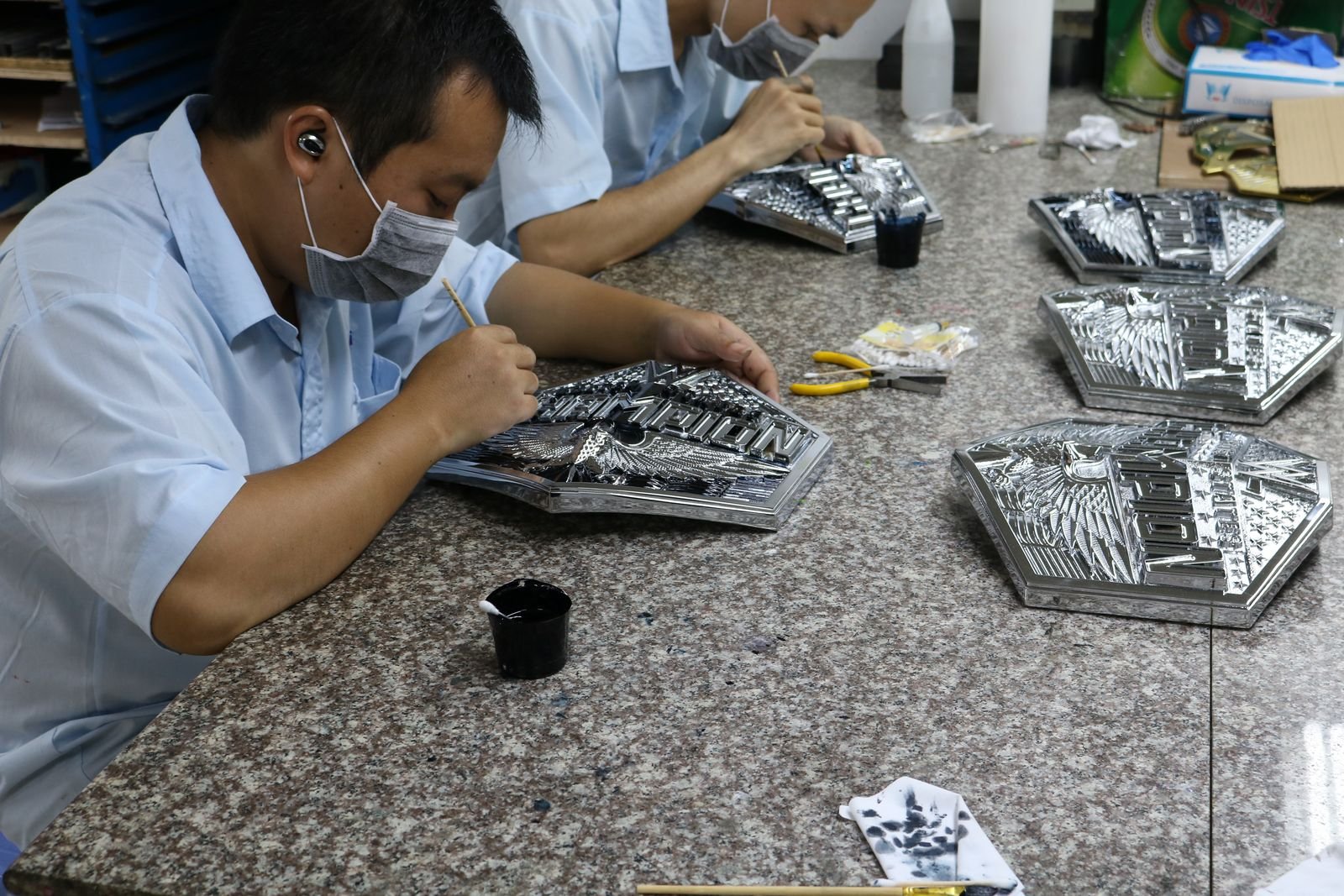
Moulded logo means the logo is part of the casting, so the file has to carry the logo as a feature with draft and adequate depth, and the die has to be cut around it. This gives the most durable result because the logo cannot be abraded off a plated surface, but it is the most demanding on the file and the least forgiving if the logo has fine internal detail. Laser engraving works on the finished plated surface and is the most flexible in terms of the artwork, but the depth of the mark and the finish quality around it depend on the plating, and the logo reads as an engraved line rather than a raised one. Screen printing puts ink on the surface and is the right answer when the logo is multi-colour, but it introduces the question of adhesion and of abrasion over the life of the product. Embossing and debossing push the surface up or down and need flat area to work on. Enamel colour fill puts colour into a recessed area and is what makes the multi-colour souvenir-style charm possible on a metal body.
The buyer-facing consequence is straightforward: the logo method is chosen at the same time as the geometry, not after it. If the artwork arrives as a flat image and the file arrives without a defined logo feature, the factory has to choose, and the choice may not be the one the buyer wanted. The keychain type reference is useful for the shape side of this decision, and the plating options article covers the finish side; the manufacturing sequence is what ties them together.
Finishing, and why a plating sample is not the same as a production sample
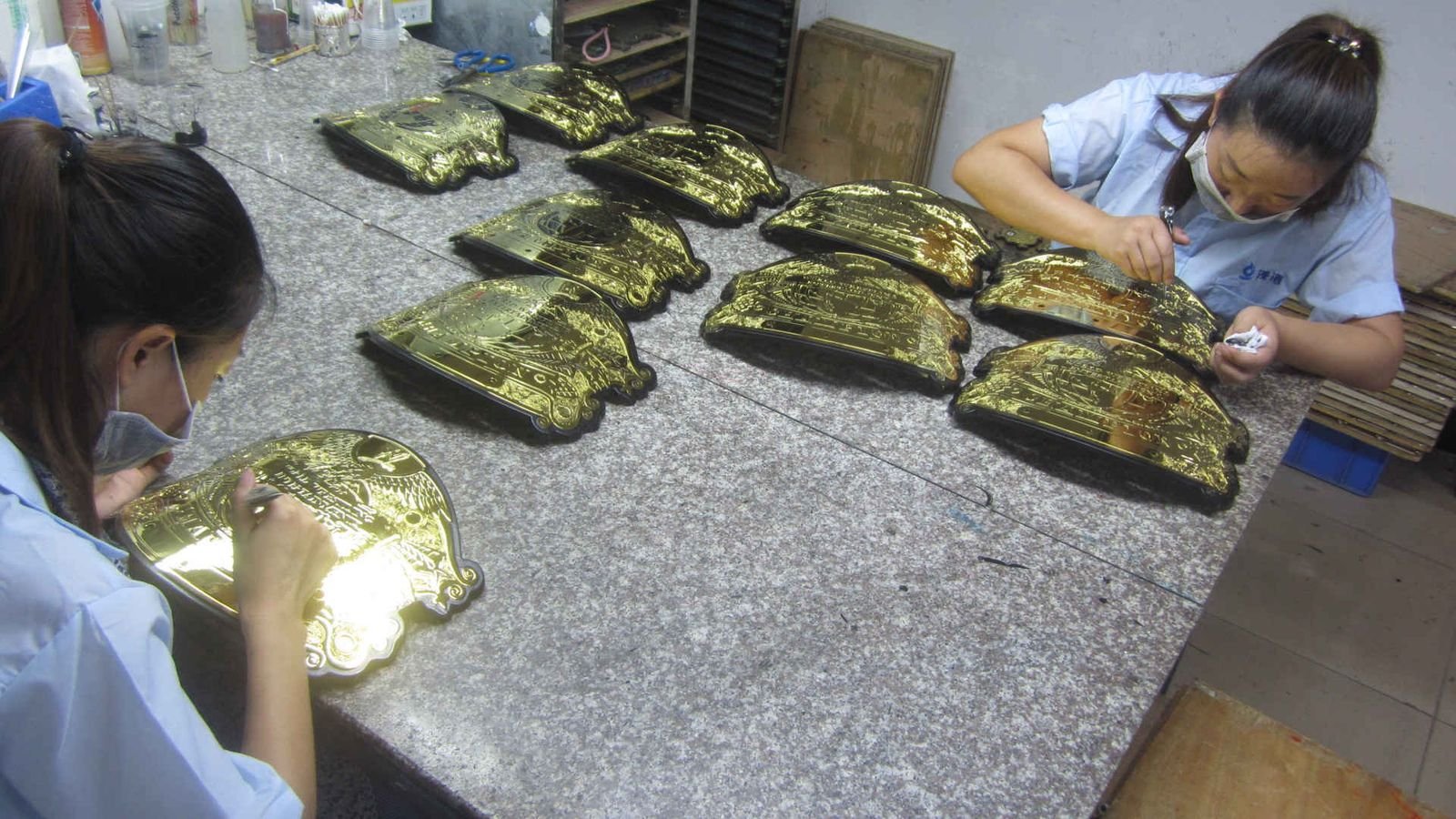
Finishing is the stage where the visual approval happens, and it is also the stage where approvals most often go wrong. A plating sample that is approved from a single piece, under one lighting condition, in one colour, is an approval of that piece. Production parts can differ from it in shade and in gloss level, because plating baths change with use, because the base alloy and the pre-treatment are consistent but the result drifts, and because the lighting in the buyer’s office is not the lighting in the shop.
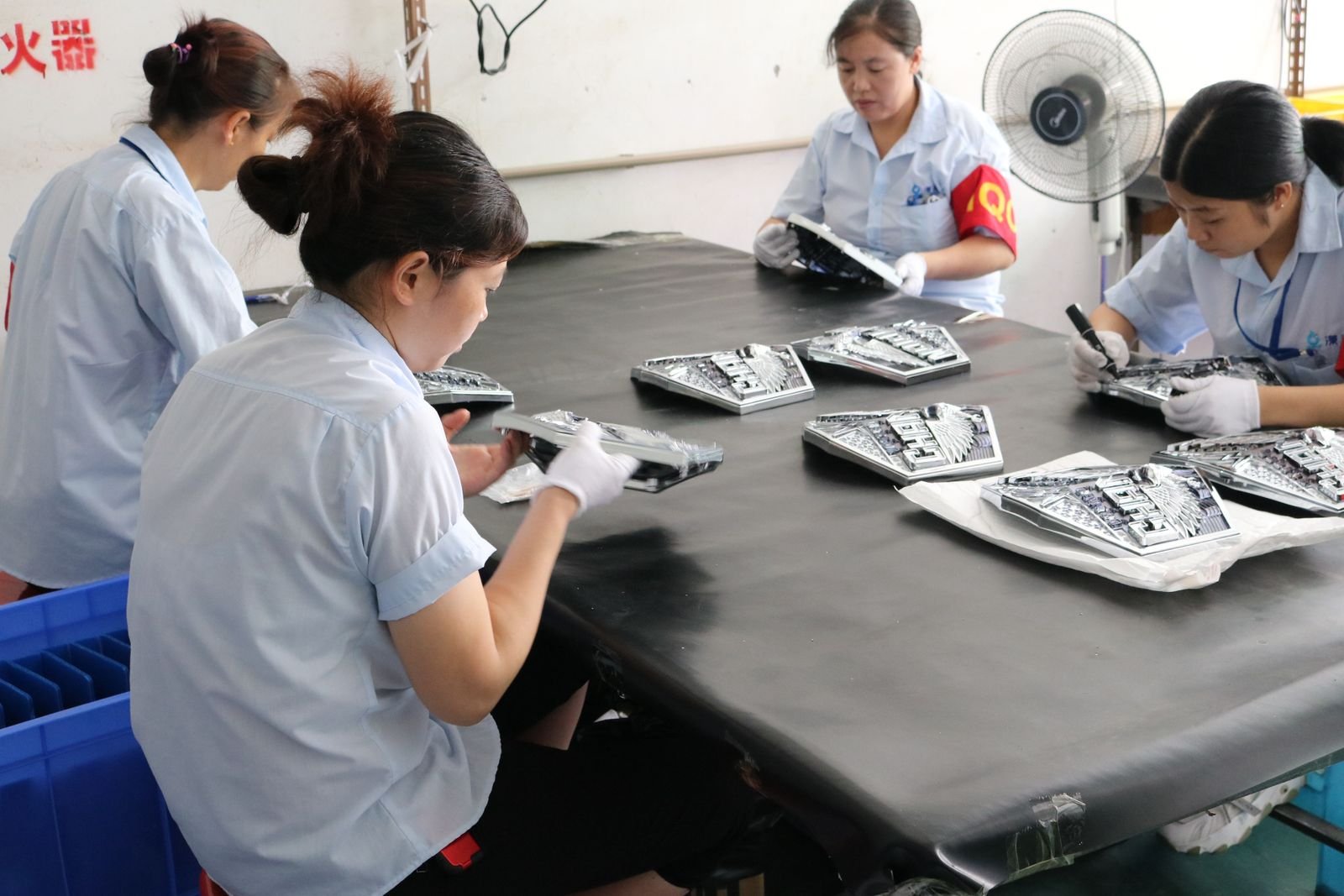
Kingtop’s confirmed finish list — gold, silver, rose gold, antique brass, antique silver, antique copper, black nickel and dual tone — is a set of routes, each with its own behaviour. Antique finishes are deliberately not uniform in a way that a bright plating is; they are meant to carry a slightly varied tone that reads as aged. Dual tone puts two finishes on one body, usually to separate the charm from the plate or the ring from the shape. The inspection step exists for this reason: the plating inspection bench is where a worker compares plated parts against a colour reference tray, and the buyer should expect that process to exist rather than assume it.
Two practical rules follow. First, approve plating against a physical reference rather than against a photograph, and ask for a reference piece to be retained so that a later production run can be compared to it. Second, decide the order of operations — whether the logo is applied before or after plating — because an engraved logo and a filled enamel logo survive a plating line very differently from a screen-printed one. That sequence is part of the manufacturing route and should be on the purchase order, not left to the factory’s default sequence.
The compliance documents a keychain order needs, and the ones it does not
A keychain is a general consumer product, not a toy and not a food contact article, so most of the compliance frameworks that dominate metal gift discussions do not apply to it. That is worth saying plainly, because buyers frequently ask for documents that do not exist for this product category and delay their own order while waiting for them.
What does apply in the European Union. The General Product Safety Regulation is the framework that applies, and the Commission sets out its obligations here: the Commission’s guidance on the General Product Safety Regulation requires that products placed on the market are safe and that the economic operator responsible for them is identifiable. REACH is the chemical framework, and the consolidated regulation is available at Regulation (EC) No 1907/2006 on the registration, evaluation, authorisation and restriction of chemical substances. The restriction that matters most for a metal product that touches skin is nickel, and the EU adopted a specific limit on nickel release in articles intended for direct and prolonged contact with the skin in Directive 94/27/EC. A keychain on a key ring is usually not in direct and prolonged skin contact, but a charm worn on a bracelet or lanyard, or sold for children’s use, can be. Deciding this is a design question with a compliance consequence, and it is cheaper to decide it at the drawing stage than to rework a plated body later.
What applies in the United States. The framework that catches most metal gift products is the lead limit on paint and surface coatings, set out in 16 CFR part 1263 for consumer products and enforced through 16 CFR part 1303. For a zinc alloy keychain the practical control is on any painted or lacquered surface, and it is a question for the factory about what, if anything, is applied beyond the plating itself.
What does not apply. The EU food contact framework for materials in contact with food does not apply to a keychain. The EU toy safety rules apply to products marketed for children under 13, and if a keychain is sold as a children’s product, the toy rules come with them and change the product substantially. Neither should be claimed by a buyer as a compliance requirement for an ordinary promotional keychain, and a factory that produces toy-compliant certificates for standard keychains is either producing something else or issuing something misleading.
Sampling, the approval package, and what “approved” has to mean
Sampling at Kingtop takes 7 days, and mass production takes 15–20 days. Those two numbers are simple, but the failure mode they cause is not about time. It is about what the sample proves. A sample proves the geometry, the finish on one piece, the logo rendering and the assembly of that one configuration. It does not prove the colour consistency of a production run, the durability of the attachment, or the behaviour of the attachment under load.
An approval package that works has to name the specific items being approved. The prototype and sample approval process describes how this is structured at Kingtop, and the point of naming the items is that approval without naming is not approval of anything: approving “the keychain” approves one physical object, whereas approving “the keychain with a 12 mm split ring, gold finish, laser-engraved logo on the reverse face, production colour per the retained reference piece” approves a specification that production can be measured against.
For the attachment specifically, a sample approval should be backed by a functional check rather than a visual one. Does the ring open and close the intended number of times? Does the charm rotate freely or does it jam? Does the connector stay closed? These are things that can be checked at the sample stage in minutes and that are expensive to check at the retail stage. The quality inspection line at Kingtop is where piece-by-piece checks are made, and the quality control guide sets out what an incoming inspection at the buyer’s warehouse should look for — because the factory’s own inspection is not a substitute for the buyer’s, it is the first of the two.
MOQ, tooling, and the cost of getting the quantity wrong
The three MOQ tiers at Kingtop — 100, 500 and 1,000 pieces — exist because the cost structure changes with quantity in a way that a buyer can plan around. Below the first tier the tooling cost per unit is high because it is spread over very few pieces. Between the tiers, the incremental piece gets cheaper. Above the last tier, the unit cost falls further but the working capital, the storage and the shelf-life of a seasonal product all rise. The Richtlijnen voor de minimale bestelhoeveelheid explains the structure in more detail, and the number that matters most for a buyer is not the MOQ itself but the point at which the order is large enough that the tooling is not the dominant cost.
Tooling creates a specific commitment that buyers sometimes underestimate. The die belongs to the shape. If the shape changes — even slightly, even if the change looks cosmetic — the die may need rework or a new die, and that is a separate cost and a separate lead time from the production run. This is the practical argument for freezing the 3D file before the sample is approved rather than after, and for agreeing what constitutes a permissible change after approval. The same applies to the attachment: a change of ring size is a change of purchased part, and it is not always a change of price, because the small ring may be the one that is harder to source at a given quantity.
There is also a freight dimension. Kingtop ships by express, air and sea, and the choice is dictated by the delivery date rather than by the unit cost of the goods, which is a fraction of the delivered cost for a metal gift. A keychain order that misses a season because it went by sea is not a freight saving; and an order of a hundred pieces sent by express costs proportionally more per piece than a thousand. The quantity decision and the shipping decision are one decision.
A checklist that prevents the second production run
The list below is the specification that, when it is complete before the sample is approved, removes most of the reasons a metal keychain order has to be repeated. It is structured as the questions a buyer should be able to answer with a yes or a number.
| # | Item to confirm before sample approval | What “confirmed” means | Where it becomes binding |
|---|---|---|---|
| 1 | 3D file frozen | One file version, marked as the production file, with the date | Purchase order drawing reference |
| 2 | Material family | Zinc alloy, stainless steel, brass/bronze or iron, stated by name | Purchase order line item |
| 3 | Finish and colour reference | One of gold, silver, rose gold, antique brass/silver/copper, black nickel, dual tone, plus the retained physical reference | Purchase order and approval record |
| 4 | Logo method and sequence | One of laser engraving, screen printing, embossing, debossing, moulded logo, enamel colour fill, and whether it is applied before or after plating | Purchase order and artwork sign-off |
| 5 | Attachment type, material and size | Type, material and dimension written as a separate line item, not “as per sample” | Purchase order line item |
| 6 | Sample approved by named items | Geometry, finish, logo rendering and attachment each approved individually | Signed approval record |
| 7 | Attachment function checked | Opening, closing, rotation and retention confirmed on the sample | Approval record checklist |
| 8 | Quantity against MOQ tier | Order quantity sits at 100, 500, 1,000 or above, and the tier used is stated | Purchase order |
| 9 | Production lead time confirmed | 15–20 days from approved sample, with the start point defined | Purchase order delivery terms |
| 10 | Shipping method and deadline | Express, air or sea, with the arrival date calculated backwards from the retail date | Purchase order and shipping instruction |
| 11 | Surface coating position | Any paint or lacquer beyond plating declared, so the applicable coating rules can be checked | Supplier declaration |
| 12 | Skin-contact assessment | Whether the product is intended for direct and prolonged skin contact, stated explicitly | Buyer declaration on the order |
| 13 | Incoming inspection defined | AQL or equivalent sampling level, plus the defect classes that will be rejected | Purchase order quality clause |
| 14 | Packing and labelling | Per-unit packing, carton quantity, carton marking and any barcode or label requirement | Purchase order packing clause |
Items 1, 5, 6 and 7 are the ones that prevent the expensive failure. A changed file, an unspecified attachment, an approval that did not name what was approved, and a sample that was only looked at rather than tested are the four ways a metal keychain order ends up being made twice. The rest of the list is ordinary discipline, but ordinary discipline written down is what separates a reorder from a repeat order.
When the specification is this complete, the conversation with the factory becomes short and concrete: the 3D file, the material, the finish, the logo method, the attachment line, the quantity tier, the delivery date. That is the state a custom metal keychain project should reach before anyone talks about price, and it is the state in which a quote actually means the same thing to both sides. For a starting point on the product range and the finishes that are available, the custom metal keychain category page sets out what the factory runs, and specific construction, MOQ and lead time for a particular item can be confirmed directly at sales@kingtopgift.com.