

A corporate metal gift programme is not a shopping decision. The same object can be a tax-free employee benefit, a taxable gift, a business gift with a deduction limit, or a restricted article depending on who receives it, what it is made of, and which market it lands in. Below is the framework for making those calls before the order is placed: the US rules on fringe benefits and business gifts, the EU nickel release limit that applies to anything worn against skin, and the paperwork that keeps the programme defensible a year later.
One programme, three rulebooks
Most metal gift programmes fail not on the product but on the paperwork around it. The object is chosen, the logo is approved, the shipment arrives, and three separate questions surface. Who is receiving it, and does the tax treatment change because they are an employee rather than a client? What will the recipient do with it, and does it touch skin long enough to trigger a chemical restriction? Can the company prove, a year later, what was bought for whom, at what value, and approved by whom?
Those questions are governed by three different bodies of rules, none of them the rules for buying ordinary promotional merchandise. The tax rules are written for the employer, not for the buyer of the merchandise. The chemical rules are written for the article, not for the programme. The record-keeping expectations come from both, plus from the receiving company’s own procurement file.
Employee gifts: what US tax rules actually say
De minimis is a judgement, not a threshold
Publication 15-B, the employer’s tax guide to fringe benefits, defines a de minimis benefit as any property or service you provide to an employee that has so little value, taking into account how frequently you provide similar benefits, that accounting for it would be unreasonable or impracticable. Two things follow. There is no published dollar figure in the definition, so a programme that assumes a fixed value threshold is reading something into the rule that is not there. And frequency is part of the test, so the same object can sit in a different place depending on how often it is given.
The line the publication draws hardest is cash and cash equivalents. Gift certificates, gift cards, and the use of a charge card or credit card are never excludable as a de minimis benefit, no matter how little the amount. This is the most useful fact for a buyer designing a giveaway programme, because it means the choice between a physical object and a card is not a matter of preference or budget, it is a matter of tax treatment. Objects sit inside a defined exclusion regime; cards sit outside it entirely.
The 2026 edition of Publication 15-B also states that if a benefit does not qualify as de minimis, the entire benefit generally has to be included in the employee’s income, which is why the frequency question belongs at design stage rather than at year end.
Achievement awards have their own regime
Length of service and safety awards are not a sub-category of de minimis. The exclusion applies to the value of tangible personal property given as an award for length of service or safety achievement, and it does not apply to cash, cash equivalents, gift cards, gift coupons or gift certificates, nor to vacations, meals, lodging, tickets, stocks, bonds and other securities. A metal commemorative piece sits inside the exclusion; a gift card for the same value does not.
Publication 15-B sets out three conditions: the award must be given for length of service or safety achievement, it must be awarded as part of a meaningful presentation, and it must be awarded under circumstances that do not create a significant likelihood of disguised pay. That third condition is why a recognition programme should be documented with stated milestones rather than run as discretionary gestures.
The figures are specific. The excludable annual amount is $1,600 for qualified plan awards and $400 for awards that are not qualified plan awards, and the employer’s deduction for awards given to any one employee in the tax year is limited to $400 for non-qualified awards and $1,600 for all awards. A qualified plan award comes from an established written plan or programme that does not favour highly compensated employees, where such an employee was a 5% owner during the year or the preceding year, or received more than $160,000 in pay for the preceding year.
For a manufacturer the translation is straightforward: an award piece has to be physical, presented and documented against a written plan, and specified with the right finish, because an award for a service milestone tends to be worn or handed to a family member, and the chemical rules follow the use rather than the intention.
Business gifts to customers: a different limit and a different reason
Gifts to clients and business contacts are governed by Publication 463. The starting rule is that no more than $25 may be deducted for business gifts given directly or indirectly to each person during the tax year. The distinction is not cosmetic: an employee benefit is about what the recipient keeps, this limit is about what the company can write off.
Two features cause most trouble. The first is the indirect gift rule. A gift to a company intended for the eventual personal use of a particular person, or of a limited class of people, is treated as an indirect gift to that person or to the individuals in that class who receive it, and a gift to a member of a customer’s family is generally an indirect gift to the customer. The publication’s own example: three gift baskets at $80 each given to a company, where three executives took the baskets home, produced a deductible total of $75, because the limit is $25 per recipient and there were three recipients.
The second is incidental costs. Engraving on jewellery, packaging, insuring and mailing are generally not included in determining the cost of a gift for the $25 limit, and a cost counts as incidental only if it does not add substantial value. Gift wrapping is incidental; an ornamental basket bought to package fruit is not, if its value is substantial compared with the fruit. For a metal gift programme this is useful, because laser engraving and screen printing are exactly the kind of cost excluded from the limit.
There is one structural escape from the limit, and it is the reason so many branded giveaway items are bought in volume. An item that costs $4 or less, has your name clearly and permanently imprinted on it, and is one of a number of identical items you widely distribute is not considered a gift for the $25 limit. Publication 463 sets out both exceptions, and they are worth reading together, because an item meeting one condition but not the other does not qualify.
| Type of gift | Recipient | US tax treatment | The figure that governs it | Record the employer keeps |
|---|---|---|---|---|
| Low value tangible gift, occasional | Employee | Excludable as a de minimis benefit if the value is so low and the frequency so occasional that accounting for it would be unreasonable or impracticable | No published dollar figure; frequency and reasonableness are the test | Recipient, date, description, value, and the frequency pattern across the year |
| Length of service or safety award | Employee | Excluded from wages where the award meets the three conditions, including a meaningful presentation and no likelihood of disguised pay | $1,600 qualified plan awards; $400 non-qualified | The written plan, the milestone, the presentation record, and the per-recipient total for the year |
| Business gift | Client or business contact | Deductible up to the limit, with a gift to a company intended for a particular person’s use counted as an indirect gift to that person | $25 per person per year; engraving, packaging, insurance and mailing excluded | Recipient or class of recipients, business purpose, date, value, and any business relationship |
| Promotional item | Any recipient | Not treated as a gift for the $25 limit where it costs $4 or less, carries your name permanently, and is one of many identical items widely distributed | $4 cost ceiling, plus the imprint and wide-distribution conditions | Unit cost, imprint method, quantity distributed and distribution list |
When a corporate gift becomes a taxable transfer
Most programmes stay comfortably inside the rules, because the $25 limit is low and promotional items are excluded outright. The situation changes when a piece is expensive, personalised, and presented to an individual in a way that looks like compensation. The question then shifts from deduction to gift tax, which applies to a transfer of property by one individual to another where nothing of equal value is received in return, whether or not the donor intended a gift.
The federal annual exclusion for gifts is indexed, and the IRS publishes the amount by year of gift. For calendar year 2026 it is $19,000 per individual recipient, applying separately to each donee. The IRS gift tax FAQ sets out the year-by-year table, and two spouses each have their own exclusion, which together allow $38,000 per donee for 2026. Gifts at or below the annual exclusion generally do not require a gift tax return; gifts above it are reported on Form 709.
For a corporate programme the conclusion is narrow but important. A company buying a gift for a customer is dealing with the business gift deduction, not the gift tax, because the company is a business entity rather than an individual donor. The gift tax rules become relevant where the gift is made by an individual, which usually means a high-value award presented by a partner or an owner rather than by the company itself. That distinction is worth confirming with the company’s tax adviser before the piece is ordered.
The product side: what the recipient will actually touch
The most commonly overlooked one for metal gifts is the nickel release restriction in Annex XVII to REACH, which covers articles in direct and prolonged contact with the skin. Restriction entry 27 states that nickel and its compounds shall not be used in articles intended to come into direct and prolonged contact with the skin, such as earrings, necklaces, bracelets and chains, anklets and finger rings, wrist-watch cases, watch straps and tighteners, and rivet buttons, tighteners, rivets, zippers and metal marks when these are used in garments, if the rate of nickel release from the parts coming into direct and prolonged contact with the skin is greater than 0,5 μg/cm²/week. For post assemblies inserted into pierced ears and other pierced parts of the body the limit is lower, at 0,2 μg/cm²/week, and articles with a non-nickel coating are outside the restriction only if the coating keeps nickel release below 0,5 μg/cm²/week for at least two years of normal use. Covered articles may not be placed on the market unless they conform, and the test methods adopted by the European Committee for Standardisation are the ones used to demonstrate conformity. The consolidated text of Annex XVII to Regulation (EC) No 1907/2006 is the reference for the current wording.
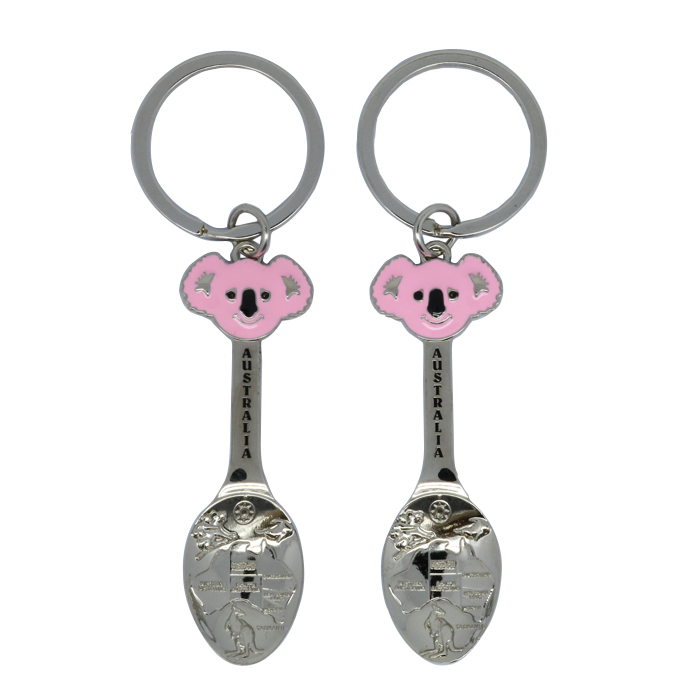
Applied to a gift programme this is a design question rather than a legal one. A keyring hanging from a belt loop, a pin worn on a shirt, a badge clipped to a lanyard against the neck, a cufflink, a pendant: each is a different article in this sense. Coating is part of the answer, because the entry treats a non-nickel coating as a route to compliance provided it holds for two years of normal use, which makes coating specification part of the compliance file rather than a cosmetic decision. How we handle this in practice is covered in nickel release and lead in coatings on metal souvenirs, and the wider regulatory picture sits in the overview of EU and US product safety rules for custom metal souvenirs.
Age is the other axis. A metal item designed or marketed for children under twelve is subject to the US children’s product certification rules, which means the certificate has to be based on third party testing and the records kept for years. A corporate gift ending up in a school, a sports club or a family event is worth checking against that line before it is ordered. Where a programme mixes adult and child audiences, two product versions with two specification files are simpler than one product with one file.
Turning the programme into a procurement document
Once the tax and product categories are settled, the rest of the programme is ordinary procurement with a few additions. The specification has to name the material, the finish and the decoration method, and the documentation the programme will require, so that the factory quotes against the same list the buyer will later check. The B2B RFQ template for custom metal gifts sets out the fields that make a quotation comparable, and adding a documentation column is the cheapest way to avoid the late argument about which test reports were in the price.
Brand handling belongs in the same document. If the programme uses a licensed logo, the licence terms determine whether the piece can be given away at all, and the breakdown of royalty rates on branded metal merchandise explains the usual charging structure. Packaging follows the same logic: a gift that arrives damaged or unmarked has failed whatever the tax treatment allowed, and packaging for custom metal gifts covers the options that protect the finish in transit.
Identification is the part corporate programmes most often skip. Every product sold online or in stores needs a unique identification number, and GS1 provides the barcodes used by retailers and marketplaces worldwide; the GS1 guide to getting barcodes explains how a company obtains its own numbers. Applying a barcode to each design and recording it against the batch turns a shipment of souvenirs into something the recipient’s team can receive, count and file, and it is the same artefact that links a physical gift to the record the employer keeps.
On our side, zinc alloy is the main material we work in, alongside stainless steel, brass and bronze, and iron. Finishes run to gold, silver, rose gold, antique brass, antique silver, antique copper, black nickel and dual tone, and logos are applied by laser engraving, screen printing, embossing, debossing, moulded logo and enamel colour fill. Our factory floor is 9,600 square metres with more than 200 staff and daily capacity of 30,000 pieces. Minimum order quantities are 100 pieces using an existing mould, 500 for a standard design using an existing mould, and 1,000 for most fully custom die castings. Sampling takes 7 days and production 15 to 20 days, so a programme with a fixed event date runs backwards from the event.
Gift tax threshold lookup
The table below pulls the thresholds into the order they are usually needed. The point is not to settle any particular gift, but to let the person buying the merchandise see, before the order is placed, which rule governs and what must be documented afterwards. Tax treatment is a matter for the employer’s own adviser; the value of the table is that it stops the programme being designed against the wrong rule.
| Situation | Governing figure | Source | What the evidence must show | Who decides |
|---|---|---|---|---|
| Employee gift, low value, occasional | No published dollar figure; the test is that the value is so low and the frequency so occasional that accounting for it would be unreasonable or impracticable | IRS Publication 15-B, de minimis benefits | Recipient, date, description, value, and how often similar benefits are given | Employer’s payroll or tax function |
| Length of service or safety award | $1,600 excludable annual amount for qualified plan awards, $400 for non-qualified awards | IRS Publication 15-B, achievement awards | The written plan, the milestone, the presentation, and the per-recipient total for the year | Employer’s payroll function |
| Gift to a client or business contact | $25 deduction limit per person per year, with engraving, packaging, insurance and mailing excluded | IRS Publication 463, gifts | Recipient or class of recipients, business purpose, date, and value | Employer’s tax function |
| Branded promotional item | $4 cost ceiling, with the permanent imprint and wide distribution conditions attached | IRS Publication 463, exceptions to the $25 limit | Unit cost, imprint method, quantity and distribution list | Employer’s tax function |
| Individual gift from an owner or partner | $19,000 annual exclusion per individual recipient for 2026, $38,000 across two spouses | IRS gift tax FAQ, annual exclusion per donee | Recipient, value, date, and whether Form 709 is required | Donor’s tax adviser |
| Article worn against the skin | Nickel release not greater than 0,5 μg/cm²/week for skin contact articles, 0,2 μg/cm²/week for pierced parts, with a non-nickel coating required to hold the limit for two years of normal use | REACH Annex XVII, restriction entry 27 | Material and coating specification, and the test report for the article as supplied | Importer and compliance function |
Read the last column across and the pattern is that almost every threshold here comes with a documentation requirement attached, and that the documentation is what a company actually owns at the end of the programme. The gift is consumed in a week; the record of why it was treated that way can still be produced three years later, provided somebody asked for it at the start.