
Most buyers start a challenge coin programme with a picture of the finished piece: a raised emblem, a team name, a date. The picture is the easy part. The parts of a challenge coin that decide whether the programme runs smoothly are the ones that rarely appear in a design file — whether the blank is die cast or struck, how much relief the die can actually hold at the requested diameter, what the plating has to survive, and whether the coin can carry a loop or chain without creating a new compliance question for the buyer who sells it.
A custom challenge coin is a commodity in shape but not in process. Two coins with identical artwork can sit on completely different manufacturing routes, and the route determines the relief you can hold, the tolerance you can buy, the finish that will age the way you want, and the paperwork your customer will ask for. Settle the route before the artwork is finalised, and the rest of the order follows. Skip that step and the same drawing can be quoted twice with two different answers.
This guide is written for the people who commission these coins rather than collect them: team and organisation buyers ordering recognition pieces, sports event organisers, corporate gift programmes, promotional product distributors and souvenir wholesalers who need a metal object with a strong silhouette and a clear message. It covers how the pieces are made, how to specify them so the quotation is comparable, and where the legal boundary sits between a commemorative token and something that behaves like currency.
Every technical reference and every regulatory statement in this guide comes from the primary source cited at that point. Where a value depends on your artwork, your tooling budget, your destination market or a live quotation, that is stated rather than estimated. No market size, unit price or production figure appears here that is not tied to a source you can open.
What a challenge coin is inside the OEM market
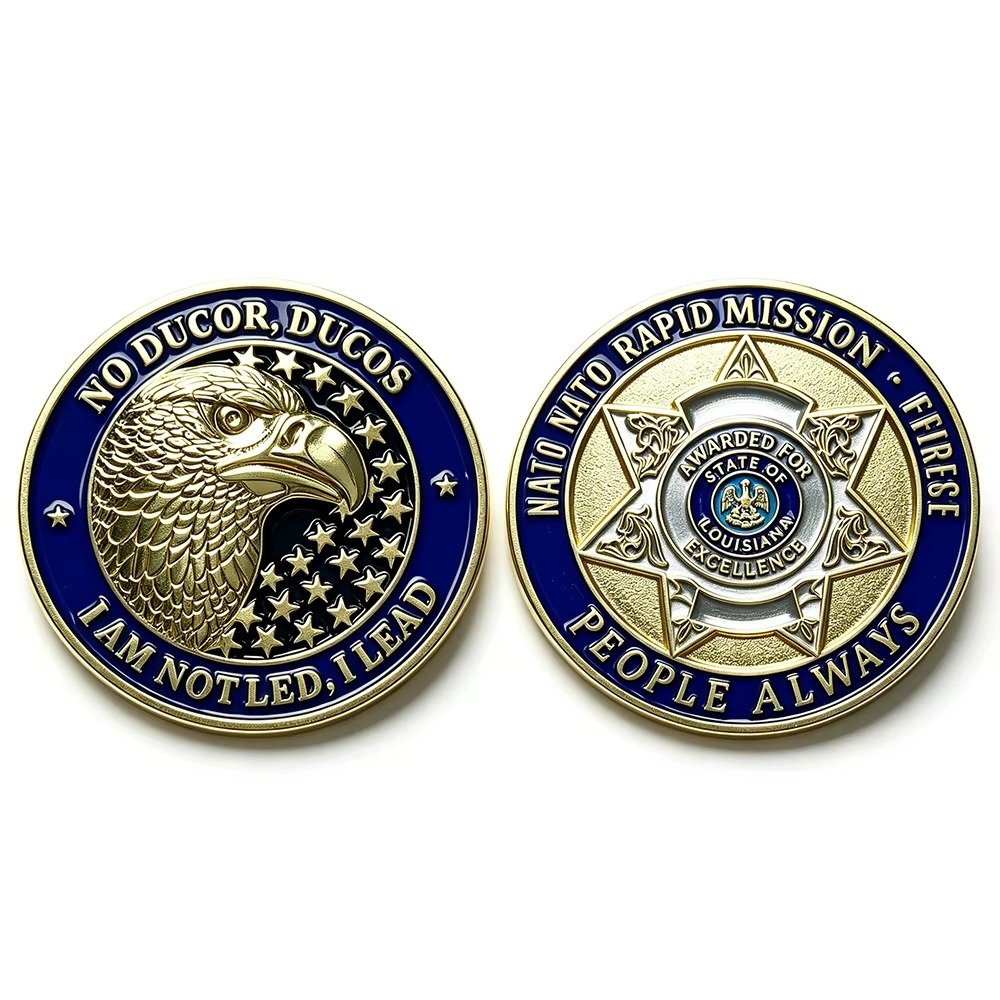
In commercial production, a challenge coin is a struck or cast metal disc, usually between roughly 30 and 60 mm across, carrying relief artwork, a finish and, very often, enamel colour. The word “challenge” comes from the military tradition of a coin being carried between members of a unit as a token of membership. That tradition survives in the modern custom market, where the coin is ordered to mark a team, a service year, an anniversary, a conference or a customer giveaway.
Two things separate this product from an ordinary medallion. The first is volume-driven detail work: the artwork is reduced to a die, and the die is the single most expensive item in the order. The second is finish: the piece is normally plated to read as gold, silver, bronze, antique brass or antique copper rather than left as bare alloy, because the whole point of a challenge coin is that it looks like an object of value at a glance.
That is why a challenge coin order is not a metal order with artwork on top. It is a tooling order with a metal order attached. A buyer who treats it as the second kind will approve a sample that the factory cannot repeat, or approve one that can be repeated but not sold.
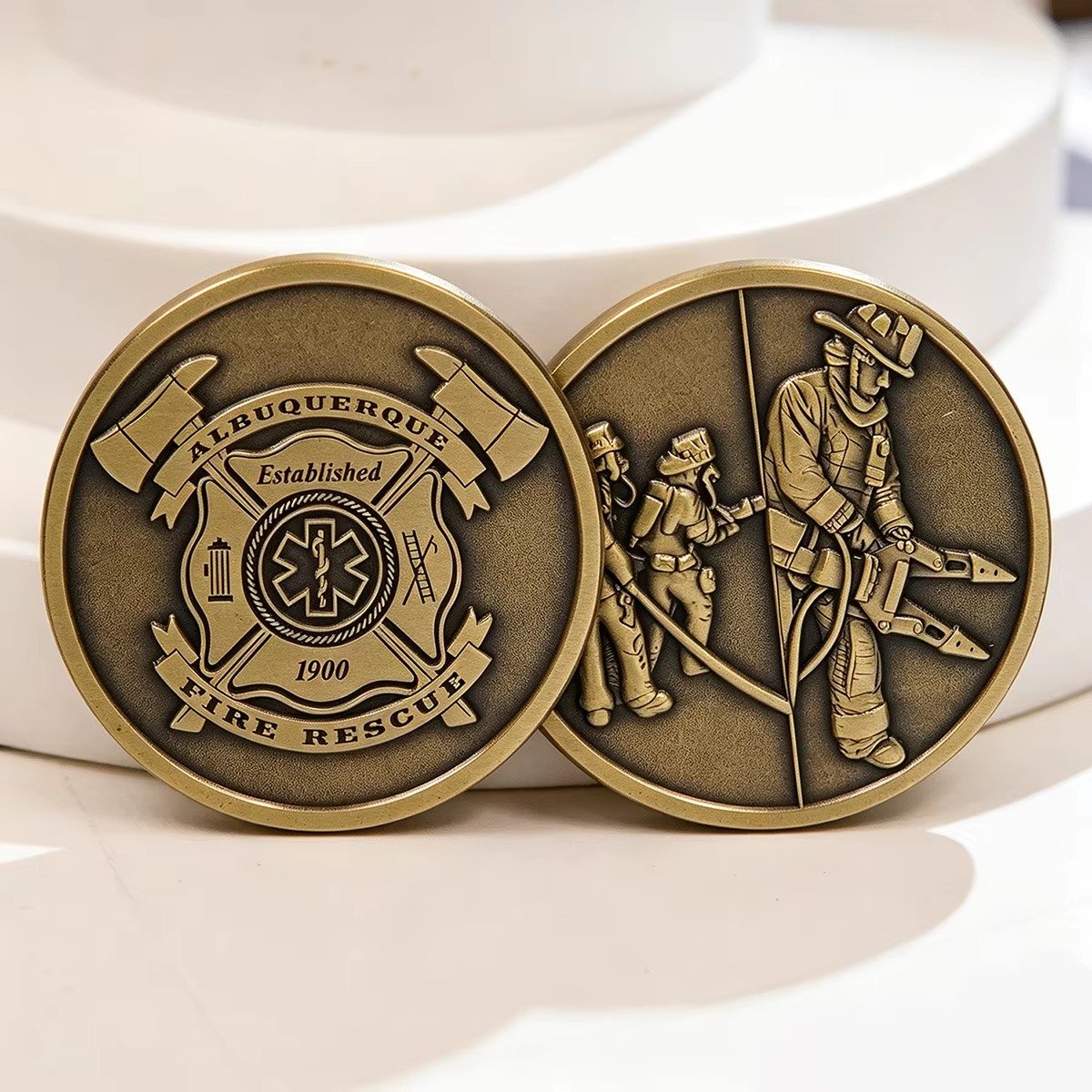
Real examples of the finished category are shown on our recognition challenge coin product page and on the fire rescue challenge coin programme, both of which use plated round bodies with applied relief artwork.
The legal line: where a commemorative token stops being currency
This is the part of the conversation that is easiest to skip and most expensive to get wrong, because the risk does not sit with the factory. It sits with the organisation whose name and emblem are on the piece and with the buyer who sells it.
United States criminal law addresses this directly. Section 486 of Title 18 of the United States Code reads: “Whoever, except as authorized by law, makes or utters or passes, or attempts to utter or pass, any coins of gold or silver or other metal, or alloys of metals, intended for use as current money, whether in the resemblance of coins of the United States or of foreign countries, or of original design, shall be fined under this title or imprisoned not more than five years, or both.” The full text is published by the Legal Information Institute at Cornell Law.
Two elements of that sentence matter to a designer. The first is intent: the coins must be “intended for use as current money”. The second is resemblance: the prohibition reaches coins made in the resemblance of United States coins, of foreign coins, or “of original design”. A programme that asks for a coin that looks like a circulating United States dollar, or that reproduces a national emblem in a way that suggests official issue, is asking for a design decision with legal exposure attached to it.
There is a second statute worth knowing about. Section 492 of the same title provides for the forfeiture of counterfeits and of “any material or apparatus used or fitted or intended to be used, in the making of such counterfeits” when found in the possession of a person without authority from the Secretary of the Treasury. For a buyer this is a practical argument for documenting design intent at the point of order, not a reason to avoid the product category.
The controls that buyers in this market actually use are administrative rather than technical:
- A visible legend on the coin stating that it is not legal tender and not government currency, placed as part of the artwork rather than added later.
- An artwork file that contains no reproduction of a circulating coin design and no national emblem used in a way that implies official issue.
- A written record, at order stage, of what the coin commemorates and who it is given to.
- A decision on whether the piece is given, sold or distributed, recorded before production rather than after.
None of this is a substitute for advice from your own counsel on the specific programme, and the design decisions that carry risk depend on how the piece is distributed. What a factory can do is tell you, in writing, that a design has been reviewed against these points before tooling is cut, and give you the artwork in a form you can pass to your legal reviewer.
Two production routes, and why they are not interchangeable
Custom challenge coins reach the market by one of two routes, and the choice determines most of the downstream specification.
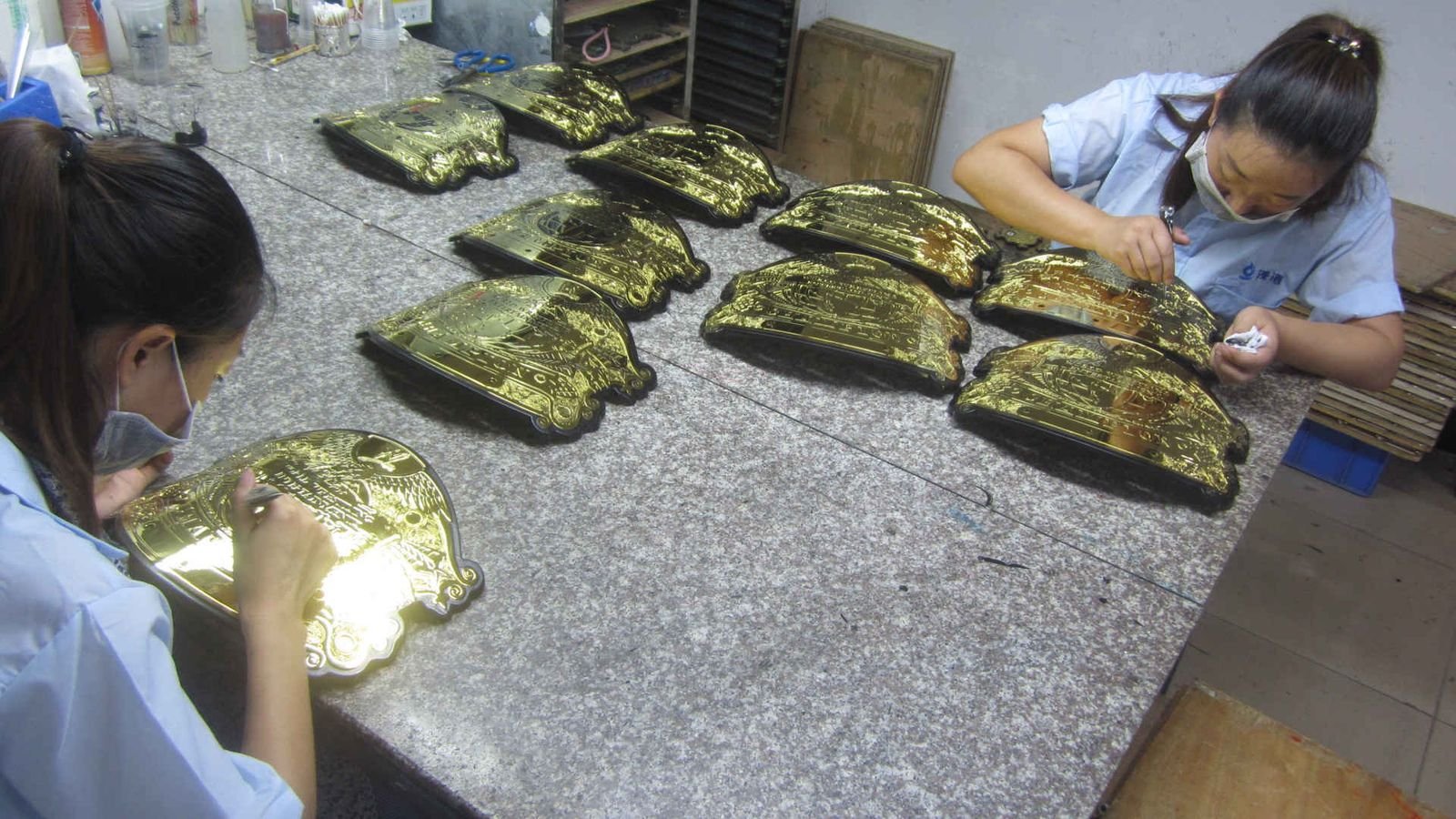
Die casting uses a closed tool into which molten alloy is injected under pressure. The cavity is filled, the metal solidifies against the tool walls, and the part is ejected for trimming, tumbling, polishing and finishing. Because the tool is a rigid steel cavity rather than a pair of forming dies, the achievable detail is a faithful rendering of the cavity surface, and the surface is exactly what the die was machined to produce. Depth, draft and detail density all have to be planned for the casting route, because a deep, undercut recess cannot be filled or released.

Struck blanks take a flat blank of metal and press it between an upper and lower die. The blank flows into the die cavity under pressure, and the metal takes the relief of the struck faces. Because the metal is being displaced rather than filling a cavity, the achievable relief is limited by the metal’s ability to flow, and the edges of the blank can pick up a raised lip where the metal flows past the cavity edge. Struck coins are the traditional route for circulating currency and for collector pieces that want a genuine struck appearance and an edge treatment.
The practical comparison for a buyer:
| Decision point | Die cast route | Struck route |
|---|---|---|
| Cost of first article | Lower tooling cost, tool designed for the specific shape | Higher tooling cost, dies have to be made for the standard blank size |
| Relief depth available | Deep relief is practical where the tool allows draft | Relief is limited by metal flow at the die edge |
| Reproducibility across long runs | Consistent, the same cavity is used for every part | Consistent, but wear on the die changes the surface over time |
| Edge treatment | Trimmed edge, later plated or filed | Edge is formed in the strike and can carry reeding or a raised lip |
| Best fit when | Shape is bespoke and the detail is graphic rather than fine-line | The look should read as struck metal and the design is conventional |
Most commercial custom programmes sit in the die casting route, because the shapes buyers want are bespoke and the tooling cost has to stay proportionate to the order value. The die casting workshop at Kingtop produces the zinc alloy bodies that this product family is built on, and the same route is used across our medals and badges range.
Specifying the body: alloy designation and casting tolerance
Two specifications do most of the work in a coin brief: the alloy designation and the tolerance standard. Get both right and the factory can quote repeatably. Leave either loose and the answer changes every time the order is re-quoted.
For the alloy, the reference point is ASTM B86, the standard specification for zinc and zinc-aluminium alloy foundry and die castings. The 2023 revision, B86-23, lists eight alloy designations across the Common, Traditional, ASTM A and UNS series, including Zamak 3, Zamak 7, Zamak 5, Zamak 2, ZA-8, ZA-12, ZA-27 and ACuZinc 5. The same section of the standard notes that the four Zamak grades are used primarily for pressure die castings while the ZA grades serve both foundry and pressure die casting. Note that the scope summary on the standard’s own page describes the list as seven while the scope table lists eight; where a buyer needs the designation for a purchase order, the designation table is the reference, and the version should be written on the order.
For tolerance, ISO 8062-3 is the standard that governs general dimensional and geometrical tolerances for moulded parts. The 2023 edition, ISO 8062-3:2023, specifies general dimensional and geometrical tolerances together with machining allowance grades for castings using plus or minus tolerances for indicated dimensions, and it applies to castings in all cast metals and alloys produced by various casting processes. Its scope is narrower than buyers sometimes assume: it covers linear dimensions and the geometrical tolerances of straightness, flatness, roundness, parallelism, perpendicularity, symmetry and coaxiality, and it does not cover other position tolerances, angular dimensional tolerances or cylindricity tolerances. It also does not apply to 3D CAD models that carry no indicated dimensions, which matters because a decorative model is exactly the kind of file that arrives without them.
The practical consequence is a two-layer tolerance system in any real coin specification: the drawing states the dimensional requirements for the coin, and the general casting tolerances of ISO 8062-3 apply where the drawing does not call out a specific value. A buyer who wants an explicit general tolerance on the order should say so, because the default is that nothing is specified.
| Specification line | Where the value comes from | What the buyer should write |
|---|---|---|
| Alloy | ASTM B86-23 designation table | Alloy grade and the standard revision the order is written against |
| General casting tolerance | ISO 8062-3:2023 | The general tolerance grade applied to dimensions not separately specified |
| Feature dimensions | Your drawing | Called-out tolerances on relief features, edge thickness and any functional feature |
| Relief treatment | Design intent | Flat, domed or dished field, stated separately from the relief itself |
| Edge | Design intent | Plain, reeded, raised lip or a separate edge treatment piece |
Plating, antique finishes and how the finish is qualified
Plating is where most first-time buyers have the least information and where the visual difference between quotations is largest. A raw zinc alloy body looks grey. The same body in polished brass colour, in a two-tone antique finish, or in a bright nickel with a copper strike underneath looks like three different products, and the price gap between them is usually smaller than buyers expect.
The decorative sequence normally used on zinc alloy bodies for bright chrome-style finishes runs in a fixed order: alkaline cleaning to remove die lubricant and surface contamination without attacking the substrate, a thin copper strike, a bright acid copper layer, a semi-bright or bright nickel layer, and then the final chromium layer. Each layer has a job. The copper strike prevents the bright nickel from bonding directly to the zinc alloy, where it would behave poorly; the bright acid copper carries the level and masks the substrate; the nickel provides the corrosion barrier; the chromium provides the surface appearance and the wear surface.
Where a buyer wants an antique or brushed look rather than a bright one, the sequence changes and the ageing chemistry becomes the specification. Antique finishes are produced by controlled chemical darkening of the surface layer, then a highlight pass that brings back the raised detail and a seal. The result depends on the base metal, on the thickness of the plated layer, and on the bath chemistry, all of which are process parameters rather than drawing dimensions. A supplier who quotes “antique gold” without naming the base alloy and the plating route has not quoted a finish, only a colour.
Qualification of the finish is what converts a colour into a specification. ISO 9227 specifies the apparatus, reagents and procedure for the neutral salt spray, acetic acid salt spray and copper-accelerated acetic acid salt spray tests used to assess the corrosion resistance of metallic materials with or without permanent or temporary corrosion protection. The standard is explicit about its own limits: it does not specify the dimensions or types of test specimens, the exposure period to be used for a particular product, or the interpretation of results, and it states that such details are provided in the appropriate product specifications. That last sentence is the one buyers should quote back to a supplier. It means the exposure period has to appear in your own specification, because the standard will not supply it.
The standard also explains which test suits which finish. The copper-accelerated acetic acid salt spray test is described as useful for testing decorative coatings of copper plus nickel plus chromium, or of nickel plus chromium, and the acetic acid salt spray test as especially useful for the same family of decorative coatings. If your coin is going out in a chrome-style or two-tone nickel finish, those are the tests that carry meaning for the finish you actually have. Our article on salt spray testing for metal finishes covers the procedure and how to read the result.
Two further points that belong in the brief rather than in a verbal agreement. First, specify the plating layer sequence, not just the colour name, because the sequence determines how the finish ages and how it responds to handling. Second, specify the salt spray exposure period and acceptance criteria in the order document, and treat any corrosion appearing at a defined period as a production defect against the drawing rather than a matter of taste.
Enamel colour fill and the two enamel processes
Enamel is what turns a flat relief field into a two-colour coin. Two processes are used in this product family and they behave differently.
Soft enamel is a pigmented resin material applied to the recessed fields and cured at a comparatively low temperature. It sits slightly proud of the surface, so the metal relief edge remains visible around each colour field. The low cure temperature means it can be applied over a plated surface, and the material can be cured and reworked more readily than a fired enamel.
Hard enamel is a glass-like vitreous enamel fired onto the metal at a much higher temperature. Because firing happens at a high temperature, the enamel has to be applied to a surface that can take it, which constrains the plating sequence and the base metal combination for a given piece. Hard enamel produces a flatter, glassier surface with a different wear and scratch profile from soft enamel, and it is generally the more demanding route to qualify.
For the buyer the practical questions are the same in both cases: which process is being used, is it declared on the quotation, what colour reference is being matched against, and what happens to the colour fields if the piece needs to be reworked. A supplier who uses the word “enamel” without naming the process has left the most expensive part of the specification open. Colour approval against a physical reference is the right control, because colour is judged visually and a written colour name is not a standard.
Attachments and the small parts question
A challenge coin is often supplied with a bail, a loop, a ring, a chain or an edge-to-edge connector so it can be worn or hung. That attachment is where a straightforward coin order turns into a product with an extra regulatory dimension, and it is worth understanding the rule before the design is fixed rather than after.
The United States small parts rule is a physical test, not a judgement call. Section 1501.4 of Title 16 of the Code of Federal Regulations states that “no toy or other children’s article subject to § 1500.18(a)(9) and to this part 1501 shall be small enough to fit entirely within a cylinder with the dimensions shown in Figure 1, when tested in accordance with the procedure in paragraph (b) of this section.” The test procedure requires that the article be placed into the cylinder without compressing it, and if it fits entirely within the cylinder in any orientation it fails; detached components are tested the same way.
The scope is what most buyers miss. The rule applies to articles intended for use by children. The same part sold as an adult collector’s item or as a corporate recognition piece sits in a different position from the same part sold in a children’s gift set, and the packaging and marketing usually decide which category the piece lands in. If your programme includes a children’s market, a detachable loop or a small chain, that question needs an answer before the order is placed rather than after it ships.
Three decisions keep this manageable. Decide early whether the coin is intended for children at all, and record the answer. If it is, either design the attachment so it cannot separate and cannot pass the small parts cylinder, or design it so that it is integral and non-detachable. If it is not, keep the packaging and the marketing language aligned with that position so the classification is not contradicted later.
Packaging for a collector audience
Challenge coins are frequently bought for the presentation as much as the object, and the packaging decision is made at a different point in the project from the coin itself. It is also one of the least specified parts of a typical brief, which is why it generates late changes and late cost.
There are three common formats. A simple poly bag with a backer card is the lowest cost route and works for giveaway or internal distribution programmes. A presentation box with a foam or die-cut insert is the normal choice for recognition and award programmes, where the coin arrives in something that can be handed over or posted. A flip or capsule format is used where the coin is sold as a collectible and where the surface has to be protected from handling.
Three specification points prevent the most common packaging problems. First, state the insert type, because a foam insert that holds the coin by the relief will mark the high points of the relief and can be seen through a surface finish. Second, state the card or insert material, because printed board and PVC have different odour and age characteristics. Third, state whether the coin is bagged separately from the card, since a coin shipped loose against printed board can pick up abrasion or a transfer of print.
Our packaging guide for custom metal gifts sets out the format options and the specification language for each of them, and the export packing line is where these are assembled before shipment.
Sample stages and the approval record
Challenge coin orders usually move through a small number of sample stages, and the single most valuable thing a buyer can do is name the stage and what it proves. A sample that arrives without a stage label creates an argument that could have been avoided.
The first article proves that the design can be made: the relief reads, the enamel fields are in the right places, the finish is applied. It is a design tool, not a quality standard, and it is normally produced at a lower quantity than a production run.
The pre-production sample proves the specification. It is made on production tooling, from production material, and it is the piece against which the golden sample is set.
The golden sample is the approved physical reference. Once it is signed, every subsequent inspection is measured against it, and the signed sample has to travel with the goods or its equivalent has to be on file at the factory.
Three questions decide whether the approval is worth anything. What exactly is being approved at each stage, against which document version, and who signs it. The document version matters because artwork files move; an approval against an unnamed file version cannot be enforced later. The signature matters because the buyer who signs is the person who carries the cost when the production run arrives and differs from what was expected.
What the approval should record, at minimum: the sample reference and stage, the drawing and artwork version approved, the alloy and finish as approved, the enamel or colour reference used, the packaging format, the agreed quantity and delivery date, and the signature and date. If the programme is likely to repeat, ask for the approval record to be retained with the order so the next run starts from the same document rather than from memory.
Third-party verification is worth adding when the programme is high volume or the finish is critical. Our article on laboratory testing and certification for metal souvenirs explains what the different kinds of report cover and which ones answer a buyer’s question rather than a laboratory’s.
| Stage | What the sample proves | What it does not prove | Decision recorded |
|---|---|---|---|
| First article | Design reads correctly and the process can produce the shape | Dimensional repeatability, finish durability | Design direction, with artwork version noted |
| Pre-production sample | Specification is achievable on production tooling | Long-run consistency | Specification, alloy, finish, enamel reference |
| Golden sample | The reference for the production run | Anything about packaging fit | Signed approval, quantity and date agreed |
| Production first-off | The run matches the golden sample | Nothing further, unless it differs | Release or hold decision |
What to send when you ask for a quotation
A challenge coin quotation is only as good as the brief behind it. The following list is what a factory needs in order to quote a coin programme without guessing, and it is short enough to assemble in an afternoon.
- Artwork in vector format at the intended relief depth, plus a reference image of the intended result.
- Target diameter and the required edge treatment.
- Relief type and depth, or a reference piece whose finish you want matched.
- Alloy grade and the plating sequence, or the finish name with a physical reference.
- Enamel process, and colour references for each colour field.
- Quantity per colour or design, and the number of distinct designs.
- Attachment and packaging format, with dimensions if a custom insert is needed.
- Destination market, so that material and labelling obligations can be confirmed against the right rules.
- Target delivery date and the date by which artwork must be frozen.
Anything on that list you cannot answer yet is worth raising as a question in the enquiry. It is far cheaper to discover that the design needs a simpler attachment or a different plating sequence while the quote is being prepared than after the die has been cut.
Choosing the production route: a decision table
Pull the answers from your brief into this table and the route usually becomes obvious. It is also the fastest way to compare two quotations that use different language for the same thing.
| If your requirement is | Route to specify | Specify this with it | Ask the supplier to confirm |
|---|---|---|---|
| A bespoke silhouette with graphic relief | Die casting | Alloy grade from the ASTM B86 table | Tooling lead time and ownership of the die |
| Fine line detail or a struck-metal appearance | Struck blank | Blank source and edge style | Whether the design is achievable at the requested relief |
| Two-colour relief | Either route | Enamel process, colour fields, reference | Whether the plating sequence supports the chosen enamel route |
| A collector presentation | Either route | Insert type, capsule or box | How the piece is held so the relief is not marked |
| A children’s market | Either route | Attachment design, intended age group | Small parts assessment of every detachable element |
| A repeat programme | Either route | Golden sample retention | That the approved sample and document versions are filed against the order |
Where to take the programme next
A challenge coin order is decided by three documents: the artwork, the specification and the approval record. Get them aligned before tooling and the programme runs on a manufacturing schedule instead of a negotiation.
To price a specific coin programme, send the artwork, the quantity and the target date to our team at the custom metal gifts MOQ page, or email sales@kingtopgift.com. We will come back with the decisions your current brief leaves open — route, alloy, plating sequence, enamel process, attachment and packaging — and a quotation that separates tooling from unit cost so you can see where the money actually goes.