
A supplier showing you an ISO 9001 certificate has told you almost nothing about the souvenirs you will receive, because the certificate describes a management system at a stated scope, on a stated date, and nothing about the tolerance of a die-cast keychain or the plating adhesion on a batch that shipped last month. What buyers actually need is a method for turning that certificate into a testable set of claims, and the standard itself moved underneath them in September 2026: ISO 9001:2015 was withdrawn and replaced by ISO 9001:2026, the sixth edition. This guide sets out what the new edition changed, how to read the certificate fields, which documents have to accompany it, and where the certificate stops being evidence and a purchase agreement has to take over.
What ISO 9001 is, and what the sixth edition actually changed
ISO 9001 is a standard for quality management systems. Its requirements define how to establish, implement, maintain and continually improve a quality management system, or QMS. It does not prescribe a specific way of operating, and it does not certify products. The official entry for the current edition describes it as a globally recognized standard used across sectors, with more than one million certificates issued to organizations in 189 countries. The same page notes that the standard is widely adapted for aerospace, pharmaceuticals, manufacturing, education, software development and construction, which is the reason a souvenir factory and an aerospace supplier can both hold a certificate without holding the same process.
The edition change matters commercially because certificates tied to the previous edition have a defined end state. The ISO 9001:2015 entry page now shows the status as Withdrawn, with the publication date 2015-09, 29 pages, and the stage recorded as withdrawal of the international standard. That same page states plainly that the edition has been withdrawn and replaced by ISO 9001:2026, and it advises organizations certified to ISO 9001:2015 to consult their certification body regarding transition arrangements to the new edition. So a certificate issued in 2024 that still names ISO 9001:2015 is not automatically fraudulent, and it is not automatically current either. Its status depends on a transition arrangement you have to ask for.
The publication itself is dated. The ISO news page records the announcement in Geneva, Switzerland, on 16 September 2026, describing ISO 9001:2026 as the new edition of the world’s leading quality management system standard. The current edition entry adds the detail that it was published on 16 September, and lists it as Edition 6 with the catalogue reference 88464.
Where the substantive changes sit
The entry page describes the direction of the revision in plain terms: the sixth edition focuses on improving clarity so organizations of any size, maturity or purpose can better understand the requirements, emphasizes the importance of quality culture and leadership, separates risk and opportunities so organizations can proactively act on beneficial results, and improves alignment to other ISO management system standards, which makes it easier to integrate ISO 9001 into an existing management system regardless of size or sector.
A published change summary from September 2026 lists the areas the revision concentrates on: considering the impact of climate change, strengthening quality culture and ethical behaviour governance, paying attention to grasping opportunities, strengthening the effectiveness of change management, emphasising knowledge sharing, reinforcing supply chain and operations monitoring, focusing on setting internal audit objectives, and increasing attention to management review inputs. Read as a buyer’s checklist, those are the areas where a 2015-era supplier’s documented system is most likely to differ from a 2026-era one, and therefore the areas where a certificate issued under the old edition says least about current practice.
The supporting framework a buyer should know exists
The committee page for the subcommittee that develops the standard sets out how the surrounding documents fit together, and two of them are worth naming because they tell you what a certification claim rests on. ISO 19011:2026, Guidelines for auditing management systems, is identified as the key standard to refer to when advising on auditing to ISO 9001. ISO/IEC 17021-3:2017, Conformity assessment, Requirements for bodies providing audit and certification of management systems, Part 3: Competence requirements for auditing and certification of quality management systems, sets out what a certification body has to demonstrate to be competent to audit and certify a quality management system. The official entry for ISO/IEC 17021-3:2017 records it as Edition 1, published 2017-03, five pages.
That last point is the one most buyers miss. When a supplier hands you a certificate, the document at the other end of the chain is a certificate issued by a certification body whose competence is governed by ISO/IEC 17021-3, in a system that includes accreditation by bodies such as the International Accreditation Forum. The committee page also notes that a group of audit practice papers was developed by the ISO 9001 Auditing Practices Group, an informal group of quality management system experts, auditors and practitioners drawn from ISO/TC 176 and the International Accreditation Forum.

Reading the certificate: the fields that decide whether it applies to you
A certificate is a short document with fixed fields, and most of the useful information sits in fields buyers routinely skip. The point of reading them is not suspicion. It is to find out whether the certificate describes the entity, the activity and the site you are actually dealing with.
| Field | What it states | Why it matters for your order |
|---|---|---|
| Certification body | The accredited body that issued the certificate | Tells you who to approach for verification and whether the claim is accredited or not |
| Certificate number | The body’s own reference for this certificate | The only field you can check against the body’s public register |
| Legal entity name and address | Which company in the group is certified | A group certificate can cover a trading company rather than the factory doing the work |
| Scope statement | The activities, products or processes covered | The single most important field: it may say die casting of zinc alloy souvenirs, or it may say manufacture of metal products |
| Site address | The location the certificate covers | Multi-site firms hold a certificate per site; a certificate for one plant says nothing about another |
| Standard and edition | Which edition the audit was conducted against | Allows you to see whether the certificate is issued under the current edition or the withdrawn one |
| Issue and expiry dates | The certification cycle dates | Defines how long the claim was valid, and whether the order you placed falls inside that window |
| Audit and surveillance cycle | Certification audits and periodic recertification | Confirms the claim rests on more than a single visit |
The scope statement deserves more attention than any other field, because it is where an ISO 9001 claim most often turns out to be narrower than the buyer’s assumption. A certificate whose scope reads die casting of zinc alloy souvenir articles, together with polishing, plating and assembly, is describing a process set that maps onto a metal gift order. A certificate whose scope reads trading and export of metal gift products describes something else entirely, and it tells you nothing about the press, the polishing line or the plating bath. Those are different facts about different legal entities, and both can be perfectly valid certificates.
The same distinction applies to sites. A manufacturer that runs a casting plant in one location and a finishing operation in another may hold certificates covering one, the other, or both. When you ask whether the factory is certified, you need the answer to name the location and the process. “Our company is ISO 9001 certified” is not an answer you can file.
What a quality management certificate does not tell you
This is where most supplier conversations go wrong, because a certificate is easy to present as a product guarantee. It is not one. A quality management system certificate says that a defined scope at a defined site was audited against the requirements of a standard, and that the certification body judged the system conforming. It says nothing about the particular tolerance, the particular finish or the particular batch in your container.
| Check | What the certificate can support | What the certificate cannot support | Where the missing evidence comes from |
|---|---|---|---|
| Dimensional control | That a documented process exists for controlling product dimensions | That your keychain is within tolerance | A dimensional inspection report against your drawing, per an agreed AQL sampling plan |
| Material conformity | That incoming material is subject to controls | That the zinc alloy in this order meets the grade you specified | Alloy composition test results, which is separate from any management system claim |
| Surface finish | That plating and finishing are covered by the scope | That the plating on this batch passed a salt spray test | Test reports, read alongside how to tell a lab report you can actually use |
| Traceability | That records are kept and controlled | That your lot can be traced back to raw material heat or batch | Lot identification and records retention, requested in the contract |
| Delivery performance | That a delivery process is defined | That your goods will arrive in 15 to 20 days | Order acknowledgement with dates, plus the shipping terms you negotiated |
| Environmental claims | Nothing, unless a separate standard is certified | Any recycled content, recyclability or sustainability claim | Separate evidence, as set out in what buyers can actually verify on recycled metal claims |
There is a second reason the certificate cannot carry the product claim, and it is technical rather than administrative. A management system audit samples processes and records across the scope. It does not measure a specific part against a specific drawing at a specific moment. Two orders placed in the same month at the same plant can differ in result, and a certificate describes the plant’s system, not the second order. This is not a criticism of certification. It is what certification was designed to be, and it is why a management system certificate and an incoming inspection report are complementary rather than alternatives.

The verification procedure, in the order that saves time
Verification is not a confrontation. It is a request for documents that a well-run factory produces routinely, and the order matters because the fastest-failing checks come first.
Step one: check the register before you check the factory
Before any call or visit, verify the certificate number against the certification body’s public certificate register. Accreditation bodies maintain public registers, and the certificate number is the field designed for lookup. This step costs minutes and it eliminates the largest category of problem, which is a certificate that does not exist, was suspended, or was issued in a name that does not match the entity you are dealing with. If the number does not appear in the register, everything else you have been told is secondary.
Step two: match scope, site and entity against your order
Take the scope statement, the site address and the legal entity name and place them side by side with the company that will sign your purchase agreement, the address on the pro forma invoice and the factory where the goods will physically be made. The test is simple: if the certified site is a trading office and the production site is a different address, you now know that the certificate does not describe the production site, and you need a different form of evidence for that site.
Step three: check the edition and the transition position
Record which edition the certificate names. If it names the withdrawn edition, ask the supplier for the certification body’s statement on their transition arrangements. The ISO 9001:2015 entry page is explicit that certified organizations should consult their certification body regarding transition arrangements to the new edition, which means the answer sits with the certification body rather than with the supplier’s marketing description of it. A supplier who can produce a certificate schedule and a transition plan is telling you something different from a supplier who simply says the certificate is valid.
Step four: confirm the certification body and its competence
Check that the issuing body operates in a system whose accreditation is recognised, and check whether the body that certified the management system is the same kind of body as the one that would test your product. These are different functions governed by different documents. ISO/IEC 17021-3:2017 governs the competence of bodies providing audit and certification of management systems, and it applies to the certificate in your hand. Laboratory competence for testing and calibration is a separate requirement, and it is the one that governs whether a chemistry or salt spray report has evidential weight. A supplier who conflates the two, or who points to a management system certificate as evidence of laboratory accreditation, has not read their own paperwork carefully.
Step five: convert the certificate into order-specific requirements
Now use the system to build the order. If the scope covers the processes you need, the certificate tells you those processes are under documented control, and you can reasonably expect records to exist for a given batch. The next step is to name those records in the purchase agreement: lot identification, retained samples, the inspection report you will receive, the acceptance criteria and the consequences when a report fails. This is the point where a management system claim starts paying for itself, because it tells you what you are entitled to ask for as a matter of course rather than as a favour.
The purchase agreement terms article on this site covers the acceptance, rejection and damages clauses in detail. The certificate narrows one part of that problem: it tells you whether the factory already has a system that will produce the records your acceptance clause depends on.
Step six: verify on site, with a scope that the certificate justifies
If a certificate exists and survives steps one to five, a site visit becomes more efficient rather than less, because you can test whether the documented system matches the shop floor. The factory audit guide for Chinese metal gift manufacturers covers the walkthrough in detail. The certificate changes the audit emphasis: instead of asking whether a process exists, you ask whether the records the system is supposed to generate actually exist for a recent batch, and whether the people running the line can point to the clause of the procedure they are following.
Common failures, and what they mean commercially
Three patterns account for most of the certificate problems buyers run into, and each has a different commercial consequence.
The first is the certificate that is real but narrow. This is the most common pattern and usually the least problematic. The certificate is genuine, in date, correctly issued, and covers a scope smaller than the buyer assumed, such as export and packing rather than die casting. The commercial response is not distrust but specification: ask the supplier which processes are inside the scope, then either accept that the certificate covers only part of the value chain, or require additional evidence for the rest.
The second is the certificate that is stale. A certificate issued under the withdrawn edition may still be running its transition schedule, or it may simply have lapsed without the supplier noticing because nobody asked. The consequence depends on timing: if the lapse happened after your order was placed, the certificate tells you nothing about current operations. The fix is to require a current certificate as a standing condition of the contract rather than a one-off document collected at onboarding.
The third is the certificate for the wrong entity, which usually appears in group structures where the trading company holds the certificate and the manufacturing company does not. This matters because it determines who is responsible when something goes wrong, and because a trading intermediary changes the customs, warranty and recall position of the whole order. That is the same territory covered in the article on supplier insolvency and buyer default, where the counterparty question runs alongside the operational one.
How this looks against a real factory profile
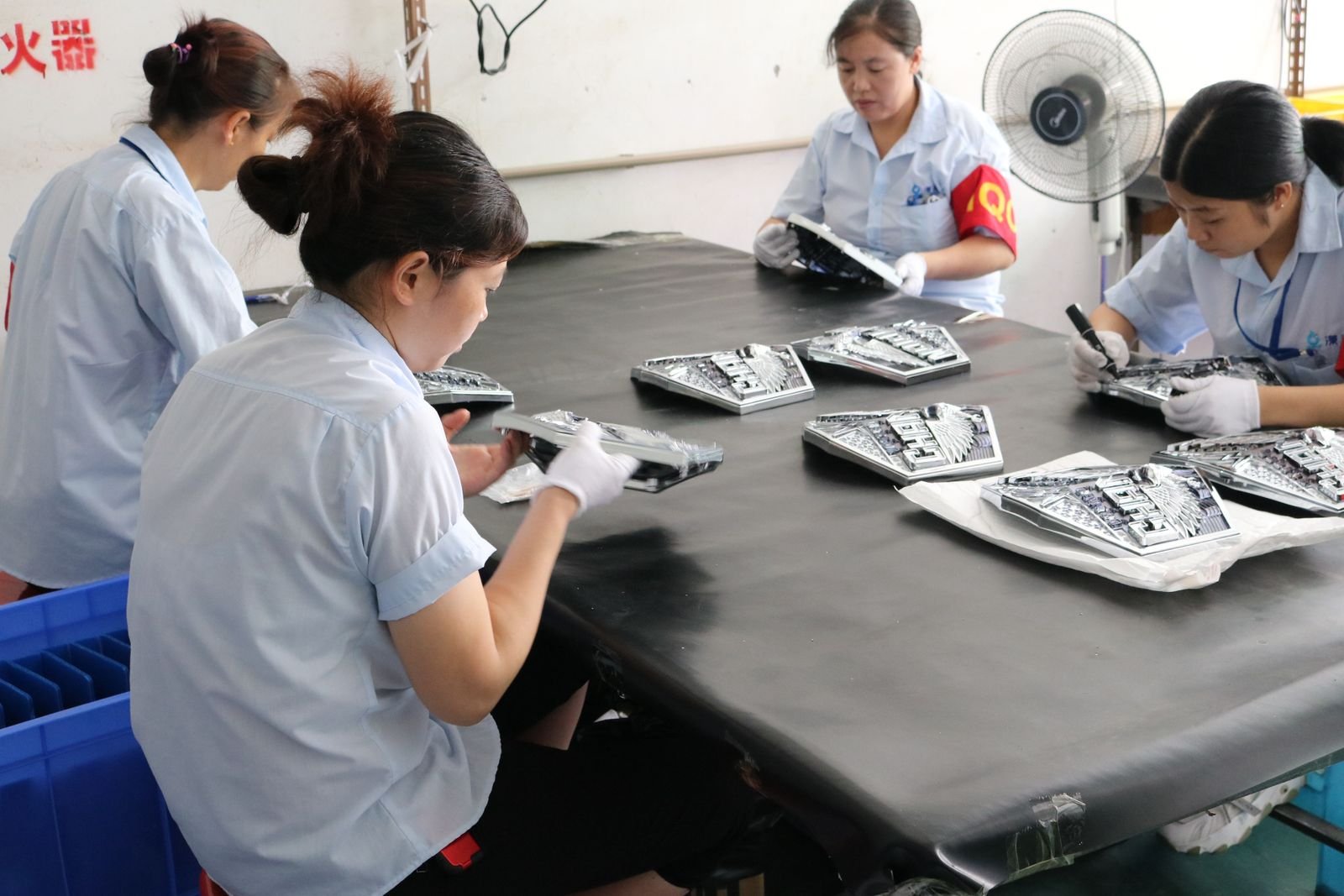
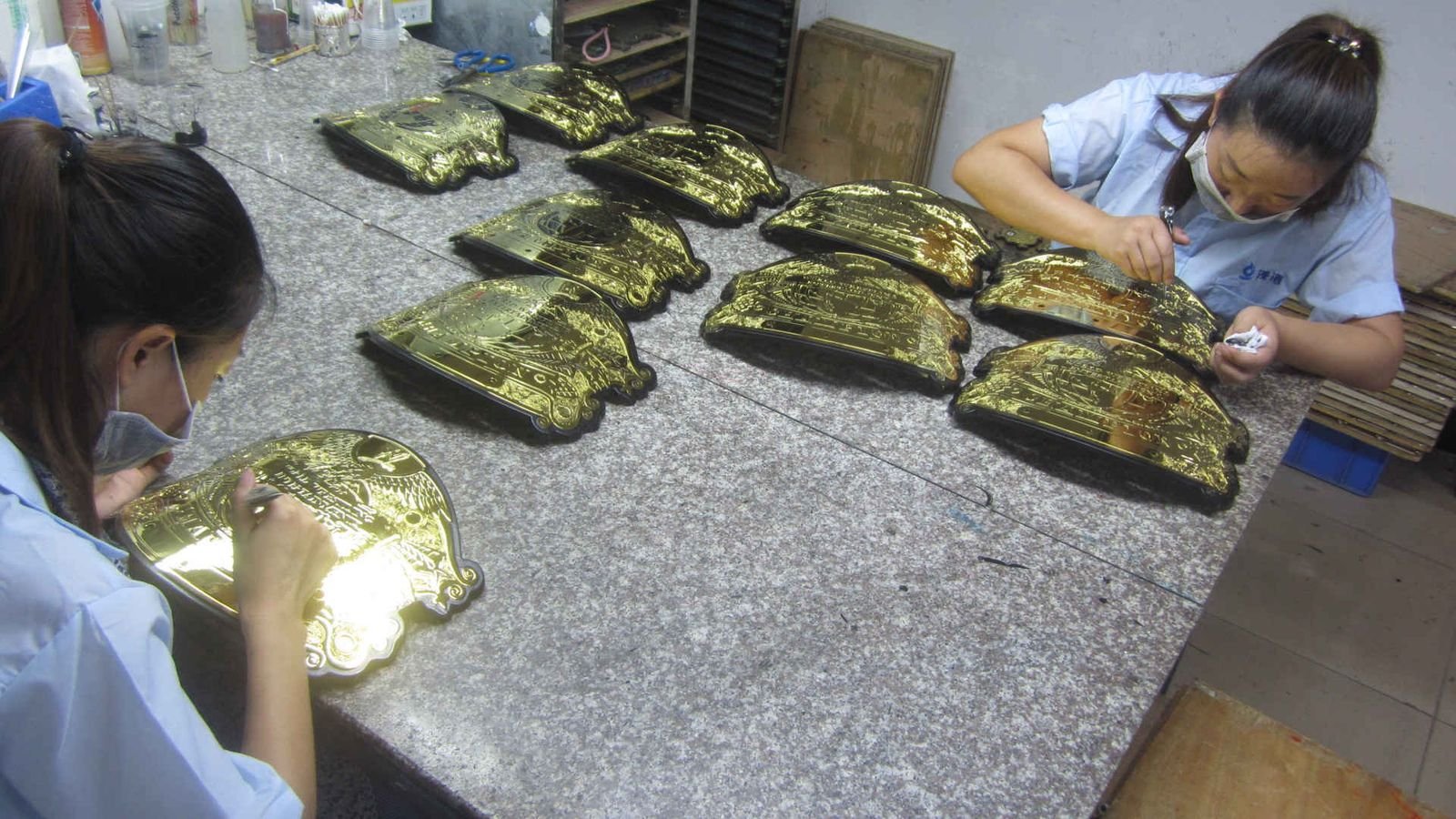
So that the discussion stays concrete, consider what a certificate would be assessed against for a metal gift manufacturer of a typical profile: a 9,600 square metre plant, more than 200 employees, daily capacity of 30,000 pieces, zinc alloy as the primary material alongside stainless steel, brass and bronze, and iron, with finishes in gold, silver, rose gold, antique brass, antique silver, antique copper, black nickel and dual tone. Branding is applied by laser engraving, screen printing, embossing, debossing, moulded logo and enamel colour fill. Sample lead time is 7 days and production is 15 to 20 days, with freight by express, air or sea.
Against that profile, a scope statement covering die casting, polishing, plating, assembly and packing is a scope that maps directly onto the work. A scope covering only export and packing maps onto a small fraction of it. A scope covering die casting but not plating would leave the finishing step outside the certified system, which for a souvenir business is often where the visible quality risk sits. The point of the scope check is not to grade suppliers; it is to know which steps of your order are being covered by a system that somebody external has audited.
The questions to send, in writing
The most useful thing a buyer can do with a certificate is convert it into a short, written set of questions. The list below is built to be sent as is, in an email, to a supplier you are considering. Each question asks for something specific enough to answer yes or no, and the answers are documents rather than assurances.
Certificate identity
- Please send the current ISO 9001 certificate as issued, with the certificate number, issuing certification body, scope statement, site address, issue date and expiry date all visible.
- Which legal entity and which site address does this certificate cover?
- Is the certificate currently valid, and is it issued under ISO 9001:2026 or under ISO 9001:2015? If it is the 2015 edition, please send the certification body’s transition statement for your organisation.
- May we verify the certificate number against your certification body’s public register, and can you confirm that you authorise us to do so?
Scope against our order
- Does the scope cover die casting of zinc alloy souvenir articles? If so, please quote the scope statement exactly as written on the certificate.
- Does the scope cover polishing and plating? If plating is excluded, which company holds the certificate that covers plating, and does that company operate at our production site?
- Does the scope cover assembly, final inspection and export packing, or does it stop at an earlier step?
- Are all steps of the scope performed at the certified site, or are any performed at a subcontractor? If so, which steps and which subcontractors?
Evidence we need per order, not per year
- Under this system, what records exist for a specific production order, and how are they indexed? Please give us the list of records you would supply with a shipment.
- How is material conformity recorded, and can alloy composition results be supplied per lot against our specified grade?
- How are non-conforming outputs identified, segregated and dispositioned, and what record survives the disposition decision?
- What is the sampling plan you apply to finished goods before despatch, and what acceptance criteria do you apply?
- Do you apply a documented change control process to production parameters, and will you notify us in writing before a change to material, finish or production method on an open order?
Schedule and review
- What are the dates of your most recent certification audit and most recent surveillance audit?
- Will you permit us, or an appointed third-party inspector, to audit the certified site against the scope during the contract term, and will you name the notice period you require?
- Will the purchase agreement name the certified entity, the certified scope and the certificate number as an undertaking, with a stated remedy if certification is withdrawn or suspended during the term?
Asking these questions produces one of two useful outcomes. Either the supplier answers them, and you now hold a documented evidence base you can use at the moment something goes wrong. Or the supplier does not answer them, which is itself the finding. Both outcomes are worth the time; the second is more valuable.
For factory enquiries in this category, capacity figures and sampling plans are best confirmed against the actual plant rather than a brochure. Kingtop Metal Product in Dongguan publishes its plant area, headcount, daily capacity, materials, finishes and branding processes directly, and quotes can be requested through sales@kingtopgift.com. Where a specific figure matters for your own documentation, such as alloy grade, plating thickness or inspection criteria, ask for it in writing against your drawing and your order, and treat any other source, including this article, as orientation rather than specification.