
Die casting and sand casting are not competing versions of the same product. They are different manufacturing systems with different cost structures, different tolerances and completely different economics at different order quantities. Most sourcing mistakes in metal souvenirs happen when a buyer accepts a sand casting quote for a 5,000-piece run, or when a supplier quotes a die casting price for a 200-piece trial and hides the tooling cost inside the unit price. This guide sets out what actually changes between the two processes, where the break-even sits in practice, and how to structure a quote request so that the two options can be compared on equal terms.
What each process actually is
Sand casting is the older of the two. Humans began pouring the first sand castings approximately three millennia ago, and the process followed a pattern that stayed essentially unchanged for most of that time: a replica of the desired object, called a pattern, is placed in an open-ended steel moulding box; special sand is poured around the pattern and pounded firmly into place, then the pattern is removed; a sprue is cut to let molten metal flow into the mould, joined to the cavity by a gate; a core is used where internal features are needed; then molten metal is poured and the finished part is removed once it has cooled. The engineering account of how 3D sand printing is changing sand casting describes that sequence and the way it has since been modified.
The economics follow directly from that sequence. A sand mould is consumed by a single pour. Producing another thousand parts means making another thousand moulds, reclaiming sand, pouring again and cleaning up again. The pattern itself is reusable and can be machined from wood, resin or metal, which is why the upfront cost is low. But the per-part cost falls only slowly as volume rises, because labour, sand, and yield losses are incurred on every single unit.
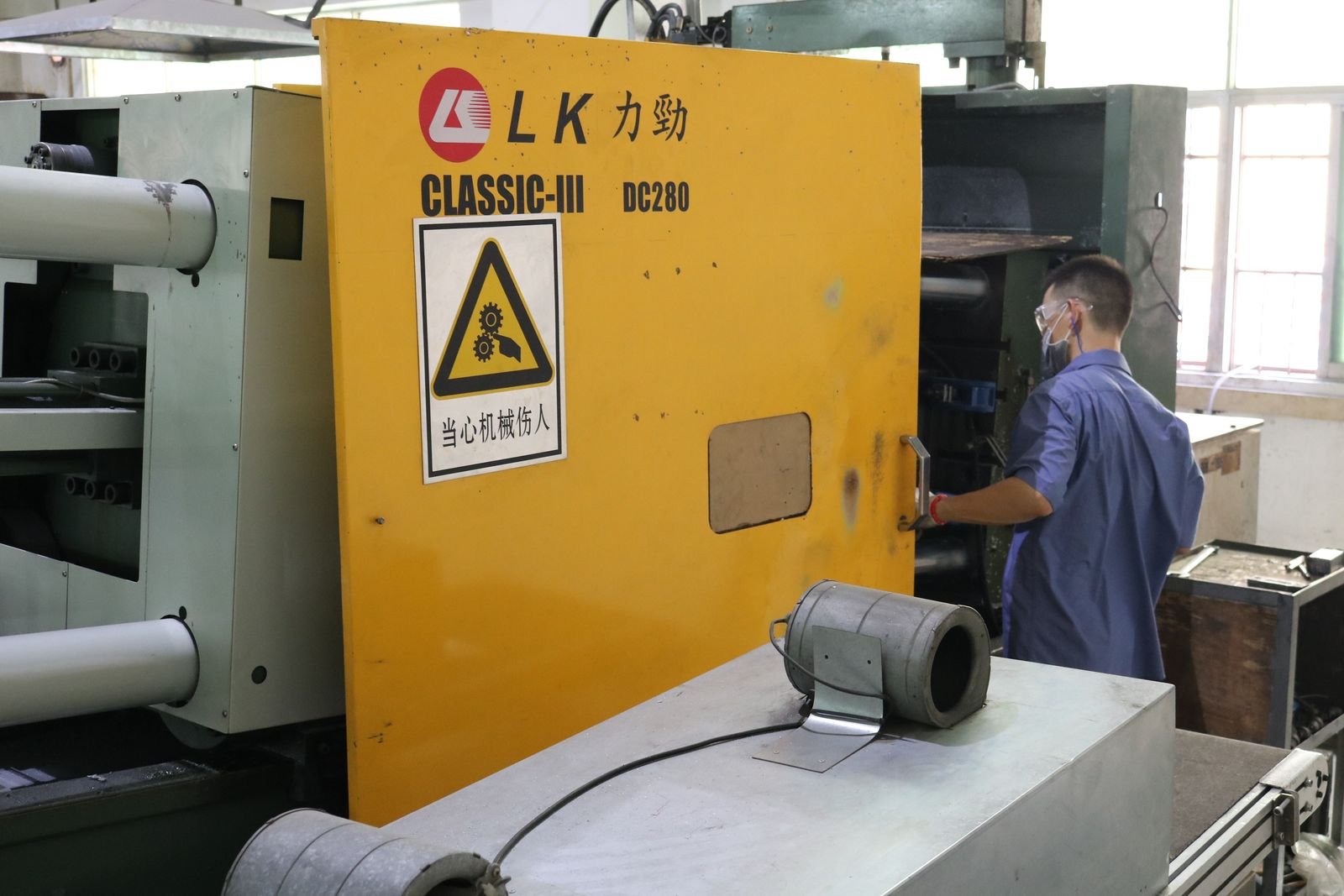
Die casting inverts the structure. Molten metal is forced into a hardened steel die under high clamping force, the die is opened, the part is ejected and the cycle repeats. The die is a capital asset that survives many thousands of shots. Everything about the economics follows from that: a heavy upfront investment, and then a unit cost that drops as the volume grows because the same tool is being amortised.
This is the single most important fact to hold on to, and it is why the question of which process to use is really a question about quantity and about whether the design is settled.
| Factor | Die casting | Sand casting |
|---|---|---|
| Tooling | Hardened steel die, water-cooled, with ejector pins, slides and a runner system sized to the projected area | Pattern in wood, resin or aluminium, plus bonded silica sand moulds that are consumed on every pour |
| Tooling cost profile | High upfront, amortised across every part produced from that die | Low upfront on the pattern, but the sand mould cost is paid again on every single pour |
| Processus | High-pressure injection of molten metal into the cavity in a closed cycle measured in seconds | Molten metal poured by gravity into a sand mould, with cycle time measured in hours |
| Metals | Non-ferrous only: zinc, aluminium and magnesium | Almost anything castable, including cast iron and carbon steel |
| Part size limit | Bounded by machine clamping force and die size | Effectively unbounded, which is how engine blocks and large housings are made |
| Surface quality | Smooth enough to plate or polish directly | Rougher, normally needing more surface preparation before plating |
| Small thin-walled parts | The natural strength of the process | Poor fit; thin sections are hard to fill and prone to misruns |
| Tooling lead time | Longer, because the die must be machined, heat treated and proven | Shorter, because the pattern is simpler, though patternmaking is still not instant |
Where the break-even actually sits
Because sand casting has almost no tooling cost and die casting has a large one, the crossover point depends on two variables: the size of the die and the order quantity. A small die spreads its cost over fewer parts per cycle, so it reaches break-even sooner. A large, complex die with slides takes longer to build, costs more to build, and needs more parts to pay for itself.
Published industry guidance puts the break-even for most parts between 500 and 2,000 units, with sand casting recommended for one-off prototypes, artistic pieces and volumes under roughly 300 units, and die casting recommended for production runs above 500 units where tight tolerances or complex features matter. One foundry analysis of the same question gives a more complete picture: sand patterns wear out after 500 to 2,000 pours depending on sand type and pattern complexity, so a 5,000-piece run may need more than one pattern, each replacement pattern costing money and causing production delays, while die casting moulds can produce 100,000 parts or more before requiring major maintenance and maintain consistent dimensions throughout their life.
The tooling numbers behind that calculation are quoted in that same analysis as $500 to $5,000 for sand casting tooling against $15,000 to $50,000 for die casting tooling, with CNC machining expenses typically 3 to 5 times higher with sand casting. A second engineering comparison of the two tooling systems puts sand pattern non-recurring engineering roughly an order of magnitude below a comparable die, while per-part cost at 10,000 pieces is several times higher once labour, sand and yield losses are summed. These are published estimates for general industrial work, not quotations for a specific souvenir, but they explain why the answer to a metal souvenir quote request is nearly always the same: the number of pieces.
Two further effects push the crossover point down for a given quantity. First, a design that is stable saves money in die casting: if the artwork changes after the die is cut, you are looking at a second die. Sand casting tolerates a design change far more cheaply, which is why sand casting is a normal development route for prototypes and a way of testing a design before committing to steel tooling. Second, a design that is not yet fixed should usually not be given a die at all, whatever the quantity, because the risk sits entirely on the tool.
There is also a cost item that does not appear in a unit price but should appear in the comparison: the machining that follows. A die cast part arrives close to net shape, so the machining allowance is small and the fixtures are simple. A sand cast part arrives with a larger machining allowance, so the same finished tolerance costs more in machine time. If your design needs tight tolerances on machined features, that cost gap persists for the life of the programme and it is worth building into the comparison rather than discovering it in the second year of ordering.
The physical limits reinforce the point. Die casting forces molten metal into the cavity at 10 to 100 MPa and above using a cold chamber machine for aluminium, magnesium and brass, or a hot chamber machine for zinc and lead-free zinc alloys, so thin walls are achievable where gravity pouring cannot fill them. Aluminium walls of 1.5 mm with plus or minus 0.05 mm tolerance are cited as achievable in die casting, while sand casting typically needs 4 to 6 mm minimum section thickness in aluminium and 6 to 10 mm in iron to avoid misruns, because the fill velocity from gravity pouring is far lower. In the other direction, die casting is bounded by machine capacity: it cannot economically produce parts above roughly 50 kg in aluminium, because platen size and clamp tonnage become limiting. Sand casting has no comparable ceiling, which is how engine blocks and large housings are made.
Surface condition follows the same split. Die cast surfaces are cited at 3.2 to 6.3 micrometres Ra as-cast on machined faces and 1.6 to 3.2 micrometres Ra on polished die surfaces, while sand castings land at 6.3 to 12.5 micrometres Ra as-cast. For a plated souvenir, the practical consequence is that a die cast part is closer to ready for plating on arrival, and a sand casting needs more surface preparation before the plating stage even begins.
Speed follows the same shape. A die casting machine cycles every 30 to 90 seconds depending on part size and complexity, so 1,000 parts might take two to three days of machine time, whereas the same 1,000 parts in sand casting, with mould making, pouring, cooling, shakeout and cleaning, could take three to six weeks.
A good quote request asks for both options separately, with the tooling stated as a separate line. If a supplier will only offer one process, that is a commercial decision rather than a technical one, and it is worth knowing which it is.

Where 3D printing changed the calculation
Sand casting was reshaped in the past decade by additive manufacturing, and this is worth understanding because it removes one of the traditional arguments against sand casting for short runs.
Binder jetting, invented at MIT in 1993 and commercialised by what became ExOne, deposits sand in layers roughly 0.26 to 0.38 mm thick and then binds selected areas with a liquid polymer that solidifies the sand. The effect on the pattern shop is substantial. One pattern shop reports that traditional patternmaking lead times are best measured in weeks and months, while 3D printing has shortened that, sometimes to just a day or two. In one example the same shop tooled up for a crane case in three weeks where it would previously have taken fourteen. That shop now runs more than 25 machining centres and four sand printers, with roughly half its business being 3D-printed sand cores and moulds, and it prints thousands of each annually.
The design freedom is genuine too. A printed mould can ignore several of the constraints that traditional tooling imposes, allowing draft, parting and coring configurations that are simply not feasible with conventional patterns.
But the cost logic does not flip. A patternshop owner puts it plainly: whether it is metal, plastic or sand, anything 3D-printed is generally going to be more expensive, and 3D printing is not yet competitive from a total-cost-of-acquisition standpoint. With traditional tooling, the cost of patterns and core boxes is amortised, allowing a rapid reduction in per-part cost as volumes climb. With 3D printing the cost per part is fairly fixed according to the volume of printed sand, so the economies of scale do not yet apply. The practical conclusion from the same source is that if you need a few pieces tomorrow, or parts with very complex geometries, printing is the answer; for repeat production, traditional tooling still wins on unit economics.
For a souvenir buyer this matters in a specific way. A printed sand mould can deliver a genuinely complex shape, or a one-off prototype, that would otherwise be impossible to justify. What it does not do is make sand casting the right process for a repeat souvenir programme.
What this means for metal souvenir orders
Most metal souvenir programmes are not one or the other. The typical shape is a development phase of a handful of pieces, then a production run, then reorder. The process decision belongs to each phase, and the honest position is that the answer can change between them.
For the development phase, the cost of a die is pure overhead. A short run can be made in sand casting, or in die casting using an existing tool, and the point of the phase is to fix the design: the shape, the wall thickness, the relief depth, the attachment point, the finish. Many souvenir programmes reach production faster by treating the first piece as a question rather than a product.
For production, the volume decides. The order thresholds that apply at our factory are a useful illustration of how this maps onto real numbers. Custom metal gifts run from 100 pieces where an existing mould can be used, 500 pieces for a standard design built on an existing mould, and 1,000 pieces for a fully custom die casting. Those three tiers are not arbitrary; they reflect where the tooling cost stops being a sensible share of the order. A buyer at 100 pieces is buying the parts, and the mould is being amortised across a very small number of them. A buyer at 1,000 pieces with a fully custom design is buying a tool and a production run.
The same arithmetic shows up in the schedule. Sampling runs 7 days and production runs 15 to 20 days at our factory. A die casting programme adds the die build to that timeline, so the calendar position of the order matters as much as the quantity. A reordering buyer with an approved mould and unchanged artwork can move much faster than a first-time buyer with a new design, and a sand casting route can be faster still for a small quantity because there is no die to build.
How to ask for a comparable quote
The comparison only works if both quotes answer the same questions. Ask for the following, and require the answer to be in writing on the quotation.
State the quantity clearly, and ask for the price at three quantities rather than one. A supplier who quotes a single quantity has an interest in that quantity being the one you order. A supplier who quotes 500, 1,000 and 5,000 is showing you the curve, and the curve tells you whether the tooling is worth amortising.
Ask for the tooling as a separate line item, including whether it is refundable or credited against a repeat order, and ask for the die life in shots. A die that survives 100,000 shots is a different commercial object from one that survives 30,000, and it changes what happens on the second and third run.
Ask what happens to the price if the artwork changes. A quotation that assumes the artwork is frozen should say so, and you should know what a change costs before you commit rather than after.
Ask what the as-cast tolerance is on the critical features, and what tolerance is achievable after machining. Give the supplier your own requirement in millimetres and ask them to tell you whether the part can be made to it in each process. A supplier who says the same tolerance is achievable in both processes is not being straight with you.
Ask for the surface condition as delivered. A part that arrives ready for plating and a part that arrives needing polishing are not the same product, and the finishing cost belongs in the comparison.
Finally, ask which process they would recommend for your quantity and why. A supplier with both capabilities will have a view, and the view is usually based on the actual cost curve for the part in front of them.
The tolerance standard that settles most arguments
When a buyer and a supplier disagree about whether a dimension is acceptable, the disagreement is usually not about the part. It is about which tolerance grade applies, because castings are not held to the same standard as machined components and both parties can end up quoting from a different assumption.
The reference for this is ISO 8062-3:2023, Geometrical product specifications, dimensional and geometrical tolerances for moulded parts, Part 3. The second edition was published in February 2023 and superseded the 2007 edition. It specifies general dimensional and geometrical tolerances as well as machining allowance grades for castings as delivered to the purchaser, in accordance with ISO/TS 8062-2, and it applies to all cast metals and their alloys produced by various casting manufacturing processes. The dimensional tolerances it covers are tolerances for linear dimensions. The geometrical tolerances covered are straightness, flatness, roundness, parallelism, perpendicularity, symmetry and coaxiality. It does not cover other position tolerances, angular dimensional tolerances or cylindricity tolerances, and it does not apply to 3D CAD models used without indicated dimensions.
Two points in that scope matter in practice for a metal souvenir buyer. First, the standard explicitly refers to dimensions as delivered to the purchaser, so a tolerance written against ISO 8062-3 is a tolerance on the casting as it leaves the foundry, before plating, before polishing and before machining. If the item you are buying is plated and polished, you are asking for a tolerance on a part that has since been coated, and the coating has a thickness of its own. Second, the standard’s exclusion of angular dimensions and cylindricity means that if your design depends on the roundness of a coin edge or on a specific angular face, that dimension needs its own stated requirement rather than being assumed to be covered.
There is a further practical trap in the same document. A geometric product specification written only as a 3D model, with no indicated dimensions on the drawing, falls outside the scope of ISO 8062-3 entirely. If you send a supplier a mesh file and ask for a casting that meets ISO 8062-3, you have to add dimensions to the drawing, because the standard cannot be applied to a model that carries no indication of what is being toleranced. This is the most common reason a tolerance argument stalls: both sides believe they are working to the standard, and the drawing does not contain the information the standard needs.
For the metal itself, ASTM B86-23 is the reference for zinc alloy die castings, naming eight alloy designations and stating that the inch-pound values are the standard values with the SI figures informational. Pair the two documents and your purchase order can specify both the material and the tolerance system without ambiguity, which is a considerably stronger position than specifying one and hoping the other is implied.
Process selection table
Use this as a first-pass filter before you request quotes. It is a decision aid rather than a specification, and the two columns are the starting position for a conversation with your supplier rather than a substitute for one.
| If your situation is | Start with | Because |
|---|---|---|
| Under 100 pieces, design not yet fixed | Sand casting or an existing die | No tooling commitment is warranted, and a design that has not settled should not be given a steel die |
| 100 pieces, existing mould available for your design | Existing die | The tooling cost is already sunk, so the unit price is at its lowest point from the first order |
| 500 pieces, standard design on an existing mould | Existing die | At this volume the mould is being amortised across enough parts to make the unit price sensible |
| 1,000 pieces, fully custom design | New die casting | A custom die is what the quantity supports, and the per-part cost falls as repeat orders run on the same tool |
| Several thousand pieces, stable design | New die casting | The die cost spreads thin, the unit cost keeps falling with volume, and sand casting per-part cost does not |
| Tight tolerance on machined features | Die casting, then machining | A tighter as-cast starting point means less material to remove and simpler fixtures |
| Very large or very heavy part | Sand casting | Part size in die casting is bounded by clamping force; sand casting has no practical ceiling |
| Ferrrous alloy required | Sand casting | Die casting is limited to non-ferrous metals such as zinc, aluminium and magnesium |
| Complex internal features on a one-off or small run | 3D printed sand mould | Printed cores can handle geometries that conventional patternmaking cannot, at a fixed per-part cost |
| Design will change after the first samples | Defer the die | A change after a steel die is cut means a second die, so the risk should be removed before the tool is committed |
| Reorder of an approved design | Same die, same process | Repeatability on the existing tool is the cheapest route and the fastest lead time |
| Deadline is short and quantity is small | Existing die or sand casting | A new die adds build time to the schedule, and building a die for a small order rarely justifies it |
For a walkthrough of how the two processes fit into the wider production route, our guide to how custom metal gifts are made covers the stages from artwork to packed carton. If the shape question is still open, 2D versus 2.5D versus 3D metal products covers what each form can achieve, and how to choose a metal material for custom gifts covers the material side. The order thresholds behind the table above are set out on our custom metal gifts MOQ page, and the timeline implications are covered in custom metal gifts lead time and shipping.
Send us your design and the quantity you are working with, and we will quote both routes so you can see the curve rather than a single number. For reference, the die casting technical reference we use for process capability sets out the published capability ranges we quote against, including as-cast tolerances of plus or minus 0.1 to 0.5 mm, machined features to plus or minus 0.05 mm, and die build times of 7 to 20 days, and the zinc alloy reference covers the material side of a hot chamber zinc programme.