
A metal bag charm looks like a small accessory decision. It hangs from a handle, it moves when the wearer walks, and it carries a colour or a motif that is supposed to read as part of the brand. Behind that small object sits an entire manufacturing chain: a body route, an alloy, a hardware selection, a plating sequence, an enamel palette, a tooling decision and a compliance file that a retailer will ask for at some point after the first shipment lands.
The buyers who get the best results from a metal bag charm programme are the ones who treat it as a hardware product rather than a decorative object. They decide how the piece attaches before they decide what the piece looks like. They ask which alloy the quote assumes. They keep the plating reference in the file next to the artwork. And they insist on a written approval step before the production order is released, because a charm that arrives with the wrong gold tone or a clasp that opens in the hand is not a sample that can be corrected after a container is booked.
A metal bag charm is an accessory that lives in the worst conditions a fashion product lives in. It swings, it knocks against leather and hardware, it gets gripped, dropped and left in a handbag through a season. The shape decides whether it is bought once or bought again, and the hardware decides whether it is still attached at the end of that season. Every decision about the body and the attachment should therefore be made before the decision about the finish.
This guide is written for the people who commission these pieces: fashion brands adding a charm programme, handbag and accessory labels building a signature attachment, promotional product distributors supplying charms to retailers, and private-label buyers who need the same charm on the shelf in six markets. It covers how the pieces are made, how to specify them so that quotations can be compared like for like, where the compliance obligations sit, and which details to put in the handover package before bulk production is released.

What a metal bag charm has to survive
Most hardware is designed for a load and released in a controlled way. A bag charm is loaded every time the bag is picked up, unloaded when it is set down, and struck when the bag is set down hard on a table or the floor of a vehicle. That cycling is the reason a charm that photographs beautifully can still fail on the shelf.
Four conditions decide whether a charm survives. The first is swinging load at the attachment point. The second is rotation, because a charm that turns a full circle around its ring exposes every part of its body to contact with the bag handle and to whatever is inside the pocket. The third is edge contact, since a charm with a sharp parting line or an untreated cast edge will wear the bag handle rather than the charm. The fourth is chemistry, because a charm that sits against damp leather or against a coated handle in a sealed handbag will see a different environment than one hanging in a shop window.
These four conditions produce the practical rules that experienced buyers build into their specification. The attachment should be the strongest single part of the assembly, not the most decorative. The body should rotate freely around its connection point so that the wear lands on the charm instead of on the handle. Edges should be broken or filed rather than left as cast. And where the charm sits close to skin, the plating and base material need to be considered together, not separately.
The commercial consequence is simple. A cheap charm sold on a low unit price that returns or breaks within a season costs the buyer the charm cost, the freight, the customer service handling and the reputational damage of a product that failed in a customer’s hand. The correct comparison is not price per piece against the cheapest quote. It is landed cost per charm that the buyer can re-order, in the same finish, at the same colour, two years later.
The three body routes and where the cost sits
Metal bag charms are made on one of three routes. The route determines the weight, the price, the achievable detail level and the tooling cost, and it should be fixed before the artwork is finalised.
| Route | How the body is made | What it suits | Where the cost sits |
|---|---|---|---|
| Solid die casting | The charm is cast in a steel die as a solid body with relief on one or both faces, then trimmed, finished and plated | Character pieces with genuine 3D volume, textured surfaces and a substantial weight in the hand | Tooling amortised over the order; the metal content itself is a real line item because the piece is solid |
| Stamped or pressed sheet | A flat or shallow-formed blank is cut from sheet metal and pressed, then plated or painted | Graphic charms, logo-led charms, flat silhouettes and high-run programmes where the shape is simple | Material is thin, so unit cost is low; the cost moves into forming dies and to separate assembly steps |
| Assembled from parts | Two or more stamped or cast elements are joined with a screw, a rivet, a bail or a weld | Charms that need a moving part, a layered graphic or a detachable chain and tassel | Assembly labour and a higher piece count, offset by cheaper individual tooling and simpler body shapes |
Solid die casting is the default for a charm that is meant to read as a small object rather than a graphic. It supports relief that catches light, it holds a texture across the surface, and it gives the piece the weight that customers read as quality. It is also the route where detail has a cost: the more the design asks the die to hold, the more the tool has to be engineered, and the more a moulding defect becomes expensive to fix mid-run.
Stamping is the right call for a charm whose message is a logo, a monogram or a flat silhouette. It suits programmes that run in volume, because the piece carries little metal and the forming die can be amortised quickly. What it cannot do is 3D relief with any depth. A charm that looks good as a screen print on a flat silhouette often looks flat in metal, and buyers who move from a flat concept to a physical sample are usually disappointed by the change.
The assembled route sits between the two and is chosen far more often than buyers expect. A layered graphic, a charm with a swivel, a piece with a chain and a separate tassel, or anything that has to be repaired rather than replaced all point here. The cost penalty is real, and it appears in labour rather than in metal.
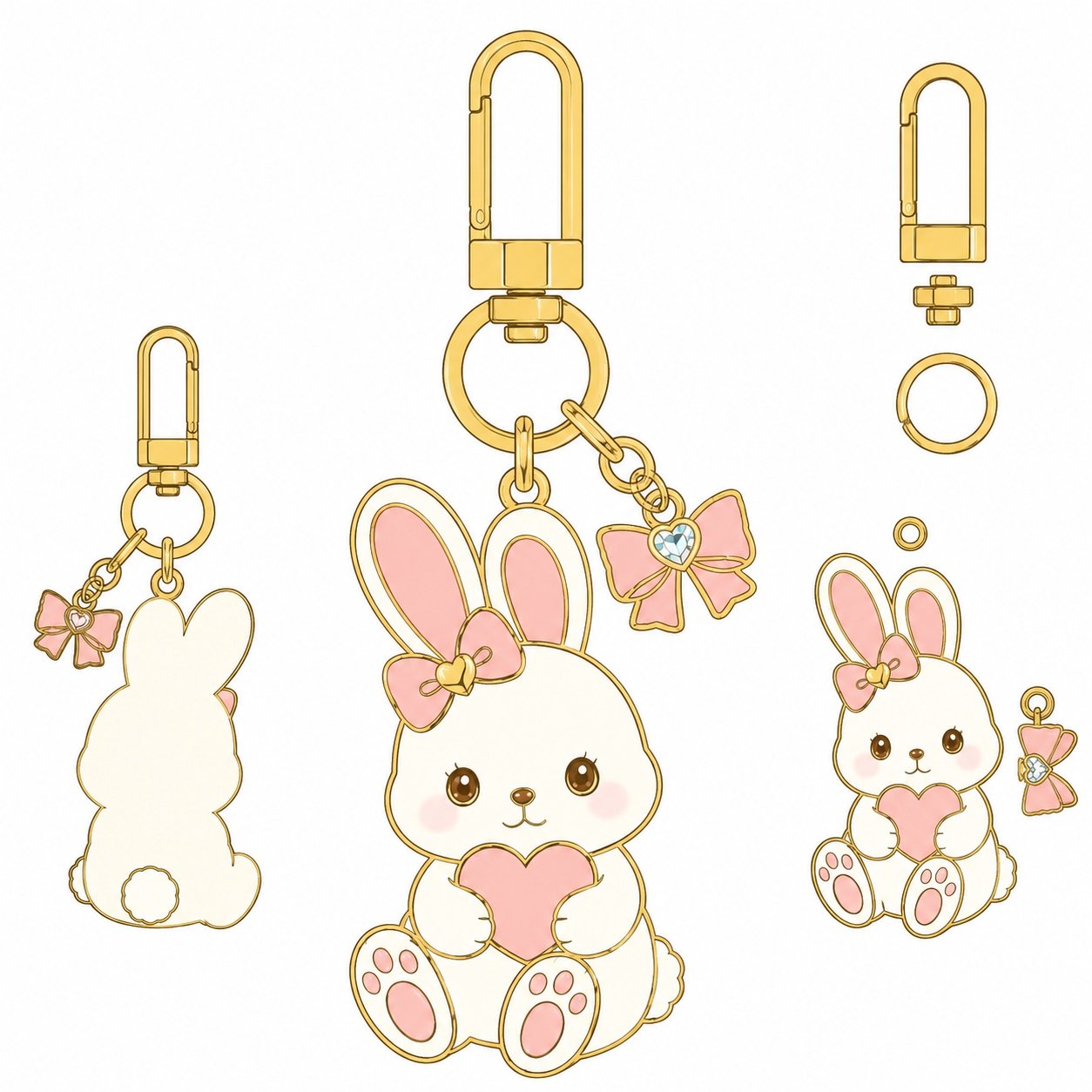
These routes are visible in the finished pieces a buyer can compare directly: the 3D mini handbag bag charm is a solid body with a raised, moulded handle and a separate clasp connection, whereas the fried egg enamel bag charm with chain and tassel combines a stamped body with a separate chain and a textile element that would be impossible to cast in metal at all.

Choosing the attachment: ring, clasp, screw eye, chain
The attachment is the part of a bag charm that buyers argue about least and should argue about most. It is the part that fails in a customer’s hand, and it is the part that determines whether the charm can be sold as a standalone accessory or has to be sold attached.
Four attachment families cover almost all commercial metal bag charms. A split ring threaded through a moulded or soldered loop is the simplest and the most common on cast bodies, and it is also the cheapest, but it opens under a sharp sideways pull and it adds thickness between the charm and the handle. A lobster clasp gives the buyer a positive, one-handed open-and-close action and lets the charm be moved between bags, at the cost of more parts and a heavier bottom edge. A screw eye or a threaded post suits charms that need to be fixed permanently, often because the brand wants the charm welded to a strap rather than clipped to one. A chain, usually combined with a tassel or a bead, turns the charm into a multi-part assembly and shifts the decision from the charm to the whole accessory.
The decision rule that holds up in practice is to specify the attachment based on how the buyer wants the charm used, then to check that the attachment is a standard stocked component rather than a custom part. A custom attachment adds a second tool, a second material and a second supplier to every order, and it is the part most likely to be substituted without anyone noticing. If a buyer wants a clasp, it is cheaper to choose a clasp the factory already runs than to specify a new one.
Buyers who are still deciding between attachment types can work through the hardware options in our bag charm hardware guide, which covers the same attachments from the point of view of the buyer rather than the factory.
Material families and what the alloy changes
Zinc alloy is the mainstream material for die-cast metal gifts, and it dominates because it is the alloy that best balances casting detail, surface quality, cost and finishing response. The widely used grades are covered by ASTM B86-23, the standard specification for zinc and zinc-aluminium foundry and die castings. The standard lists eight alloy compositions across its Common, Traditional, ASTM and UNS designation columns, and it distinguishes between the zinc alloys used primarily for pressure die castings and the zinc-aluminium alloys used in both foundry and pressure die casting. That last point has a practical consequence for bag charms: continuous cast bar stock in those alloys is produced for prototyping and for screw machine stock, which means a design can be iterated in a softer, machinable form before the die casting route is committed.
Stainless steel and brass sit alongside zinc alloy, and each behaves differently enough to change the design rather than just the price. Stainless steel resists corrosion, takes a crisp stamped edge, and is the usual choice when a charm will be exposed to salt, moisture or a lot of handling. It is heavier for the same apparent size, it is more expensive, and it holds a brushed or polished surface rather than a warm plated tone. Brass, and its bronze relatives, offer a different colour behaviour entirely: brass develops a warm tone that reads well next to leather and is often preferred for heritage and vintage-styled ranges, but it is softer than stainless steel and moves with wear.
Iron remains a legitimate option for flat stamped charms where the piece is coated rather than plated, mainly because the material cost is low and the coating carries the appearance. It is not a good match for a charm that will be handled constantly.
The failure mode to watch for is not the wrong alloy but an unspecified one. A quotation that says “metal charm” without naming the alloy and the finish route is not comparable with a quotation that names both, because the second one carries an obligation to deliver a specific appearance and the first one does not. Ask for the alloy designation, not the family name. The custom metal souvenirs range at Kingtop is produced in the confirmed material families, and the same approach applies to charms.
Plating, finishing and colour matching
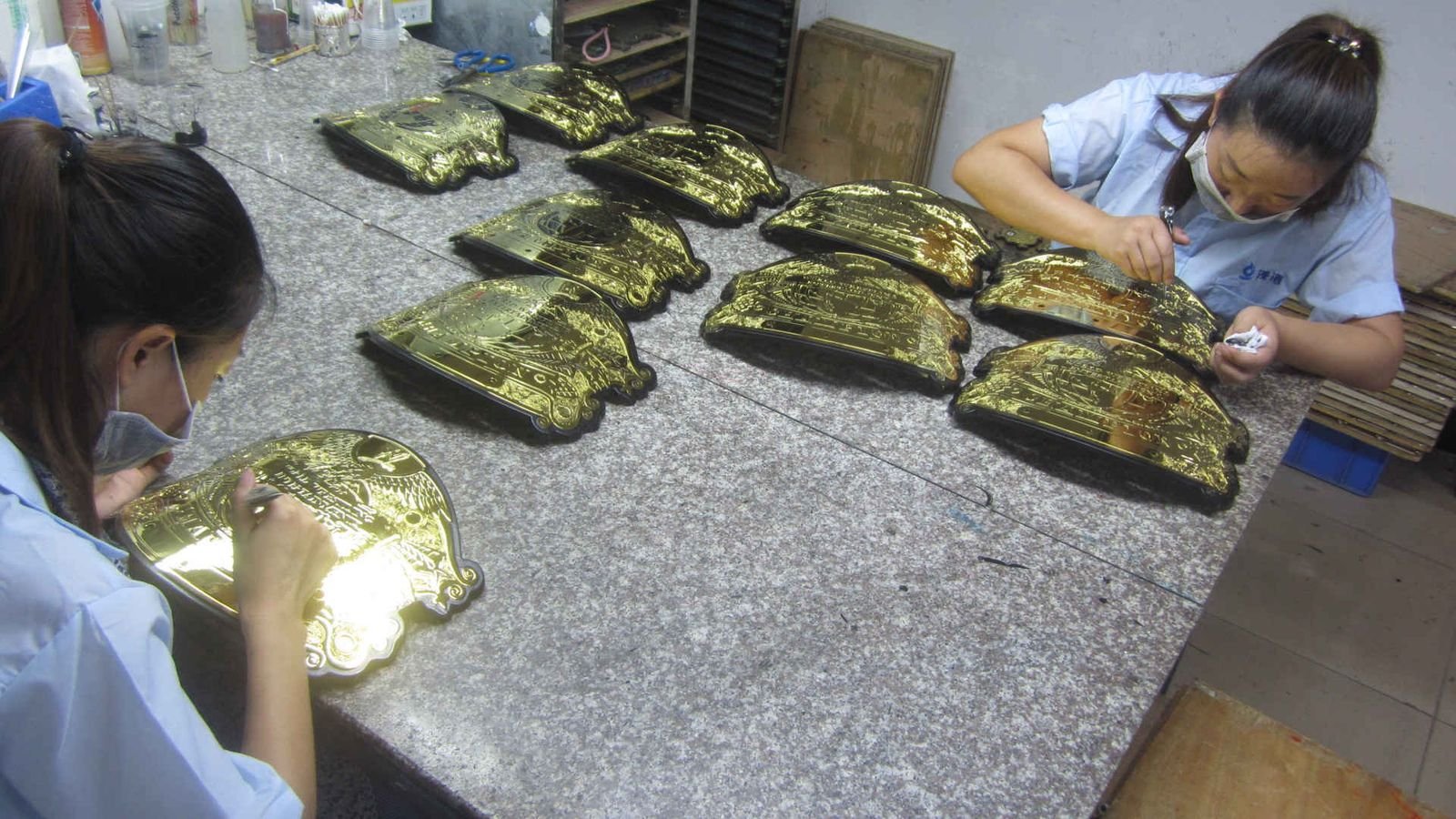
The finish is what the customer sees, and it is also the part of the specification most often left vague. For a plated charm the industry sequence is broadly consistent: the cast or formed body is cleaned, a copper strike layer is laid down, then bright acid copper, then semi-bright or bright nickel, and finally the top layer, which for a chrome-style bright finish is chromium. Each step exists for a reason. The copper strike provides a continuous base that the subsequent layers can bond to, the acid copper and nickel build the barrier that prevents the base alloy from attacking the top layer, and the final layer provides the visible colour and the wear surface.
What the sequence means for a buyer is that “gold plated” is a description, not a specification. Gold, silver, rose gold, antique brass, antique silver, antique copper, black nickel and dual tone are all achievable, and each behaves differently under wear. A bright gold tone shows fingerprints and fine abrasion quickly. An antique finish is created by a controlled surface treatment on top of the plated build, so its colour depends on the plating underneath and on the chemistry of the antiquing step. A dual tone combines two distinct plated areas and needs a masking decision at the design stage.
Colour matching is the practical discipline here. A buyer should hold a physical or printed reference for the target tone and send it with the artwork, and the factory should return a plated sample against that reference before bulk release, not a photograph on a screen. Screens vary, lighting varies, and a photograph of a gold charm can be anything from pale brass to deep yellow. The check that matters is a physical comparison under a consistent light, and the record that matters is a signed reference sample. Kingtop’s plating inspection stage compares finished pieces against a colour reference tray for exactly this reason.
Salt spray testing is a separate question from appearance. ISO 9227:2017 specifies neutral, acetic acid and copper-accelerated acetic acid salt spray tests for assessing the corrosion resistance of metallic materials with or without protective coatings, and it is particularly useful for detecting discontinuities such as pores in metallic and conversion coatings, and for decorative coatings of copper, nickel and chromium. The standard is explicit that it does not specify specimen dimensions or types, the exposure period for a particular product, or the interpretation of results, and that those details come from the appropriate product specification. The standard also states that salt spray methods are not intended for comparative testing as a means of ranking materials or predicting long-term corrosion resistance. Read that way, a salt spray result is evidence about the particular sample tested under a particular regime, not a lifetime figure for the charm, and a buyer who wants a durability claim should ask for a specification that defines the exposure period and the acceptance rule.
Enamel colour fill and artwork preparation
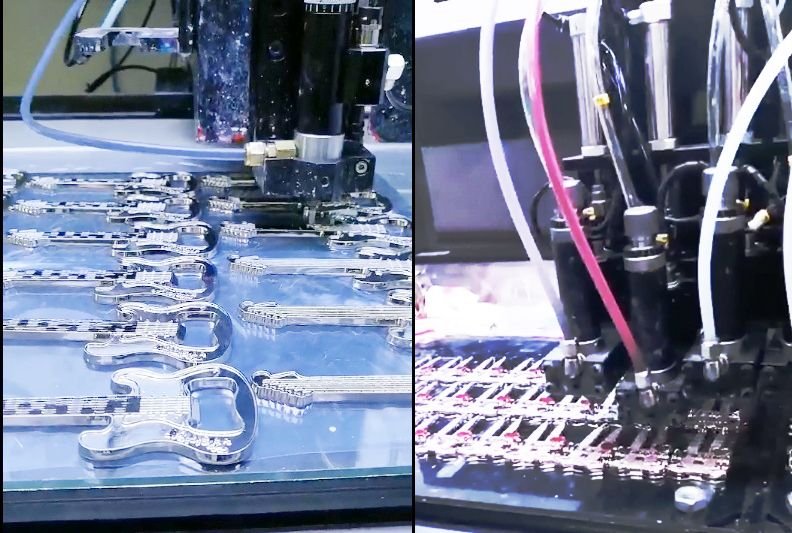
Enamel colour fill is the process that turns a metal charm into a graphic object. It is also the most common source of rework, and the rework is almost always caused by artwork rather than by the process.
There are two distinct products in general use. Soft enamel is a viscous colour that is dispensed into a recessed area and cured; it sits slightly proud of the surface and holds a rounded, glossy meniscus at the edge of the cavity. Hard enamel, also called vitreous or cloisonné-style fill in the trade, is fired and produces a flatter, glassier result with a hard surface and a visible boundary. A charm designed with soft enamel and reviewed as hard enamel, or the reverse, will not look the same, because the cavity geometry and the shrink behaviour are different.
Artwork for enamel needs to be prepared with the process in mind. Colour boundaries need to be closed areas with defined edges, since a colour that runs to the edge of the cavity will bleed at the boundary. The designer needs to know the cavity depth and the target fill level, because a cavity filled too high will show a lip once the metal is polished back. Very fine line work is generally the wrong choice for a cavity that has to hold a viscous colour, and the practical result is a muddy or incomplete fill.
The other artwork rule concerns what happens after the fill. A design that leaves a thin metal web between two colours will crack when the metal is polished back around the cavity, so the minimum web width has to be set by the manufacturing route rather than by the artwork. And a design that places a colour right on a parting line will produce a visible seam that no amount of polishing removes, so parting lines need to be indicated on the drawing before the artwork is finalised.
The enamel colour filling stage itself is straightforward to photograph and straightforward to get wrong. What matters for a buyer is the number of colours, whether each colour is a stock colour or a matched colour, and whether the charm is to be filled on one face or both.
Branding methods and the limits of each
Logo application on a charm is a choice between methods that read differently and cost differently. Six methods cover nearly every commercial requirement, and the right one depends on whether the mark sits on a flat field, on a curved surface, on a relief, or in a recessed area that already holds enamel.
| Method | How it reads | Best fit | Main limitation |
|---|---|---|---|
| Laser engraving | A recessed, tonal mark with no added colour | Fine detail, serial numbers, small marks on an already finished surface | Low contrast on a polished surface; it darkens rather than brightens |
| Screen printing | A flat, controlled colour layer | Flat graphic areas, brand names, colour-matched logo elements | Needs a flat surface; it cannot follow relief or a curved edge cleanly |
| Embossing | A raised mark formed from the metal | A monogram or mark that should read as part of the object | Requires the mark to be designed into the tool, so it is fixed before the first shot |
| Debossing | A pressed-in mark | Minimal, quiet branding on a body with spare space | Visibility depends entirely on the light angle and the finish |
| Moulded logo | A logo formed in the die as part of the body | Charms where the brand mark is the object itself | Any change to the logo means new tooling |
| Enamel colour fill | A colour area that is also the branding | Graphic charms where the mark is part of the illustration | Constrained by cavity geometry; a fine wordmark will not fill |
The commercial mistake is choosing a method for the logo before deciding the route for the body. A mark that has to be embossed cannot be changed after the first sample, and a mark that is screen printed onto a curved surface will be rejected at inspection. Put the logo decision in the same conversation as the body route and the finish, not after the sample has been approved.
Designing for the die: relief, undercuts, parting lines and draft
Charm designers who have worked with metal for a year will design differently from those who have only worked with printed artwork. The constraints are not negotiable, but they are easy to learn.
Undercuts are the first problem. Any feature that a straight pull of the die cannot clear will either not fill or will need a side action, and a side action adds cost and adds the risk of a witness line on the visible face. Deep recesses, overhanging shapes, and hooks that curve back towards the body are all candidates for rejection during die review, and it is far cheaper to find them in a model review than in a first shot.
Parting lines are the second problem. The line is where the two halves of the die meet, it appears on every cast piece, and it is visible on a curved surface far more than on a flat one. A charm shaped as a rounded volume has a parting line that has to run somewhere sensible, and where it runs is a design decision rather than a manufacturing detail. Buyers who want a particular surface to look uninterrupted should tell the factory which surface matters, and expect the answer to constrain the shape.
Draft is the third. A vertical wall in a die will not release; a slightly tapered wall will. When a charm is nearly a flat disc with a small relief on one face, the whole outline needs enough taper to clear the die, and a charm designed with a sharp vertical rim will need either a correction or a parting split.
Relief depth is the fourth, and it is the one most often specified by non-specialists. A deep relief reads well on a coin or a medal but competes with the rest of the design, increases the risk of a short-fill defect, and raises the weight of the piece. A shallow relief reads as a printed graphic once the charm is in the hand and moves. The useful question to ask is not “how deep should the relief be” but “at what viewing distance and in what light should this mark still read”, and to let the answer set the depth with the factory rather than fixing it in a drawing.
The last practical point is wall thickness and weight. A charm that is too thin flexes at the attachment point and will crack there first. A charm that is unnecessarily heavy pulls the handle out of shape and gets removed by the customer. Both problems are solved in the same place: at the model review, with a physical sample in the hand, not on a screen.

Protecting the design before tooling
A charm shape is an industrial design, and for a fashion brand that sells the same form in several markets, it is worth protecting as one. The instrument for that is design registration rather than a trademark, because a trademark protects a name and a logo, while a registered design protects the shape itself.
The Hague System, administered by WIPO, is the route most international fashion brands use. It allows a single international application to register up to 100 designs in 102 countries, and the system has 85 contracting parties, which includes all European Union member states. One of its practical advantages is that no prior national or regional application is required, unlike the Madrid System for trade marks. The fee structure is transparent: a basic fee of 397 Swiss francs for one design with 50 Swiss francs for each additional design in the same application, a publication fee of 17 Swiss francs per reproduction, and designation fees per contracting party where protection is sought. The Hague System overview at WIPO sets out the filing mechanics and the renewal cycle.
Two points deserve emphasis for a buyer commissioning production. First, a design application has to be in place before the shape is released to the factory in a form that can be reverse engineered, because the protection does not retroactively cover a shape that has already been published. Second, the filing and the supplier relationship should be handled in that order, with the supplier contract including a confidentiality obligation on the artwork and the tooling for the duration of the programme.
Selling into the EU: the general product safety rules and nickel release
Two European instruments matter to a bag charm programme, and they apply to different things. The first is safety in general, the second is a specific material restriction.
The General Product Safety Regulation, Regulation (EU) 2023/988, places obligations on the party that places a product on the market. For a brand that imports charms for sale in the European Union, this is not a formality. Article 9 requires the manufacturer to ensure that products have been designed and manufactured in accordance with the general safety requirement, to carry out an internal risk analysis before placing the product on the market, and to draw up technical documentation containing at least a general description of the product and its essential characteristics relevant to assessing its safety. Where there are risks, that documentation must include an analysis of the possible risks and the solutions adopted to eliminate or mitigate them, the outcome of any reports related to tests conducted by the manufacturer or by another party on its behalf, and the list of any relevant European standards applied, identifying which parts were applied where only parts were used.
Article 9 also sets the retention rule: technical documentation must be kept up to date and kept available to market surveillance authorities for 10 years after the product has been placed on the market. Article 9 requires procedures to be in place for products produced in series to remain in conformity, which matters for a charm line that runs over several seasons with incremental design changes. And the same Article requires publicly available channels for consumers to submit complaints and report accidents, plus an internal register of complaints, product recalls and any corrective measures taken. For a small accessory, the practical reading is that the importer needs a file that survives the length of the programme, not a folder that is emptied when the order is closed. The full text of the General Product Safety Regulation is the reference for the file structure.
The second instrument is narrower and more specific. Directive 94/27/EC inserts entry 28 into Annex I of Directive 76/769/EEC, covering nickel, CAS number 7440-0-20, and its compounds. The entry lists three prohibitions. Nickel may not be used in post assemblies inserted into pierced ears unless the post assembly is homogeneous and the nickel concentration expressed as mass of nickel to total mass is less than 0.05 per cent. It may not be used in products intended to come into direct and prolonged contact with the skin, and the list of examples is broad: earrings, necklaces, bracelets and chains, anklets, finger rings, wrist-watch cases, watch straps and tighteners, and rivet buttons, tighteners, rivets, zippers and metal marks when these are used in garments. For those products, the rate of nickel release from the parts in direct and prolonged contact with the skin must not be greater than 0.5 micrograms per square centimetre per week. Third, where such a product has a non-nickel coating, that coating must be sufficient to ensure the same release rate is not exceeded for a period of at least two years of normal use. Products subject to these points may not be placed on the market unless they conform.
Applied to bag charms, the practical question is whether the charm or its hardware is intended to contact skin directly and for a prolonged period. A charm hanging from a bag handle usually does not. A charm sold as a necklace pendant, a charm on a bracelet, a charm on a phone strap held in the hand, or a charm fitted to a garment through a metal mark does. The full text of Directive 94/27/EC sets out the entry in full. Buyers who need to answer the question for a specific charm should ask for a nickel release test against the relevant CEN method rather than accepting a supplier statement, because the directive sets the limit and the test method is a separate question.
Sampling, approval and the handover package
The sample stage is where most programmes are won or lost, and the reason is usually that the approval was informal. A photo of a sample arriving by email is not an approval, because the recipient cannot hold it, cannot check it against the artwork at the same time, and cannot see how the finish behaves under a different light.
A workable approval sequence looks like this. The artwork is issued as a dimensioned drawing with the parting line indicated and the finish, the material and the attachment named separately. The factory produces a first sample on the production route, not a CNC or soft-machined model, because a machined model can flatter a design that the die will not reproduce. The sample is checked against the drawing for form, against the reference for colour and plating, and in the hand for weight, edge finish and attachment security. The factory returns the sample with a written note listing what has been changed, if anything, and why. The buyer responds with a signed approval that names the sample by a reference, not by “the one with the gold clasp”.
The handover package is the file that travels with the programme. It should contain the approved drawing, the artwork files used to cut the cavity and to apply the logo, the material and finish specification, the plating reference and the approved colour sample, the attachment component specification, the artwork file for the enamel colours with their references, the signed sample approval, the packaging and labelling instruction, the compliance documentation the buyer needs for its own file, and the tool ownership terms. Kingtop’s design and engineering stage is where those files are typically produced and consolidated.
Buyers who want the sampling and approval stage specified in more detail can read the wine stopper sample approval checklist and the metal keychain sample approval guide, which apply the same structure to two other product families.
Quantities, lead time and packaging
Quantities and lead time in this product family are not fixed numbers in the industry, they are a function of the route, the tooling and the finishing. What a buyer should take from a factory is the tier structure rather than a single figure. Kingtop’s confirmed position is a minimum order quantity structure of 100, 500 and 1000 pieces, a sampling stage of about 7 days, and a production lead time of 15 to 20 days, with shipping by express, air or sea. Product-specific quantities, costs and lead times should be confirmed from the current quotation for the item in question rather than assumed from the general structure.
Packaging is decided at the same time as the finish, because the packaging has to protect the charm from the finish. A charm with a bright polished surface and a fingerprint-prone plating should not be bagged in a thin soft sleeve that rubs. A charm with a chain and a textile tassel needs a tie-back rather than a glued card, because a glued card will pull the chain through its own knot point. A charm sold as an accessory to a handbag needs a header card with a hole position that matches the bag handle in use, and a small charm sold as a gift needs a carton that will not crush the relief.
The other packaging decision is regulatory rather than physical. If the charm is sold into the European Union as a consumer product, the packaging and any attached documentation are part of the product information the manufacturer has to produce, and they should be reviewed before the first production run rather than adapted afterwards.
Quality control points that catch real defects
Quality control on a charm programme is not a final inspection. The points that matter are the ones where a defect can still be corrected without scrapping the run.
Incoming material inspection matters when the charm uses a base alloy that arrives as cast bar stock or as granules, because the alloy batch determines the casting behaviour and the surface response to plating. In-process control at the die casting stage catches short fills, cold shuts and porosity, and these are the defects that are expensive later because they are hidden under plating. Trim and file control catches the sharp edges and the incomplete parting-line cleanup. Plating bath control and the colour reference comparison are what keep a batch of 1,000 pieces consistent with the approved sample. Assembly control matters most for charms with a chain, a clasp or a tassel, because an incorrectly attached clasp is invisible on a tray and obvious in a customer’s hand. Final inspection then checks the specific thing the programme is known for, which is usually colour match, attachment security and the presence of the correct logo.
The controls worth writing into the purchase order are the ones a buyer can audit: a defined sample approval, a defined colour reference, a defined defect rule for the plating and a defined method for verifying attachment security. Where a programme runs across several seasons, add the requirement for the batch record to be retained, because that is what allows a repeat order to match the original.

How to brief a factory and compare quotations
A brief that produces comparable quotations needs six named items, not a mood board. Name the body route. Name the material alloy and the finish with its reference. Name the attachment as a component rather than as a picture. Name the branding method for each element of the logo. Name the quantities you need and the packaging you need. Name the market you are selling into and the documents you need with the goods.
When the quotations come back, compare them on those six items rather than on unit price. Two quotations can differ by a wide margin and still be comparable, and two can be close in price and describe different products entirely. The specific things that make two quotations incomparable are the ones most often left out: an unspecified alloy, a finish described only as “gold”, an attachment described only as “metal ring”, and a lead time quoted without a route for the enamel or the plating stage.
Ask for one thing from every factory that responds, and it is the one that separates a supplier from a vendor: the factory’s own proposal for the design. A factory that returns the artwork with a marked-up drawing, an alternative parting line position, a suggested cavity width for the enamel and a note about which logo method will fail on the raised surface has done work. A factory that returns a price against the artwork alone has quoted a price against a file it has not yet read. The custom bag charms range at Kingtop is the reference point for the finished examples.
Frequently asked questions
Can a bag charm be made from the same alloy as a medal or a keychain in the same range?
Yes, and it is normal practice to consolidate a brand programme onto one alloy so that plating, enamel and packaging can be shared across the range. The benefit is consistency of colour between the charm and the other products, which matters to a retailer. The cost is that the charm is then tied to the plating cycle used for the rest of the range, so a later change to the range finish affects the charm too.
Is a charm worn against the skin subject to the same nickel rules as jewellery?
It depends on the intended use. A charm suspended from a bag handle that does not touch the skin is outside the scope of the direct and prolonged skin contact rules. A charm sold as a necklace or bracelet pendant, or fitted to a garment as a metal mark, falls inside them, and the nickel release limit and the coating durability requirement apply. Deciding this before the design is finalised is far cheaper than reworking the plating afterwards.
How many colours of enamel can a single charm carry?
There is no fixed number and any answer without the cavity geometry would be misleading. Each additional colour adds a fill cycle and a risk of bleed at a shared boundary, and the practical limit is set by how small the cavities can be and how cleanly the metal web between them can be finished. A cleaner rule for the buyer is to specify the artwork in colours that the cavity geometry can hold, and to have the factory confirm the colour count against the model before approving it.
Can the logo be changed after the first sample?
It depends on the method. Screen printed and laser engraved marks can be changed on later orders without new tooling. Embossed, debossed and moulded logos are part of the tool, so a change means new tooling and a new cost. This is the strongest practical argument for fixing the branding method at the same time as the body route.
What should be on the purchase order so that a repeat order matches?
The approval reference for the sample, the colour reference for the plating, the alloy designation, the attachment component specification, the cavity and enamel colour file, the packaging instruction, and an agreement that the batch record is retained and can be supplied with a repeat order. Without the retained batch record, a reorder two seasons later is a new colour negotiation even when nothing has changed on the design.
What to send with your enquiry
Send the artwork as a vector file with the parting line marked, the material and finish you have in mind, the attachment type, the quantities for each market, the packaging format, the market you are shipping into and any compliance documents you need. If the design is still a concept, a photograph and a sketch with the attachment circled is enough to start a conversation about the route, and a factory that can advise on the route before quoting is worth keeping.
For specific advice on a metal bag charm programme, or a quotation against your own artwork, the fastest route is to send the design to the Kingtop manufacturing team with the six named items above. You can reach them at sales@kingtopgift.com and discuss the project, the alloy options, the attachment selection and the sampling plan with the people who will run the tooling and production rather than with a sales desk that forwards the file.