
Wine stoppers are reusable closures designed to reseal opened wine bottles and reduce exposure to air. Common types include cork, silicone, stainless steel and decorative metal stoppers, while custom designs can also be produced for gifts, wineries and promotional projects.
Which Wine Stopper Should You Buy? A Buyer’s Decision Table
If you are sourcing wine stoppers for resale, a winery gift pack, a hotel programme or a promotional giveaway, the decision comes down to three things: how well it seals, how it looks on shelf, and what it costs at your volume. Use this table to narrow the field before you request a quotation.
| Your Use Case | Recommended Type | Material | MOQ | Key Point to Specify in Your RFQ |
|---|---|---|---|---|
| Winery or vineyard — take-home gift for customers | Custom 2.5D or 3D metal stopper | Zinc alloy | 500 pcs | Bottle neck fit (standard 18.5 mm / 20 mm) and whether the stopper is for standard or sparkling bottles |
| Souvenir or gift shop — sellable retail item | Decorative metal stopper, city or landmark shape | Zinc alloy, plated + enamel | 500 pcs per design | Retail packaging: backing card or gift box, and individual barcode labelling |
| Corporate gift or employee programme | Logo-applied stopper on a stock shape | Zinc alloy | 100–500 pcs | Logo method (laser engrave vs screen print) and Pantone colour reference |
| Hotel or restaurant programme | Vacuum stopper or metal stopper | Stainless steel / silicone seal | 500 pcs | Seal rating required, and whether the piece must be food-contact compliant in the destination market |
| Champagne or sparkling wine | Champagne stopper (not a standard wine stopper) | Zinc alloy or stainless steel | 500 pcs | Pressure rating and the presence of a mushroom or cork-style top |
| Event or wedding favour | Personalised stopper, engraved | Zinc alloy | 500 pcs | Engraving text, date format, and individual versus set packaging |
What to Check Before You Choose a Wine Stopper Supplier
The stopper itself is the easy part. What separates a reliable metal gift supplier from a trading intermediary is the manufacturing setup behind it. Before you commit, confirm these six points:
- Are they the factory? A manufacturer owns die casting, polishing, plating, enamel and assembly lines. A trading company subcontracts all of it and adds a margin between you and the actual production cost.
- Who owns the mould? Once the tooling fee is paid, the mould should be yours. Ask for this in writing — it is your leverage for repeat runs and your protection if the relationship changes.
- What is the real lead time? A realistic timeline is roughly 7 days for a physical sample, 15–20 days for tooling, and 15–20 days for mass production. Any supplier quoting a materially shorter timeline is either not doing the tooling or is skipping sample approval.
- What are the minimum order quantities? Standard MOQ is 500 pieces per design; designs requiring a new mould usually start at 1,000. Ask whether a stock shape with your logo can start at 100.
- Which certifications do they hold? Look for ISO 9001, BSCI and Sedex/SMETA for social compliance, plus RoHS and EN 71-3 where the product may reach children.
- How is quality confirmed before shipment? Expect a pre-production sample check, in-line inspection, and a final AQL inspection with photos sent to you — not just a “looks fine” message on the last day.
Kingtop is a metal gift manufacturing factory in Dongguan, Guangdong, producing custom wine stoppers since 2003, with ISO 9001, BSCI and Sedex/SMETA certification. See our buyer FAQ for pricing, packaging, shipping and payment terms, or how MOQ works.
Wine stoppers are reusable closures designed to reseal an opened wine bottle and help reduce unnecessary exposure to outside air. Opening a bottle of wine is easy, but keeping the remaining wine protected after opening requires the right closure. Modern wine stoppers are available in many materials, structures and decorative designs, ranging from simple reusable stoppers to custom metal wine stoppers for wineries, gifts, souvenirs and promotional projects.
A wine stopper provides a simple way to close an opened bottle again. However, modern wine stoppers are no longer limited to basic functional closures. They are available in many materials, structures, shapes, finishes, and decorative designs. Some are designed primarily for everyday wine storage, while others are developed as branded gifts, promotional products, souvenirs, winery accessories, or premium retail items.
For businesses, wineries, hotels, souvenir distributors, gift companies, and promotional product buyers, a wine stopper can therefore serve two purposes at the same time: it can be a practical bottle accessory and a customizable product that carries a brand, logo, theme, or decorative design.
This guide explains the main types of wine stoppers, the materials used to manufacture them, how they work, how they differ from corks and champagne stoppers, and what buyers should consider when developing a custom metal wine stopper.
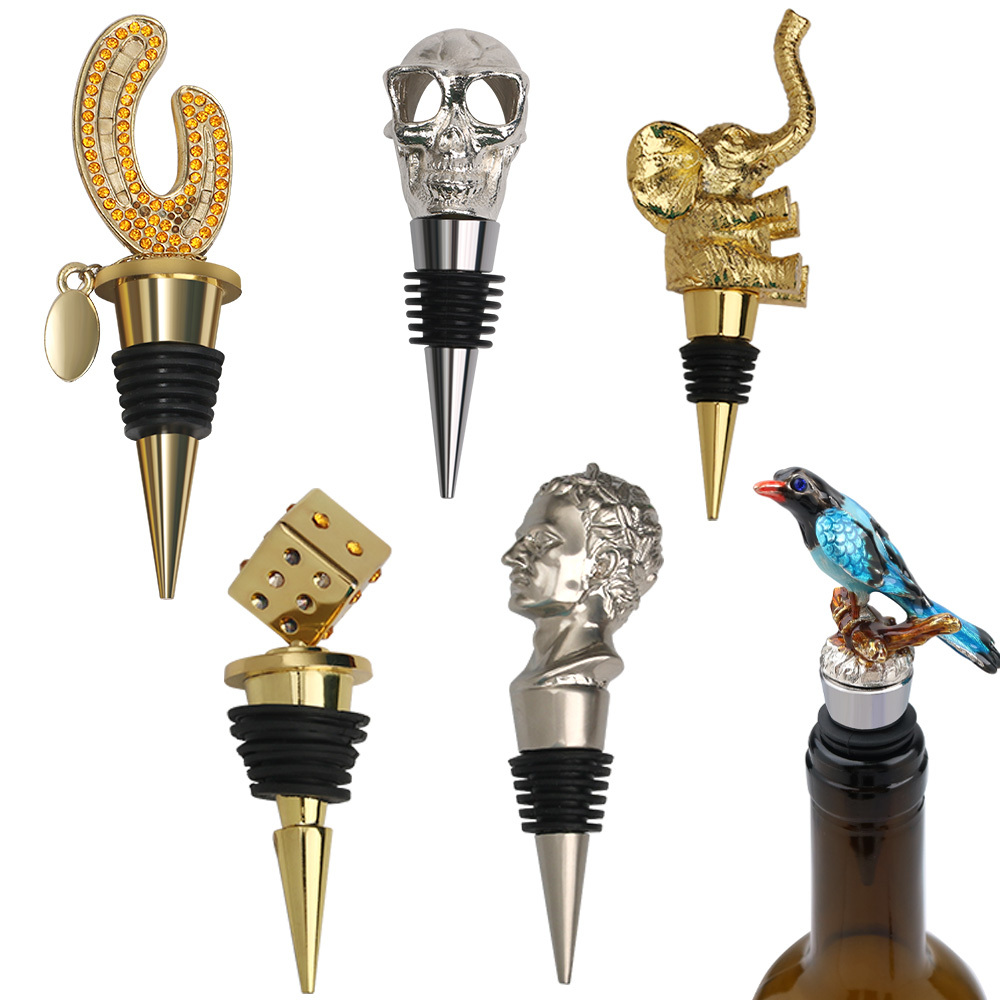
What Is a Wine Stopper?
A wine stopper is a closure used to reseal an opened wine bottle and help reduce exposure to air. Wine stoppers are available in cork, silicone, stainless steel, zinc alloy and other materials. They range from simple functional closures to decorative and custom designs used for wineries, gifts, promotional projects and branded merchandise.
Unlike champagne stoppers, which are designed to withstand pressure from sparkling wine, standard wine stoppers are mainly used for still wine bottles.
Why Use a Wine Stopper?
A wine stopper is primarily used to reseal an opened wine bottle, but its value extends beyond basic storage.
When wine is exposed to oxygen, chemical changes begin to occur. Controlled oxygen exposure plays an important role in how wine changes after opening. A limited amount of oxygen can initially help some wines open up, but continued exposure eventually changes the wine’s aromas and flavors.
A wine stopper does not return the bottle to its original unopened condition, but it can help reduce unnecessary air exchange and keep the bottle closed between servings.
For everyday users, this makes the stopper a convenient reusable accessory. For businesses, however, the product can also become part of the customer experience.
A winery may use a custom metal stopper carrying its vineyard logo. A hotel may include an elegant bottle stopper in a guest gift set. A souvenir shop may sell a stopper topped with a miniature local landmark. A company may use a personalized wine stopper as an anniversary or promotional gift.
This combination of function and decoration is one reason custom wine stoppers are especially suitable for OEM and ODM development.
Common Types of Wine Stoppers
Different wine stopper structures are designed for different uses. Understanding the main types makes it easier to select the right product for a retail collection, gift program, or custom manufacturing project.
Standard Wine Bottle Stopper
The standard reusable bottle stopper is one of the simplest designs.
It usually contains a rigid stem or body that enters the bottle neck and a flexible sealing section made from silicone or rubber. The flexible rings create contact with the inner surface of the bottle opening.
This style is compact, convenient, and easy to use.
Because the functional structure is relatively simple, manufacturers can place more attention on the decorative top. That makes the standard inserted stopper one of the most common structures for custom metal wine stoppers.
The top can be customized while the lower sealing mechanism remains standardized.
This combination is particularly useful for bulk OEM production because buyers can create many different visual designs without completely redesigning the functional stopper mechanism for every project.
Metal Wine Stoppers
Metal wine stoppers are particularly popular in premium gift, souvenir, hospitality, and promotional applications.
The term “metal wine stopper” does not necessarily mean that every component is made entirely from metal. A typical decorative metal stopper may combine several materials.
For example, the upper decorative component may be made from zinc alloy, brass, or stainless steel. The stem may be stainless steel, while the sealing rings are usually made from silicone or another flexible material.
This mixed-material structure provides both appearance and functionality.
The metal top gives the product weight, texture, and decorative value, while the flexible sealing section helps the stopper fit different bottle openings.
Metal stoppers also provide significantly more customization opportunities than basic plastic closures.
They can support:
| Custom Option | Typical Application |
|---|---|
| 2D relief | Logos, emblems, simple graphics |
| 2.5D relief | Layered artwork and dimensional logos |
| 3D sculpture | Animals, landmarks, figures, decorative objects |
| Enamel | Colored logos and detailed graphics |
| Plating | Gold, silver, antique and other finishes |
| Engraving | Names, messages, dates or branding |
| Printing | Small graphics and detailed color areas |
| Custom packaging | Retail, gifting and promotional projects |
For this reason, custom metal wine stoppers are frequently developed as more than bottle accessories. They become decorative gift products in their own right.
Zinc Alloy Wine Stoppers
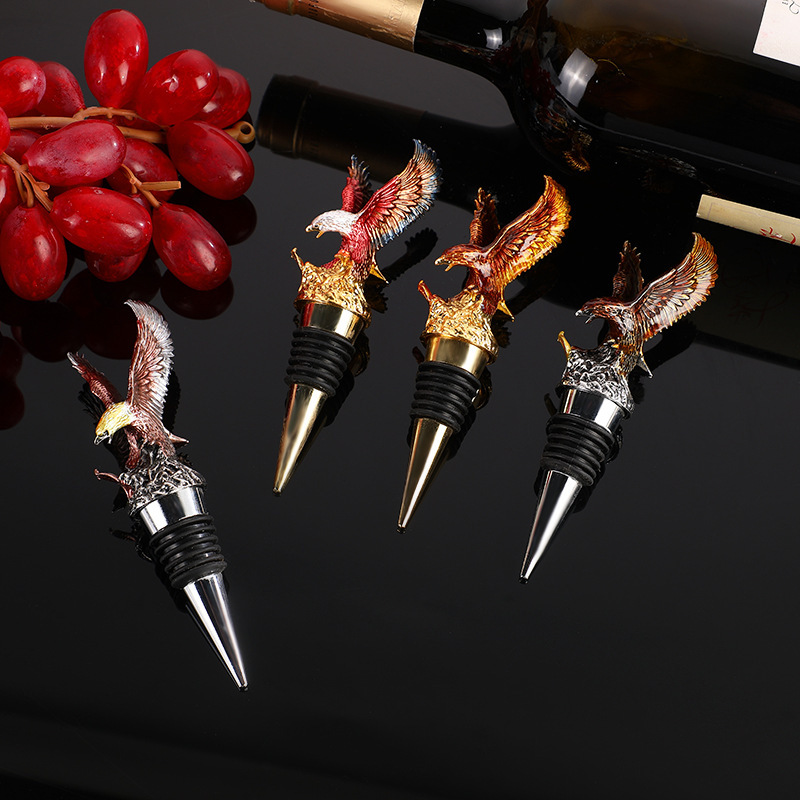
Zinc alloy is one of the most practical materials for highly decorative custom wine stopper tops.
One of its main advantages is design flexibility.
Zinc alloy can be die-cast into detailed shapes, making it suitable for complicated logos, animals, buildings, sculptural decorations, souvenir themes, and 3D designs.
It also accepts a wide range of surface treatments and plating finishes.
A zinc alloy wine stopper can therefore be produced in polished silver, gold, rose gold, antique silver, antique gold, black nickel, or other decorative finishes depending on the project.
For buyers developing complex decorative products in larger quantities, zinc alloy usually offers a useful balance between detail, production efficiency, customization, and cost.
A 3D animal wine stopper, for example, would normally be easier to manufacture in zinc alloy than by machining the same complex form from stainless steel.
Likewise, a miniature building or landmark can be developed with architectural details, textured surfaces, recesses, and layered relief.
This makes zinc alloy particularly suitable for:
wineries with distinctive branding, souvenir collections, commemorative projects, tourism products, corporate gifts, branded hotel accessories, and decorative retail wine products.
Decorative Wine Stoppers
Decorative wine stoppers place more emphasis on visual design.
Instead of using a simple round knob or plain handle, the stopper top becomes the focal point of the product.
Common themes include animals, flowers, grape and wine motifs, architectural landmarks, travel symbols, abstract ornaments, initials, monograms, seasonal designs, and original branded shapes.
For souvenir programs, a local landmark can be recreated as a miniature metal sculpture.
For wineries, a grape cluster, vineyard emblem, family crest, or wine label symbol can be adapted into a decorative topper.
For gift projects, designs can be created around weddings, anniversaries, holidays, corporate events, or commemorative occasions.
Decorative stoppers are especially effective when the product is intended to remain visible after purchase. Unlike many promotional items that are stored away, an attractive wine stopper may remain on a dining table, wine cabinet, home bar, or kitchen counter.
That gives the decorative design greater long-term value.
Personalized Wine Stoppers
Personalized wine stoppers add customer-specific information to the product.
Personalization may include a company logo, initials, names, dates, event information, custom artwork, a branded emblem, or a completely original shape.
There are several ways to personalize a metal wine stopper.
Raised or recessed logos can be built directly into the mold. Enamel can be added to selected areas. Laser engraving can be used for names and text. Printed graphics can be added where extremely fine detail is required.
The best method depends on the design, quantity, material, appearance, and budget.
For large-volume orders, incorporating the logo directly into the tooling usually creates a more integrated product appearance than applying a generic decorative piece afterward.
This is why OEM projects often begin with artwork evaluation rather than simply choosing an existing stopper and printing a logo onto it.
Vacuum Wine Stoppers
Vacuum wine stoppers use a pumping mechanism designed to remove some of the air from an opened wine bottle.
The stopper is inserted into the bottle, and a compatible pump is used to reduce the amount of air inside.
These systems are mainly designed around wine preservation rather than decoration.
A vacuum stopper can reduce the amount of air in the bottle, although it does not completely stop the chemical changes that occur after wine has been opened.
For buyers comparing wine accessories, vacuum stoppers are therefore best understood as a different product category from decorative custom metal stoppers.
One focuses primarily on preservation mechanics.
The other combines practical closure with branding, decoration, gifting, or souvenir value.
Champagne and Sparkling Wine Stoppers
Champagne and sparkling wine require a different closure structure because the bottle contains internal pressure.
A simple inserted wine stopper may not be appropriate for sparkling wine.
Champagne stoppers generally use a locking or clamping structure that secures the closure around the bottle neck. This helps prevent pressure from pushing the stopper out.
The distinction is important for both consumers and product buyers.
A standard wine stopper and a champagne stopper may look similar at first glance, but their mechanical requirements are different.
If you are comparing the two products in more detail, see our guide:
Wine Stopper vs Champagne Stopper: What’s the Difference?
This type of internal connection is useful for buyers because it separates two products that are often incorrectly treated as interchangeable.
Wine Stopper Materials
Material selection affects appearance, weight, durability, design complexity, manufacturing method, and cost.
For custom projects, there is rarely one material that is universally “best.” The right option depends on what the product needs to achieve.
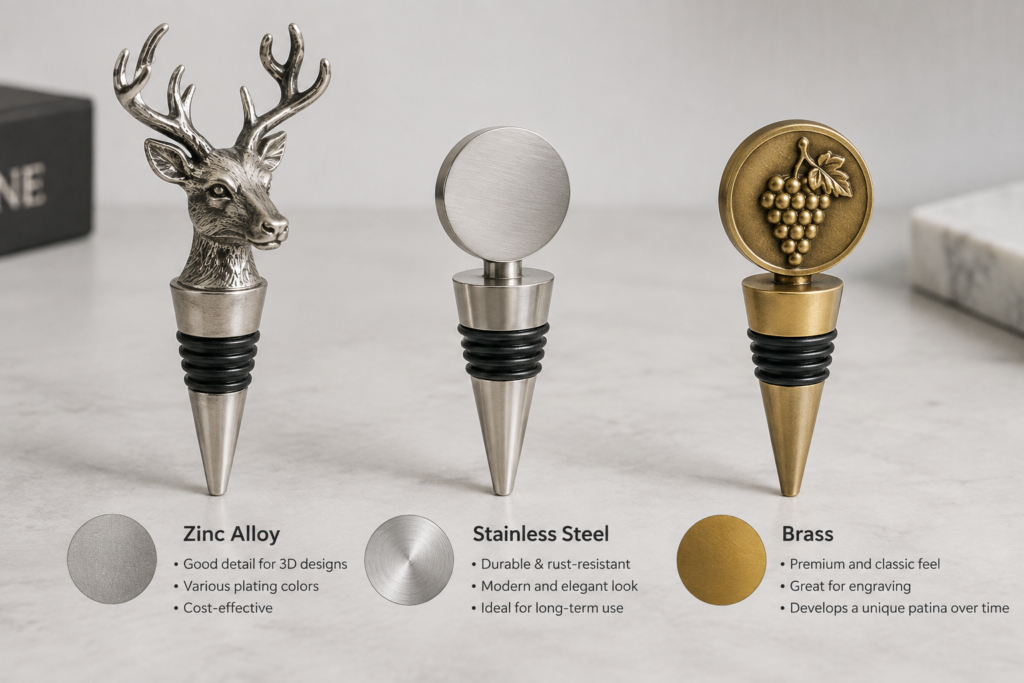
Zinc Alloy Wine Stoppers
Zinc alloy is especially suitable for decorative custom wine stopper tops.
Its main strengths are casting flexibility and dimensional detail.
Complex forms can be produced efficiently through die casting, making zinc alloy particularly useful for 2.5D and 3D designs.
After casting, the parts can be polished, plated, painted, enamel-filled, assembled, and packaged.
Zinc alloy is therefore a strong option for designs where visual complexity is more important than achieving a minimalist machined-metal appearance.
Typical applications include animal figures, architecture, souvenir landmarks, ornate emblems, corporate symbols, and decorative sculptures.
Zinc alloy is especially suitable for custom wine stoppers because it can be die-cast into detailed 2D and 3D shapes while supporting a wide range of decorative finishes. Custom zinc alloy wine stoppers can be produced with
logos, landmark designs, mascots, award themes and branded elements for wineries, souvenir programs, corporate gifts and promotional projects.
For wholesale and OEM projects, zinc alloy tops can be finished in gold, silver, rose gold, antique brass, antique silver and other plating options. Enamel colors, engraving, polishing and custom packaging can also be added to
match different branding requirements. This makes zinc alloy a practical choice for businesses that need decorative wine stoppers in bulk while maintaining consistent design and finish quality.
Kingtop supports custom zinc alloy wine stopper projects from artwork and mold development to die casting, plating, assembly and bulk production.
Learn more about our custom wine accessory manufacturing capabilities for OEM and bulk projects.
Stainless Steel
Stainless steel offers a cleaner and more modern appearance.
It is frequently used for functional wine accessory components because of its durability and corrosion resistance.
In many decorative wine stopper designs, stainless steel is used for the stem or structural part of the stopper, while another metal is used for the decorative top.
For simpler premium products, stainless steel can also be used as the primary visual material.
It is particularly suitable for designs that rely on smooth surfaces, geometric forms, or a contemporary appearance.
Brass
Brass has a heavier feel and a naturally premium character.
It can be polished, plated, engraved, or finished in antique styles.
For selected high-end designs, brass provides a substantial weight that can contribute to a luxury impression.
However, material choice should still be based on the design.
A highly detailed 3D animal figure may be more economical and practical in zinc alloy, while a simple engraved premium stopper may work well in brass.
Silicone and Rubber
Silicone or rubber is normally used in the sealing portion rather than the decorative top.
Flexible sealing rings adapt to the inner wall of the bottle neck and help create friction and contact.
The geometry of these rings is important.
A stopper that looks attractive but does not fit the intended bottle properly will not provide a good user experience.
For custom product development, manufacturers therefore need to consider both decorative design and functional dimensions.
Cork
Cork remains closely associated with wine bottles, but it serves a different role from most reusable wine stoppers.
Natural cork is commonly used as the original bottle closure before opening.
A decorative wine stopper is usually intended for repeated use after opening.
Some designs combine decorative tops with cork-style lower sections, creating a hybrid product that retains the traditional appearance of cork while adding a decorative reusable component.
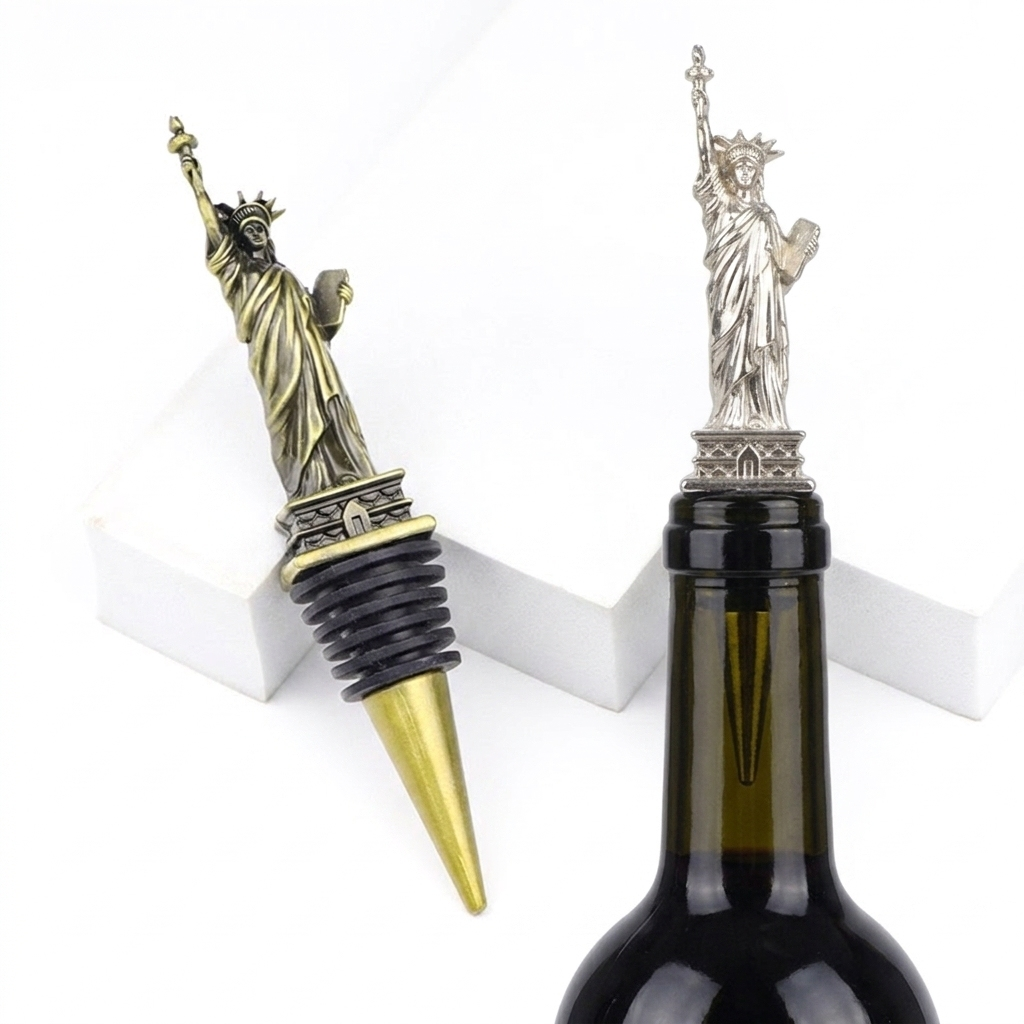
How Does a Wine Stopper Seal a Bottle?
The structure of a typical inserted wine stopper is relatively simple, but each component has a specific function.
The upper section is the decorative top. This is where branding, shape, color, and visual customization usually occur.
Below the decorative section is the stem.
Around the stem are flexible silicone or rubber rings.
When the stopper is inserted into the bottle neck, these rings compress slightly against the inner surface of the glass.
That contact helps hold the stopper in place and limits open airflow through the bottle opening.
A typical structure can be understood as:
Decorative Metal Top → Metal Stem → Silicone Sealing Rings → Bottle Neck
This also explains why custom wine stopper development should not focus only on appearance.
Weight distribution, stem dimensions, sealing ring size, bottle compatibility, and assembly quality all influence the finished product.
Wine Stopper vs Cork
Wine stoppers and corks both close wine bottles, but they are usually used at different stages.
| Feature | Reusable Wine Stopper | Traditional Cork |
|---|---|---|
| Typical use | After opening | Original bottle closure |
| Reusability | Designed for repeated use | Limited |
| Decorative customization | Extensive | Limited |
| Custom 3D shapes | Yes | Generally no |
| Logo branding | Easy to integrate | Possible but more limited |
| Gift potential | High | Lower |
| Metal finishes | Available | Not applicable |
| Souvenir use | Suitable | Uncommon |
A cork is still highly appropriate as an original wine closure.
A reusable stopper is simply better suited to situations where the bottle needs to be opened and closed repeatedly or where decoration and branding are important.
The two products should therefore not be treated as direct replacements in every application.
Wine Stopper vs Champagne Stopper
The main difference between a wine stopper and a champagne stopper is pressure.
For a more detailed comparison of sealing structure, pressure resistance and bottle applications, see our Wine Stopper vs Champagne Stopper guide.
Still wine does not create the same internal pressure found in sparkling wine bottles.
As a result, many standard wine stoppers rely mainly on friction and flexible sealing rings.
Champagne stoppers typically require a locking mechanism that grips the outside of the bottle neck.
This extra mechanical security helps keep the closure in place.
For buyers developing wine accessory collections, this distinction matters because the products may require different tooling, components, structures, and testing.
A decorative top can potentially share a similar design language across both products, but the functional closure beneath it should be appropriate for the type of bottle being used.
Common Uses for Custom Wine Stoppers
Custom wine stoppers can serve a wide range of B2B markets.
Wineries and Vineyards
Wineries can use branded wine stoppers as tasting-room merchandise, wine-club gifts, gift-box accessories, event souvenirs, or customer loyalty products.
A winery logo can be incorporated directly into the stopper top, creating a product that remains connected to the brand after the wine has been consumed.
Hotels and Restaurants
Hotels, resorts, bars, restaurants, and hospitality groups may use customized wine accessories in branded gift collections or premium customer programs.
A well-designed metal stopper can also complement corkscrews, wine pourers, wine charms, or other accessories in a coordinated wine gift set.
Corporate Gifts
Wine accessories are commonly associated with business gifting.
A custom logo stopper can be developed for anniversaries, conferences, client gifts, employee recognition, product launches, and promotional campaigns.
Packaging can also be customized to create a more complete presentation.
Weddings and Events
Names, initials, dates, symbols, and themed designs can be incorporated into customized stoppers for weddings, celebrations, anniversaries, and special events.
Souvenir and Gift Shops
Decorative stoppers are well suited to tourism markets.
Landmarks, animals, local symbols, cultural elements, and destination graphics can be transformed into metal souvenir products.
For example, the top of a wine stopper can be shaped into a miniature building representing a city or tourist attraction.
Promotional Programs
Brands can develop custom wine stoppers as long-lasting promotional products.
Compared with disposable advertising items, a reusable wine accessory can remain in use for a much longer period.
Custom Wine Stopper Design Options
One of the advantages of metal manufacturing is the range of customization possibilities available.
2D, 2.5D and 3D Designs
A 2D design normally uses relatively flat raised or recessed areas.
It is useful for logos, text, emblems, and simple graphics.
A 2.5D design introduces multiple depth levels, creating a more dimensional appearance without forming a completely sculptural object.
A full 3D design can reproduce shapes from several viewing angles.
This is ideal for animals, statues, landmark buildings, characters, flowers, and decorative objects.
The choice between 2D, 2.5D and 3D should depend on the artwork and the desired finished appearance rather than simply selecting the most complex option.
Custom Shape
The decorative top does not need to be round or square.
Depending on manufacturing feasibility, it can follow the outline of a logo, building, animal, symbol, crest, bottle, grape cluster, flower, or original illustration.
The more complex the geometry becomes, the more important it is to consider production requirements such as mold release, wall thickness, polishing accessibility, assembly balance, and fragile protruding areas.
Good custom design therefore involves both aesthetics and manufacturing engineering.
Logo and Branding
Branding can be incorporated through several processes.
A raised logo can be part of the original mold.
A recessed logo can be filled with enamel.
A flat metal surface can be engraved.
Printed graphics can be used for complex multicolor artwork.
The most appropriate method depends on the quantity, design size, color requirements, finish, and budget.
For OEM and branded projects, explore our custom wine accessories including custom wine stoppers, wine pourers and gift accessories.
Plating Finishes
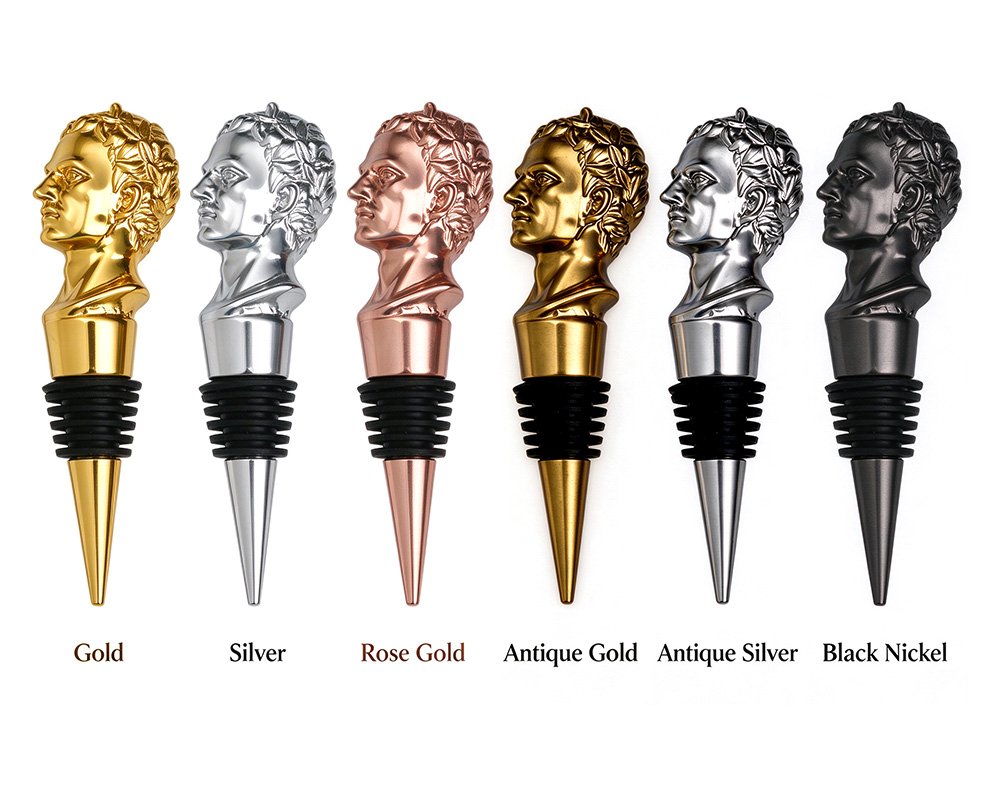
Plating has a major effect on the visual character of a metal wine stopper.
Common choices include:
| Finish | Visual Style |
|---|---|
| Gold | Warm, premium, decorative |
| Silver | Clean and versatile |
| Rose Gold | Soft, modern, gift-oriented |
| Antique Gold | Vintage and traditional |
| Antique Silver | Aged and sculptural |
| Black Nickel | Dark and contemporary |
Antique finishes are particularly effective for detailed 3D relief because the darker recessed areas make the raised details easier to see.
Bright polished plating is more suitable when a clean, reflective appearance is desired.
Enamel, Painting and Printing
Color can be added after the metal component is formed and plated.
Enamel is commonly used for logos, decorative areas, flags, symbols, and graphic details.
Painting can be useful for 3D components where colors need to follow sculptural surfaces.
Printing may be selected when artwork contains fine gradients or details that are difficult to reproduce with enamel.
The finishing method should therefore be selected according to the artwork rather than simply choosing one standard process.
Custom Packaging
Packaging is especially important when wine stoppers are intended for retail or gifting.
Options may range from simple polybags to presentation boxes, foam inserts, gift boxes, branded sleeves, or accessory sets.
For distributors and retail brands, packaging is part of the product.
A high-quality decorative stopper placed in unsuitable packaging can reduce the overall perceived value.
Ideally, packaging decisions should therefore be considered during product development rather than after production is already complete.
How Custom Metal Wine Stoppers Are Made
Custom metal wine stopper production normally involves several stages.
The process begins with artwork or a design idea.
The manufacturer first evaluates whether the design is suitable for metal production. Details may need to be simplified, thickness adjusted, or shapes modified to make casting, polishing, plating, and assembly more reliable.
After the design is confirmed, technical artwork or a 3D model can be created.
The typical process is:
Artwork → Product Design → Mold Development → Casting → Trimming → Polishing → Plating → Coloring → Assembly → Quality Control → Packaging
During mold development, the decorative metal component is prepared for production.
For zinc alloy designs, die casting is commonly used to form the part.
After casting, excess material is removed and the surface is refined.
Polishing is especially important because plating will emphasize the quality of the underlying surface.
The metal part is then plated in the selected finish.
Enamel, painting, printing, or additional decorative processes can be completed afterward.
The finished decorative component is assembled with the stem and sealing parts.
Quality inspection should include both appearance and function.
Inspectors may check plating quality, surface defects, color consistency, assembly strength, dimensions, packaging, and the fit of functional components.
For B2B buyers, understanding this production process is valuable because it explains why lead time depends on more than simply “making a metal part.”
Tooling, finishing, manual assembly, quality control, and packaging all contribute to the final production schedule.
How to Choose the Right Wine Stopper for Your Project
The best wine stopper depends on the intended market and product objective.
| Project Requirement | Suitable Direction |
|---|---|
| Complex 3D decorative design | Zinc alloy stopper |
| Animal or landmark design | 3D zinc alloy topper |
| Simple premium appearance | Brass or stainless steel |
| Winery branding | Custom logo metal stopper |
| Tourism souvenir | Landmark or regional decorative stopper |
| Corporate gift | Personalized metal stopper with gift packaging |
| Wedding or event | Initials, names, dates or theme design |
| Sparkling wine | Dedicated champagne stopper |
| Retail gift set | Coordinated stopper, corkscrew or wine accessory set |
Buyers should also consider the target price, quantity, bottle compatibility, packaging, required level of detail, finish, and expected market position.
A highly detailed sculptural stopper may be ideal for souvenir retail, while a minimalist engraved design may be better suited to a luxury corporate gift.
There is no single structure that is correct for every project.
What Should Buyers Consider Before Ordering Custom Wine Stoppers?
A custom project is more successful when the basic requirements are defined early.
The buyer should provide clear information about the intended design, target quantity, dimensions, material preference, plating color, branding method, packaging requirements, and target market.
Bottle compatibility is also important.
Although many wine bottles use similar neck dimensions, buyers should not assume that every stopper will fit every bottle used worldwide.
If the stopper is being developed for a particular winery or bottle system, actual bottle samples or dimensional specifications may be useful during development.
Another important issue is weight.
A large decorative metal top may look impressive, but excessive size or poor weight distribution can affect how the stopper sits in the bottle.
Manufacturability should therefore be evaluated together with visual design.
This is especially important for highly detailed 3D products.
Custom Wine Stopper Manufacturer
Kingtop is a custom wine stopper manufacturer specializing in decorative metal wine stoppers for wineries, gift companies, souvenir brands, retailers and promotional projects.
We support OEM and ODM production from artwork and mold development to zinc alloy die casting, polishing, plating, enamel coloring, assembly, quality inspection and custom packaging. Wine stopper tops can be customized in 2D or 3D shapes with logos, landmarks, mascots, corporate symbols and other branded designs.
For bulk projects, customers can choose different plating finishes, colors, stopper structures and packaging options according to the target market and product positioning.
Explore our custom wine accessories manufacturing service for more OEM and bulk production options.
Frequently Asked Questions About Wine Stoppers
Are wine stoppers reusable?
Most standard wine stoppers are designed for repeated use. The stopper should be cleaned according to the materials and structure used in the product.
Do wine stoppers fit every wine bottle?
Many reusable stoppers are designed to fit common wine bottle necks, but bottle dimensions can vary. For commercial projects involving a specific bottle, compatibility should be confirmed during product development.
What is the best material for a custom wine stopper?
There is no universal best material. Zinc alloy is particularly useful for complex decorative and 3D designs. Stainless steel works well for modern and functional components, while brass can provide greater weight and a premium appearance.
Can a wine stopper be customized with a company logo?
Yes. Logos can be incorporated through molded relief, engraving, enamel, printing, or other decorative processes depending on the design and material.
Can a 3D animal or landmark be made as a wine stopper?
Yes. Zinc alloy die casting is particularly suitable for detailed 3D decorative toppers such as animals, buildings, monuments, symbols, and souvenir designs.
What is the difference between a wine stopper and a champagne stopper?
A standard wine stopper is designed mainly to close still wine bottles. A champagne stopper usually includes a locking mechanism because sparkling wine bottles contain internal pressure.
Can wine stoppers be supplied with custom packaging?
Yes. Depending on the project, wine stoppers can be supplied in individual boxes, gift packaging, presentation sets, branded packaging, or combined wine accessory kits.
What is the typical MOQ for custom metal wine stoppers?
For fully customized OEM metal projects, the minimum order quantity depends on the product design and manufacturing process. Kingtop’s typical MOQ for many custom metal products is around 1,000 pieces, with samples developed before bulk production.
Custom Wine Stoppers as a Branded Product
The most important difference between a generic wine stopper and a custom wine stopper is not simply the logo.
A successful custom product combines brand identity, function, manufacturing feasibility, surface finish, packaging, and the intended selling environment.
A winery may need a restrained metal stopper that matches its bottle label.
A souvenir distributor may require highly detailed 3D landmark designs.
A corporate gift company may prioritize logo visibility and premium packaging.
A retailer may need a collection of animal-shaped stoppers that share the same structure but use different decorative tops.
These projects have different goals, even though they all fall under the category of wine stoppers.
That is why OEM and ODM development is often more effective than selecting a generic existing model when a buyer wants the product to represent a specific brand or market.
Create Your Custom Metal Wine Stopper
Custom wine stoppers combine practical bottle closure with decoration, branding, gifting, and retail value.
From simple logo designs to detailed 3D animals and landmark miniatures, metal manufacturing allows the decorative top to be developed in many different directions.
Zinc alloy provides flexibility for complex shapes and dimensional artwork. Stainless steel offers a clean and durable appearance. Brass can add weight and a premium feel. Enamel, engraving, printing, plating, and custom packaging can then be used to create a finished product that matches the intended brand or market.
For wineries, hotels, corporate gift companies, promotional product distributors, souvenir businesses, and retailers, the key is to choose the structure, material, finish, and customization method according to the actual project rather than treating every wine stopper as the same product.
Kingtop supports OEM and ODM custom metal wine stopper development, including custom shapes, 2D and 3D designs, plating finishes, logos, coloring, assembly, and packaging.
If you have a logo, drawing, photograph, landmark, animal design, or other product concept, it can be evaluated and developed into a manufacturable metal wine stopper for bulk production.
View Custom Wine Accessories