
Buyer’s Guide
A buyer who searches for a wine stopper is usually choosing between two very different products, and the search terms they use reflect it: wine stopper cork zinc, custom cork stoppers, metal wine cork holder. One is a natural cork cylinder with a small metal top. The other is a die-cast metal body with a silicone sealing ring and a pointed plug. They cost differently, they seal differently, they age differently, and they suit completely different buyers. This guide compares them on the criteria that actually decide the order — sealing method, appearance, branding capacity, durability and cost — so you can specify the right one before you ask for a quote.
Both products in this comparison are made by the same factory, in the same workshops, using the same metalworking and finishing processes. That is worth saying plainly, because it means the difference between them is a design decision rather than a quality decision. The zinc alloy wine stopper guide covers the metal side of this in detail; this page is about how the two material choices compare when you are the one writing the purchase order.
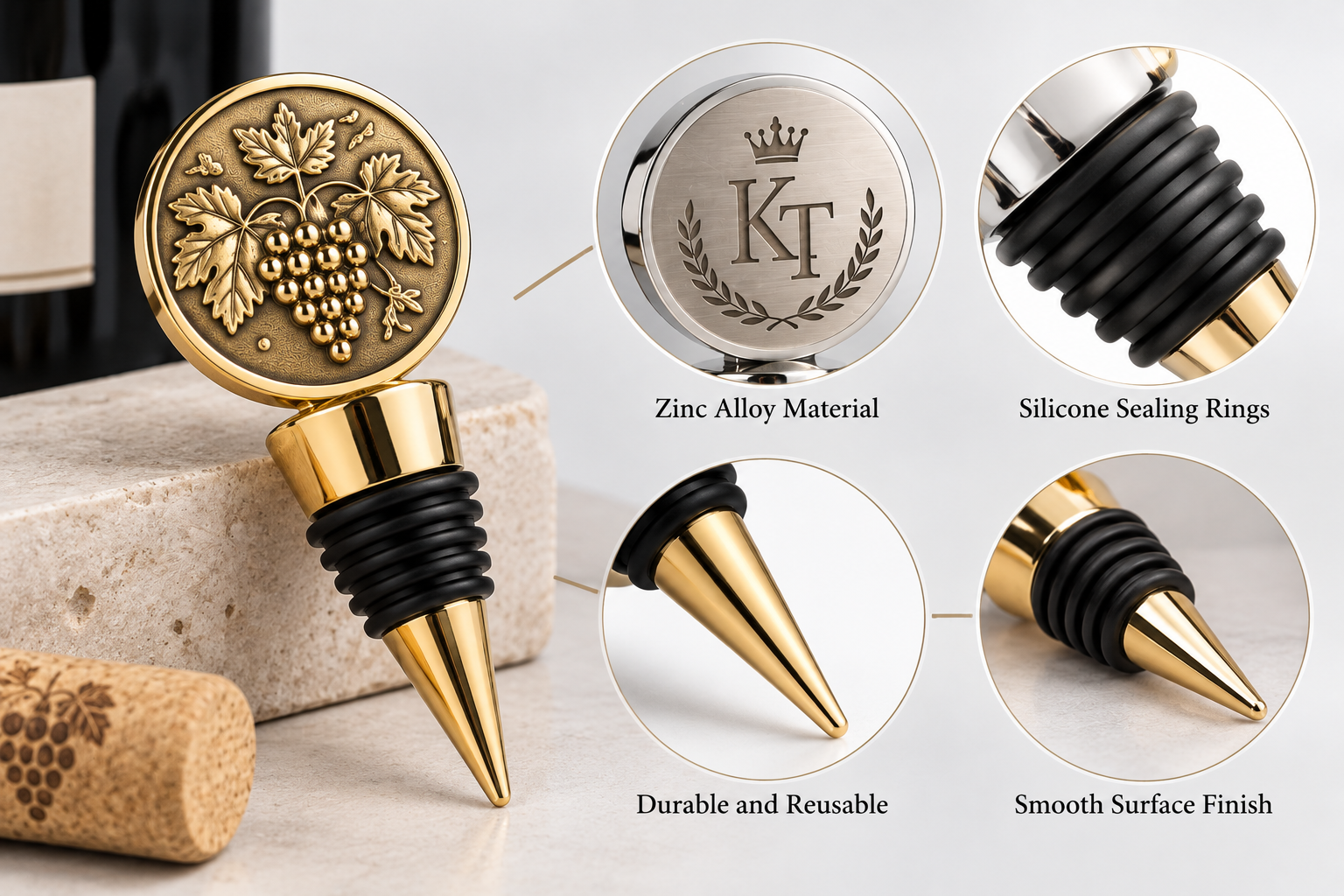
The two product types side by side. The metal stopper on the left uses a black silicone sealing ring; the natural cork stopper lying beside it is the alternative this page compares. Everything else in the callouts — the zinc alloy body, the plating, the surface finish — is a feature of the metal route.
What follows is the comparison we would walk a buyer through on a call. Nothing here is a catalogue claim. Where a number appears, it comes from a product specification that we actually manufacture to.
Two Products, Two Different Structures
The most common misunderstanding is that a cork stopper and a metal wine stopper are the same object made from different materials. They are not. They differ in what they are made of, how they seal the bottle, and how they are made at the factory.
A natural cork stopper with a metal top is a two-part product. The body is a natural cork cylinder that compresses into the bottle neck, and the top is a zinc alloy decorative cap die-cast onto the cork. The cork does the sealing. The metal does the branding. That division of labour is what gives this product its appeal: it looks traditional at the bottle mouth while carrying a logo, a landmark or a relief design on top.
A metal wine stopper is a single die-cast piece with a stepped body and a pointed plug, sealed by a black silicone or rubber ring around the shaft. There is no cork in the product at all. The plug enters the neck and the ring grips it, so the fit is set by the ring profile and the plug taper rather than by the compression of a natural material.
The structural difference between a natural cork stopper and a metal wine stopper
| Point | Natural cork with metal top | Metal stopper (silicone ring) |
|---|---|---|
| Sealing element | The cork body itself compresses into the neck | A black silicone or rubber ring grips the plug |
| Metal part | Zinc alloy decorative cap on top of the cork | Zinc alloy body, cap and plug are one casting |
| Shape at the neck | Straight cylinder, cork visible below the cap | Stepped shaft with a pointed plug |
| How the top is made | Die cast separately, then assembled onto the cork | Die cast as a single piece with the relief form |
| Typical decoration on top | Enamel colour, plating, UV printing, laser engraving | Enamel colour, plating, UV printing, laser engraving |
| Where the brand mark sits | On the cap, above the bottle neck | On the cap, above the bottle neck |
One practical consequence of the structure is worth calling out before you compare anything else: a cork stopper and a metal stopper are not interchangeable in a gift box. The cork version has a wider, softer footprint and a visible natural material surface. The metal version is a single hard object with a pointed plug. If you are producing a set where both appear together, the packaging has to accommodate the difference, not just the product.
How Each One Actually Seals
This is where the two routes differ most, and it is the question a buyer should ask first, because a stopper that does not seal turns a gift programme into a returns problem.
The cork route
Cork is compressible. It is a natural material with enough elasticity to be pushed into a bottle neck that is slightly narrower than itself, and it holds enough of that compression to keep the bottle closed. That is why cork closures have been used for centuries and why a cork stopper does not need a separate gasket to work.
The practical consequences for your order are these. Cork is a natural material, so grain and colour vary between pieces — you are not buying a uniform surface, you are buying a natural one. And the cork body has to be sized to the bottle neck it will enter. If your programme involves more than one bottle shape, that sizing has to be settled per bottle type, which is a conversation worth having early.
The metal route
The metal stopper seals mechanically rather than elastically. The plug enters the neck and the silicone or rubber ring around the shaft grips it. That means the seal is a manufactured feature rather than a natural property, and it is consistent from piece to piece because it was formed to a specification.
The metal route also gives you a wider tolerance band on bottle neck sizes, because the ring compresses within a designed range instead of relying on one exact cork diameter. If your customers are opening bottles from different producers, or you are supplying a stopper that has to work as a generic gift item rather than for one specific label, that is an argument for the metal route.
The visible trade-off is that the sealing ring is black rubber sitting against the bottle mouth. On a gold or silver finished stopper it is visible, and some buyers plan the gift box around it deliberately rather than being surprised by it.
Appearance and Gift Value
A cork stopper reads as traditional. It signals wine, craftsmanship and vineyard, and it is the route a winery or a vineyard gift programme will usually ask for first. It sits in the hand as a soft, natural object with a small metal crown on top — the metal is an accent, not the statement.
A metal stopper reads as a gift object. The relief, the enamel colour and the plating carry the whole design, and the piece is clearly a branded keepsake rather than a piece of packaging. It is the route a promotional programme, a wedding favour set or a souvenir line will ask for.
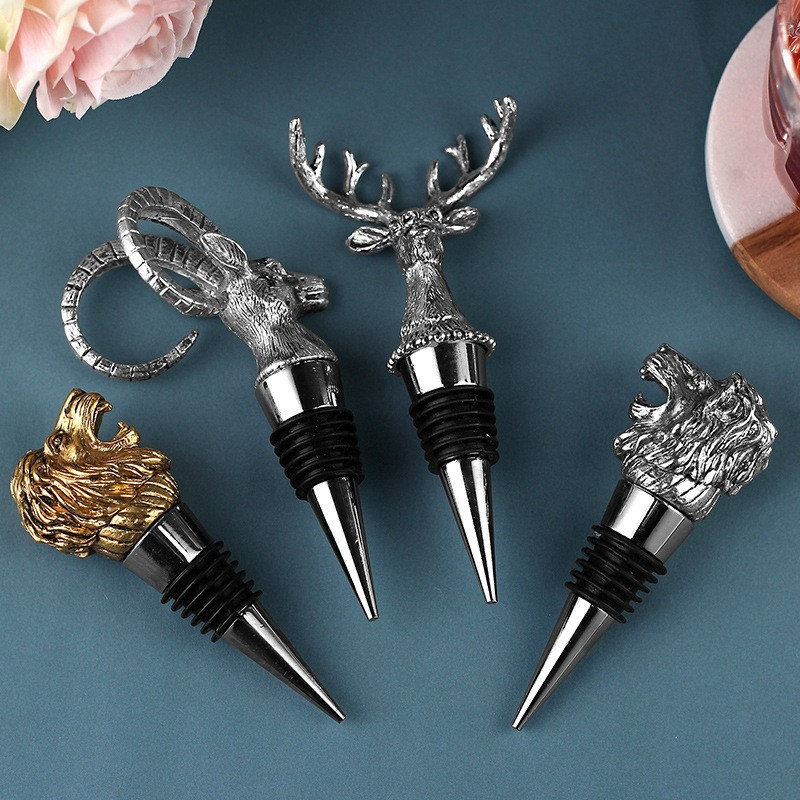
Metal stoppers are sold on the design. The stag, ram and lion head reliefs are cast into the top, which is why the metal route is the one buyers choose when the shape itself is the message. The black silicone sealing ring is visible on every one of them.
One point of comparison that gets asked about: metal stoppers are reusable. The body does not deform the way a natural cork eventually does, and a silicone ring can be replaced if it wears. That makes a metal stopper a better fit for a guest to keep and re-use than a natural cork stopper, and a weaker fit for a single-use hospitality programme.
Against that, the metal stopper will not biodegrade, and a cork stopper will. For a winery running a sustainability programme this is not a small consideration, and it is worth raising with us early rather than at the end of a sampling round.
Branding Capacity on Each Route
Both routes run through the same finishing lines. On the metal top of a cork stopper you can specify a logo, a shape, a size, 2D or 3D relief, enamel colour, UV printing, laser engraving and a plated finish. The available plated finishes are gold, silver, nickel, chrome, antique brass, antique copper, black nickel and rose gold.
On a fully metal stopper the same decoration options apply, and you have one extra degree of freedom, because the relief form and the body are cast as one piece rather than assembled. A molded logo exists only on the metal route — laser engraving, screen printing and enamel fill can all be applied to a body cast from an existing mould, but a logo that is part of the casting needs its own tooling.
What each route can carry
| Decoration option | Cork with metal top | Full metal stopper |
|---|---|---|
| Molded logo (part of the casting) | No — the cork body is not cast | Yes — one piece with the body |
| Laser engraving | Yes, on the metal cap | Yes |
| UV printing | Yes, on the metal cap | Yes |
| Enamel colour fill | Yes, on the metal cap | Yes, including recessed relief areas |
| Plated finish | Yes | Yes |
| 2D / 3D relief | Yes, on the cap | Yes, across the whole top form |
| Shape customisation | Cap shape and relief | Cap shape, relief and body form |
The practical buying consequence: if your design is a logo and a colour, both routes will deliver it, and the cheaper one may be the right answer. If your design is a distinctive form — a grape cluster, a barrel, a landmark, a heraldic crest, an animal head — then the metal route is where that design can actually live, and the cork route limits you to the cap.
A further constraint on the cork route is that the cap has a smaller usable face than a full metal top. A detailed logo with fine lettering needs that area. This is the single most common reason a buyer who planned a cork stopper ends up ordering the metal version after sampling.
Cost, MOQ and Where the Money Goes
The honest summary is that the metal stopper carries more process cost, and the cork route carries more material cost. Which one is more expensive for a specific order depends on the design, and any supplier who tells you otherwise is quoting a standard product.
The metal route adds a die-casting operation, a polishing stage, a plating bath and an assembly step on top of the raw material. The cork route adds a natural component and an assembly step, but skips most of the finishing work because the metal is only the cap.
Two practical points on minimum order quantity. The full metal wine stopper specification we manufacture carries an MOQ of 1,000 pieces, with sample time around 7 days and bulk production normally 15 to 20 days after order confirmation. The cork stopper specification carries the same 1,000-piece MOQ and the same sample and production timeline, because the tooling requirement, not the cork, is what sets the floor.
If you are ordering well under 1,000 pieces, the useful question is not “which material is cheaper” but “which of these can be made from an existing mould with my logo on it”. That route exists for both products and it is the most common way a first custom order gets under the tooling threshold. The MOQ explainer covers how the fixed costs behind a custom design set that floor, and the 500-piece MOQ guide works through what is actually orderable at the lower tiers.
Ask any supplier for a quote broken down by process, and this is what the answer should contain. If the quote is a single number with no breakdown, you cannot tell whether you are being quoted for the design you asked for or for a simpler version of it.
The parameters that change a wine stopper quote
| Parameter | Cork with metal top | Full metal stopper |
|---|---|---|
| Tooling | Cap mould, if the cap is custom | Body mould, if the body form is custom |
| Metal process | Die cast, polish, plate the cap only | Die cast, polish, plate the whole body |
| Natural component | Cork body, sized to the neck | None |
| Sealing component | Cork body | Silicone or rubber ring |
| Decoration on the metal | Logo, enamel, UV print, laser engraving, plating | Logo, enamel, UV print, laser engraving, plating |
| MOQ on our current specification | 1,000 pieces | 1,000 pieces |
| Sample time | About 7 days | About 7 days |
| Bulk production | 15–20 days after order confirmation | 15–20 days after order confirmation |
How Each One Is Made
The metal side of both products runs through the same ten stages, whether the cork version is assembled onto a cast cap or the stopper is cast as a single piece. Knowing the stages is what lets you ask a useful question at the sampling stage: “which stage is this defect from?”
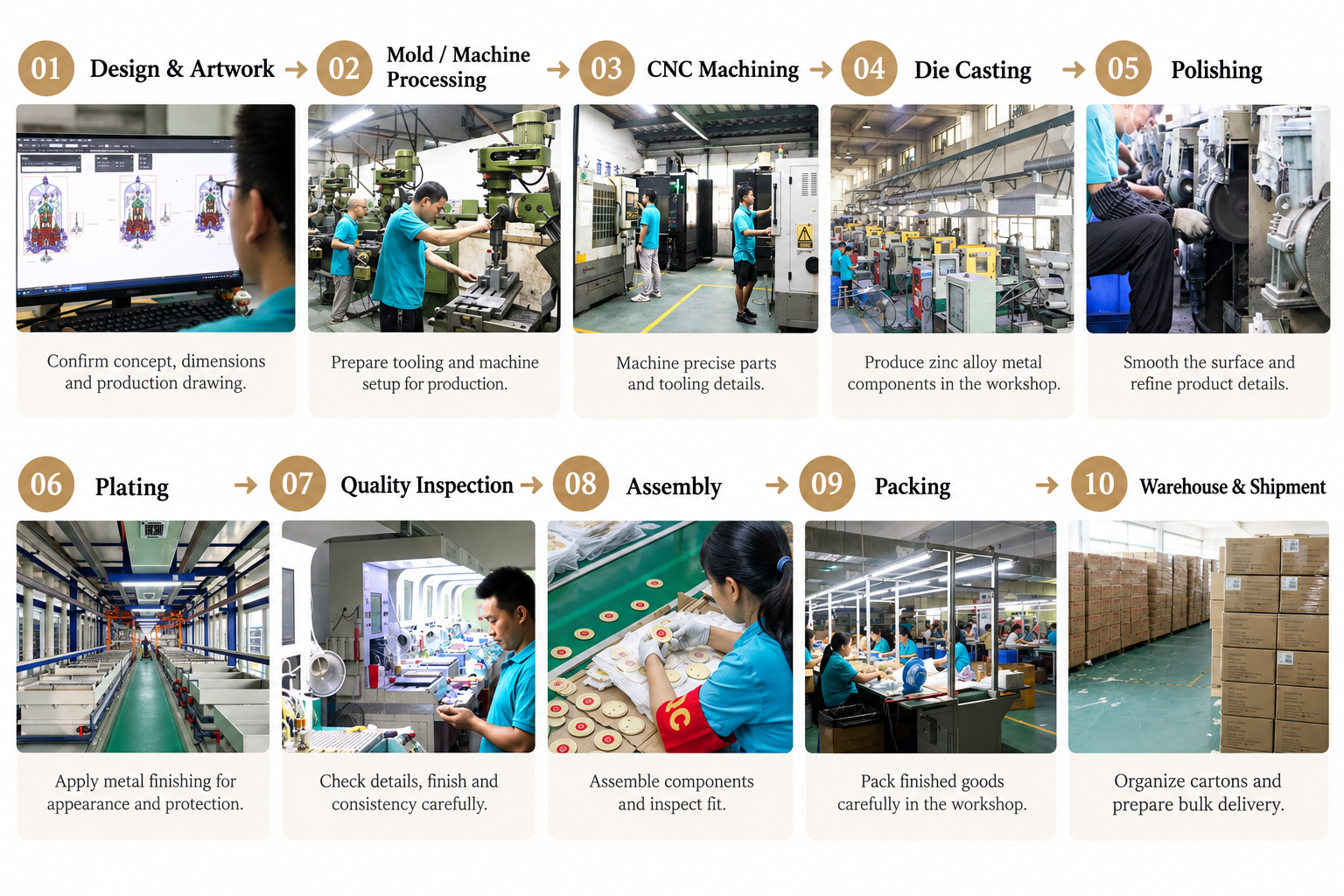
The production route for a zinc alloy wine stopper. The cork version follows the same route for its metal cap, then adds the cork body and the assembly of the two together at the assembly stage.
For the cork version there is one extra stage after the metal work is complete: the cork body and the finished cap are brought together and assembled. That is the stage where a fit problem between the two parts would show up, and it is the reason a cork stopper should be sampled as a finished assembly rather than as separate components.
If you have not yet read how the metal side works in detail, the zinc alloy wine stopper guide walks through each stage including the plating and enamel work, and the custom metal gifts quality control guide covers the inspection points worth checking before you accept a shipment.
Which One to Specify
If you have read this far and still cannot decide, the decision is usually made by three questions. Here is how they usually resolve.
Question 1: Is the design a form or a mark?
If the design is a recognisable shape — a landmark, a crest, a barrel, a grape cluster, an animal, a bottle of a specific silhouette — then it is a metal stopper. The cork route can carry that design on the cap, but the cap is a smaller area and the form will read as a topper rather than as the product.
Question 2: Is the stopper a gift or part of the packaging?
If the stopper is meant to be kept, the metal route wins on every count: it is a designed object, it carries the branding across its whole top, and it is reusable. If the stopper is functional packaging that will be thrown away with the bottle, the cork route is the more sensible purchase and nobody will ever look at it twice.
Question 3: Does the programme have a sustainability requirement?
If there is a stated requirement around natural or biodegradable materials, that points to the cork route. Everything else in the decision tree points to the metal.
A decision guide by buyer type
| Buyer type | Usually the right route | Why |
|---|---|---|
| Winery or vineyard | Cork with metal top | The cork reads as authentic and the metal cap carries the estate mark |
| Corporate promotional programme | Full metal stopper | Highest branding area, reusable, keeps working as a desk or bag item |
| Wedding favour or guest gift | Full metal stopper | The form is the keepsake value, and a shaped favour is remembered |
| Tourist souvenir programme | Either, by price point | A cork version suits a lower price tier, metal suits a premium tier |
| Retail shelf product | Full metal stopper | Shelf visibility depends entirely on the top form and finish |
| Single-use hospitality | Cork with metal top | Where the stopper is packaging rather than a gift, the metal adds cost without adding value |
| Hotel or restaurant bulk use | Cork with metal top | Lower unit cost and a natural material that fits the table |
One last thing worth saying, because it is the question behind most of these searches: there is no universally better wine stopper. A cork stopper is not the budget version of a metal stopper. It is a different product that answers a different requirement. The right way to buy either of them is to start from the bottle you are closing, the person who will hold it, and the reason it exists — and then let the material follow from that.
If you want a recommendation for your specific programme, send the bottle type you are stopping, the design you have in mind and your quantity, and we will tell you which route we would build it on and why. If it is easier to compare finished options first, the custom wine accessories page shows the current range, and the wine stoppers buyer’s guide covers stopper types beyond the cork and metal comparison.
Frequently Asked Questions
What is the difference between a cork wine stopper and a metal wine stopper?
A cork wine stopper has a natural cork body that compresses into the bottle neck and a zinc alloy cap on top that carries the branding. A metal wine stopper has no cork at all — the body, cap and pointed plug are die cast as one zinc alloy piece, sealed by a black silicone or rubber ring around the shaft. The cork does the sealing and the metal does the branding in one route; in the other, both are metal and the ring does the sealing.
Which type of wine stopper is better for a gift programme?
For a gift programme the metal stopper is usually the stronger choice. The whole top is available for the design, so a logo, an enamel colour or a 2D or 3D relief form all carry properly, and the piece is a reusable keepsake rather than something that is thrown away with the bottle. The cork route makes more sense when the stopper is functioning as packaging for a winery or a hospitality programme.
What is the minimum order quantity for custom cork and metal wine stoppers?
Both the natural cork stopper with a zinc alloy top and the full metal wine stopper specifications carry a minimum order quantity of 1,000 pieces. The floor is set by the tooling and finishing setup rather than by the cork itself, so switching between the two material routes does not by itself lower the minimum.
Can I get my logo on a cork wine stopper?
Yes, on the metal cap. A cork stopper can carry a custom logo through enamel colour, UV printing, laser engraving and plated finishes, and the cap can be cast in a custom shape with 2D or 3D relief. One limitation is that a molded logo — one that is part of the casting itself rather than applied afterwards — exists only on the fully metal route, and the cap face is smaller than a full metal top, so very detailed logos need more area.
How long does production take for custom wine stoppers?
Sample time is usually about 7 days, and bulk production is normally 15 to 20 days after order confirmation. This applies to both the natural cork stopper with a metal top and the full metal stopper. Tooling for a new design is quoted separately and should be confirmed before the production clock starts.
Which plated finishes are available on wine stoppers?
The available plated finishes are gold, silver, nickel, chrome, antique brass, antique copper, black nickel and rose gold. These are applied to the metal cap on a cork stopper and to the body on a full metal stopper, together with enamel colour fill, UV printing or laser engraving depending on the design.
Are metal wine stoppers reusable?
Yes. The zinc alloy body does not deform the way a natural cork eventually does, and the silicone or rubber sealing ring can be replaced if it wears. This makes a metal stopper a better fit for a guest to keep and re-use, and a weaker fit for a single-use hospitality programme where the stopper is functioning as packaging.
How do I specify which type of wine stopper I need?
Three questions usually settle it. If the design is a recognisable form such as a landmark, crest, barrel or animal head, specify the metal route. If the stopper is meant to be kept as a gift, specify the metal route; if it is packaging, specify the cork route. If there is a stated sustainability or biodegradability requirement, specify the cork route. Send us the bottle type, the design and your quantity and we will confirm which route we would build it on.
Ready to Start Your Custom Project?
Send us your design or reference photo - free rendering and quotation within 24 hours. MOQ from 100-500 pcs, factory-direct pricing since 2003.